
The First Expedition,
Operation “Longcloth”
Welded into a seven column fighting force totaling over 3,000 men with mules, oxen and elephants to carry heavy supplies, the Chindits (aka, the 77th Brigade), prepared to move into Burma.
THE MARCH IN
On 12 February 1943, at the threshold of battle, Wingate addressed the men under his command, saying, “Today we stand on the threshold of battle…It is a small minority that accepts with good hearts tasks like this that we have chosen to carry out. The time of preparation is over, and we are moving on the enemy to prove ourselves and our methods. We need not, as we go forward into the conflict, suspect opportunity of withdrawing and are here because we have chosen to bear the burden and the heat of the day.” With this “Operation Longcloth” began and the 3,250-strong Chindits headed into the jungles of eastern India.
Two nights later, as a diversionary attack by the 23rd Indian Division struck Kalewa, two Gurkha columns under Lt-Colonel Leigh Alexander (a first-class Cricketer before the war) slipped crossed the Chindwin 50 miles to the south. Their mission: to attack Japanese outposts, blow up bridges and sever the Mandalay-Mytikyina railway at the key Burmese town of Kyaikthin. At the same time, Wingate, with five columns led by Lt-Colonel S. Cooke, crossed the river a little to the north and went forward to sever the same railway between Wuntho and Indaw. (see map above)
Wingate’s main objectives were to:
1) Cut the main railway line between Mandalay and Myitkyina
2) Harass the enemy in the shwebo area
3) Cross the Irrawady river and cut the rail line between Mandalay and Lashio
The operation called for extraordinary ability and luck. The first objective was 150 miles to the east with the number one priority being to reach the target undetected.
In an effort to break the formal regimental structure of the British Army, the seven columns each had about 400-500 men, 100 pack-mules, horses or oxen and accompanied by RAF radio operators, under the overall command of Squadron Leader Robert Thompson. Each man in the lightly-armed columns (heaviest weapons were medium machine guns and mortars), had to lug a 70 lb (31 kgs) load, including a pack, rifle, bayonet, ammunition and grenades, water bottle, four pairs of socks, spare shirt, climbing rope, utility knife and a five day ration pack consisting of biscuits, cheese, chocolate, meat, nuts, raisins, dates, tea, powdered milk and sugar. All together a daily ration weighed less than 1 kg (2 lbs) – although these meager rations were sometimes augmented by local bananas, rice and other fruits provided by friendly villagers.

As men marched, others struggled to get their mules over steep and plunging ridges. Burma was the land of extremes, rich with ancient cultural architecture and a treasure of natural resources amid lush rain forests and hills. Yet northern and central Burma was no tropical paradise. Mountain ranges thick with seemingly impenetrable jungles covered the borders. The rain forests were trackless, steep regions, filled with vines and rotting vegetation. This, alternating with sharp elephant grass as tall as a man or with thick bamboo thickets could obscure visibility to only a few meters. The steep hills and ridges provided narrow paths. The British depended on RAF (Royal Air Force) reconnaissance and Burmese guides to get them through. Summer humidity reached up to 46º Centigrade (115º F) in the central plains, and during the monsoon, which lasted half a year, pack animals became the only reliable form of transport in the narrow jungle trails and through the mud. In this pitiless environment the Japanese became only one of the Chindits’ many enemies.
There was the torrential rain, for one, which produced a sea of glutinous mud and permanently sodden clothes, and the dense thickets of brush and foliage which slashed at men and animals. “Sometimes the going was frightful, occasionally it was just bad,” said one man, Sergeant Tony Aubrey. Like many Chindits, Aubrey was astounded by the scale of the Burmese jungle, the constant dew and rains which wet uniforms and equipment, the oozing black mud, belligerent red ants and huge black spiders with their painful stings and thickets of impenetrable bamboo whose stalks and leaves “cut both clothes and flesh to ribbons.”
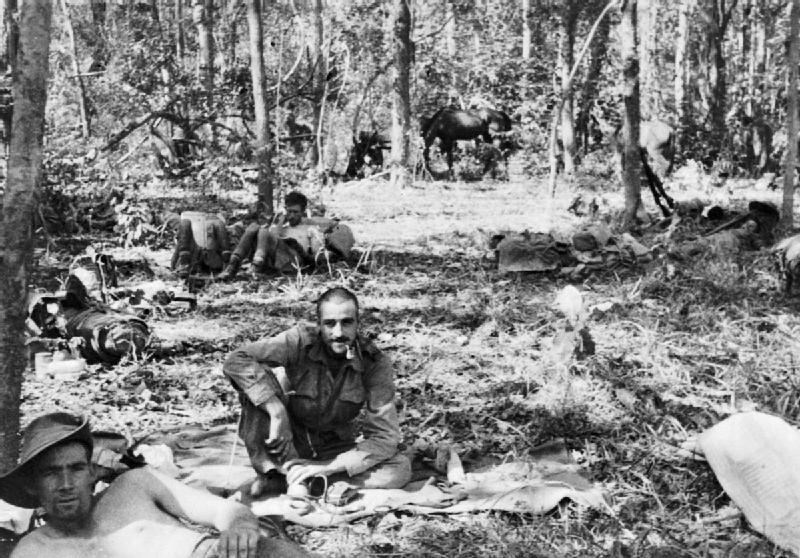
Clothing, boots and skin rotted from prolonged exposure to the humid atmosphere, and the first casualties from tropical and parasitic diseases were reported. To this were added swarms of leeches, clouds of mosquitoes which appeared regardless of the time, poisonous snakes, flukes, ticks and flies. Open wounds were to be quickly covered up or risk viral infections. Many of the Chindits quickly learned that wearing beards (like Wingate), mitigated the need for a shaving kit, formed the best natural camouflage for the face, and more importantly – kept out mosquitoes and ticks.

Progress was painfully slow but Wingate tried to hasten the advance by paying surprise visits to subordinates and issuing radio orders embedded with Biblical quotations. By the beginning of March, Cooke’s group was positioned at attack the railway. Meanwhile, in the south, Alexander’s two columns were advancing without incident. Every day, British C-47 Dakotas from 31 Squadron and the Lockheed Hudsons from 194 Squadron appeared over pre-arranged drop zones identified by accompanying RAF signalers, dropping supplies. On March 2, the No. 5 Column led by Major Bernard Fergusson brushed aside a Japanese patrol and blew the bridges at Bongyaung, the cracks of the explosions ringing through the hills. The attack had taken the Japanese completely by surprise, but they recovered and two divisions were dispatched to deal with the intruders who were believed to be no more than a reconnaissance party. In the south meantime, Alexander’s columns had been heading down to the Irrawaddy River. Moving in force, Alexander hoped to create the impression that his columns were the vanguard of a larger British force. The Japanese called his bluff and attacked, badly mauling No. 2 Column.
By now convinced that an entire British commando division had crossed the Chindwin, the Japanese Army spent several tense days scrambling a counter-offensive. But misinformation and speculation plagued their understanding of the situation. Most Japanese commanders were even baffled at how this “commando division” was being supplied. They simply could not or would not believe that the British would be so brazen as to resupply their forces in full daylight with slow and vulnerable transport aircraft – especially in an area heavily patrolled by Japanese fighters.

In the north meantime, things were going better. Of Cooke’s five columns, three moved north with the intent of drawing Japanese forces away from other two columns heading to hit the railways. The diversionary force soon met the enemy at the Irrawaddy. One column (Major Bromhead’s No. 4 Column) was badly mauled and scattered, forced to withdraw back to the Chindwin. Yet, 4 Column’s sacrifice had not been in vain. Two other two columns – Fergusson’s No. 5 Column and Michael Calvert’s No. 3 Column – were able to use the confusion of the melee to move unobserved to the railway line and adjacent bases. They reached their positions in early March; to sabotage the line in 72 places, destroy bridges and cut roads.
As Japanese awoke to the threat, the Chindits set up ambush parties and waited for the Japanese as they rushed to respond. Hundreds of Japanese were wiped out and pinned down by the ambush parties even as Fergusson’s and Calvert’s RAF signalers called in RAF air support to complete the massacre. Elated at these early successes, Calvert pushed on to destroy the Gokteik Gorge viaduct, an important structure which carried the Lashio road about 100 km (60 miles) north of Mandalay. But now the columns had to cross a triangular area between the Irrawaddy and the Shweli rivers – an area that was open, waterless country, criss-crossed by roads and frequently patrolled by enemy armored cars. It was hopeless for guerrilla operations.
THE RETURN
As the unfavorable terrain and Japanese commitment escalated, the expedition began to unravel.
The hardships multiplied when supply drops became difficult, not only because of Japanese fighter patrols, but also because by now the Chindit columns had become so dispersed that air supply had become all but impossible. This in turn increased the demand for food and water. Many columns struggled, if only for a few hours to keep ahead of pursuing Japanese forces while hurriedly collecting supplies from airdrops. Others fought for the supply zones and villages where the Japanese stationed troops knowing full well that the Chindits would seek them out for food. Finally in desperation, men ate many of their mules and made a soup of their horses.
Informed of the situation, Lt-General Geoffrey Scones of the British IV Corps, ordered Wingate to withdraw. Wingate in turn instructed his columns to disperse in small, independent parties on March 24th. Lt-Colonel Alexander’s group shifted to the east, hoping to reach the safety of China while Cooke’s group fell back to the Irrawaddy. The men were now exhausted and riddled with disease. Sadly, many of the wounded were left behind. Lieutenant Ian MacHorton of No. 2 Column was one of those abandoned. “At the moment when I gave up straining my ears for any last faint sound of my vanished comrades, my utter loneliness engulfed me,” he later wrote.
One by one, small groups of Chindits struggled through the jungle and managed to cross the Chindwin. Wingate returned to India on April 29. Fergusson and Calvert also made it, but some 883 were lost, killed, wounded or captured – many as they crossed the Chindwin, where Japanese patrols were waiting. Of the 2,182 that did return, only 600 would ever fight again. They had spent almost nine weeks in the jungle and had marched over a thousand miles, and Wingate regarded the entire operation as a bitter failure.

But how key had their efforts been? In February, before “Longcloth” was launched, Wingate had told reporters that, “If this operation succeeds, it will save thousands of lives. Should we fail, most of us will never be heard from again. If we succeed, we shall have demonstrated a new style of warfare to the world, bested the Jap at his own game, and brought nearer the day when the Japanese will be thrown bag and baggage out of Burma.” Disregarding the little material damage inflicted, in which some railways were cut, bridges blown or Japanese killed, “Longcloth” had accomplished ten times its weight in psychological terms. In one blow, the Chindits had destroyed the myth of Japanese invulnerability, and showed that a lightly-armed, well-trained force could take on the Japanese, beat them at their own game, in their own backyard and return to talk about it. At a time when heroes were badly needed and when the Allies faced their darkest hour, Wingate and his Chindits were indeed heroes.
The tales of their endeavors ran like a hurricane through the dispirited armies in India. Newspaper articles carrying photographs of a gaunt, bearded Wingate in an Australian slouch hat and his battered Chindits only strove to increase the legend. A copy of Wingate’s after-action report reached the Churchill, perhaps the final judge of success. Depressed by the long string of defeats and disappointments in the Far East, Churchill was jubilant to hear of Wingate’s success.
In July he wrote, “I consider Wingate should command the army against Burma. He is a man of genius and audacity, and has rightly been discerned by all eyes as a figure quite above the ordinary level… There is no doubt that in the welter of inefficiency and lassitude which has characterized our operations on the Indian front, this man, his force and his achievements, stand out, and no mere question of seniority must obstruct the advance of real personalities to their proper stations in war.” So impressed was Churchill that he wanted to Wingate promoted up four ranks, over the heads of other senior men. The proposal was met with shock, and then resistance from senior army commanders.
In the end Churchill had to settle for promoting Wingate up one rank, to Major-General. But tellingly, he insisted on taking him to Quebec for the Allied Quadrant Conference that August. Here, Wingate won approval for an expanded Chindit force and a more ambitious expedition that following year in cooperation with U.S. Lt-General Joseph “Vinegar Joe” Stilwell and his Chinese Army. Many Allied officers seethed at these concessions, not least of all “Vinegar Joe,” who having waited long and hard for U.S. troops became enraged when told that the 3,000-strong American Regiment, nicknamed Merrill’s Marauders, was being diverted to Wingate’s command.
“After a long struggle we get a handful of U.S. troops and by God they tell us that they are going to operate under Wingate,” Stilwell said. “We don’t know how to handle them but that exhibitionist does! He has done nothing but make an abortive jaunt to Katha, cutting some railroad that our people had already cut, get caught east of the Irrawaddy and come out with a loss of forty percent. Now he’s an expert. That’s enough to discourage Christ.”
Yet, barring his critics, great things were expected of Wingate — now that he had been reinforced, and as 1944 came, his legend and that of his beloved Chindits multiplied as they went into the task of completing all that was asked of them and more.

The 77th Indian Infantry Brigade
Commander – Brigadier Charles Orde Wingate, DSO (Ex-Royal Artillery)
Brigade Major – Maj. R.B.G. Bromhead → Repl. by Maj. Gilmour M. “Gim” Anderson (Highland LI)
Staff Captain – Captain H.J. Lord (Border Regt)
13th King’s Regiment (Liverpool)
3/2nd Gurkha Rifles
2nd Burma Rifles
142nd Commando Company
Staff, The Bush Warfare School
Eight Royal Air Force Sections (to co-ordinate supply airdrops)
Brigade Signal Section (Royal Corps of Signals)
Mule Transport Company

This brigade (which used the designation of “Indian infantry” purely for deceptive purposes) deployed the field in the form of the following groups:
No 1 (Southern) Group
CO – Lt-Col. Leigh Alexander (3/2 Gurkha Rifles) – KIA 28 Apr 1943 (by sniper).
Adjutant – Captain Birtwhistle (3/2 Gurkha Rifles)
No 1 Column – Major G. Dunlop, MC (Royal Scots)
2-i-C: Captain V Weatherall (3/2d Gurkhas)
Guerrilla Platoon (142d Company): Lt. J Watson (Black Watch) → Repl. by Lt Nealon (KOSB)
Burma Rifles (Recce Platoon): Captain M Freshnie
Medical Officer: Captain N Stocks (RAMC)
RAF Liaison Officer: Flight Lt. J Redman
No 2 Column – Major A. Emmett (3/2nd Gurkha Rifles) → Repl. by Major Burnett
No 2 (Northern) Group
CO – Lt-Col. S.A. Cooke (Lincs Regt, attached to King’s Regt)
Adjutant – Captain D. Hastings (King’s Regt)
No 3 Column – Major J. Michael Calvert (R.E.)
2-i-C: Captain G Silcock (3/2d Gurkhas)
Commando Platoon, 142d Company: Lt. Jeffrey Lockett
Burma Rifles (Recce Platoon): Captain Taffy Griffiths
Medical Officer: Captain Rao (RIAMC)
RAF Liaison Officer: Flight Lt. Robert Thompson
No 4 Column – Major R.A. Conron (3/2d Gurkha Rifles) → Repl. by Maj. Bromhead (Royal Berkshire Regt)
No 5 Column – Major Bernard E. Fergusson (Black Watch)
2-i-C: Captain J.C. Fraser
Adjutant: Lt. D.C. Menzies (Black Watch)
Commando Platoon: Lt. J.B. Harman (Gloucestershire Regt)
Burma Rifles (Detachment): Captain J.C. Fraser
Medical Officer: Captain W.S. Aird (RAMC)
RAF Liaison Officer: Flight Lt. D.J.T. Sharp
No. 7 Platoon: Lt. P.G. Stibbe (Royal Sussex)
No. 8 Platoon: Lt. J.M. Kerr (Welch Regt)
No. 9 Platoon: Lt. G. Roberts (Welch Regt)
No 7 Column – Major Ken D. Gilkes (King’s Regt)
No 8 Column – Major Walter P. “Scotty” Scott (King’s Regt)
Commando Platoon: Lt. T. Sprague
Burma Rifles (Detachment): Captain Whitehead
Medical Officer: Captain J.D.S. Heathcote (RAMC)
HQ Group (2nd Burma Rifles →This group was primarily a recce element)
CO – Lt-Col. L.G. Wheeler (Burma Rifles) – KIA 4 Apr 1943 (by sniper).
Adjutant – Captain P.C. Buchanan (Burma Rifles)
Deception Party CO – Major Gordon Jeffries
 Achilles the Heel
Can I please have your permission to use the map on this section of the Chindits, 1943? I hope to use it in my printed transcript of my father, Capt T.C.Roberts’ POW diary, which I am producing privately for the family, as part of my late father’s legacy.
Many thanks
Patricia Ireland
My father Sgt Sam Quick was a POW,held in Rangoon Gaol for 2 years.He was part of the 1st Chindit expedition.He was from the Kings Regiment(Liverpool)He survived & died at the age of 86 in 2001.His best friend (Bob Glasgow-from Edinburgh) was wounded & had to be left behind with a few rifles& grenades.
He started to write his memories at my request but never finished.
Regards
Tony Quick(DOB 4/4/1940)
The Rank chart is a modern one. The St.Edwards Crown wasn’t used in 1943, but from 1953 on, by Queen Elisabeth II.
Why, you’re absolutely right, old chap. The Tudor Crown is required.
Anyway, the image has been fixed.
My father pte Henry Taylor 13th Kings was interviewed by me some years ago on his experiences in a group of 12 who tried to walk out.
Only 6 managed to make it in June. The interview was archived at the
British Museum and is available although not cheap if anyone is interested
Pingback: War stories…. World War Two edition (2) – The Knife and me
I have a Chindits patch in my collection and having a hard time finding information about the patch. Was told it’s a pocket patch but I can’t find any pictures of a member wearing this patch? Has the Chindits name above the figure. Came out of an old collection. Would like to send a few pictures of the patch
Hi, Keith. You can send images if the patch to akhil213@yahoo.com. I will take a look.