
The Third Act
The success of Band of Brothers and The Pacific had much to do with their production at HBO, with its track record of honest, gutsy story-telling. The project’s move to Apple+ arguably brought in the added baggage of token diversity, equity and inclusion, and the reduction of episodes from 10 to nine.
Masters’ third act should have included how the 8th Air Force brass sorted out the 100th’s leadership problems and made the group effective – and how the USAAF conducted a hard-fought battle that finally destroyed the Luftwaffe between February and April 1944.
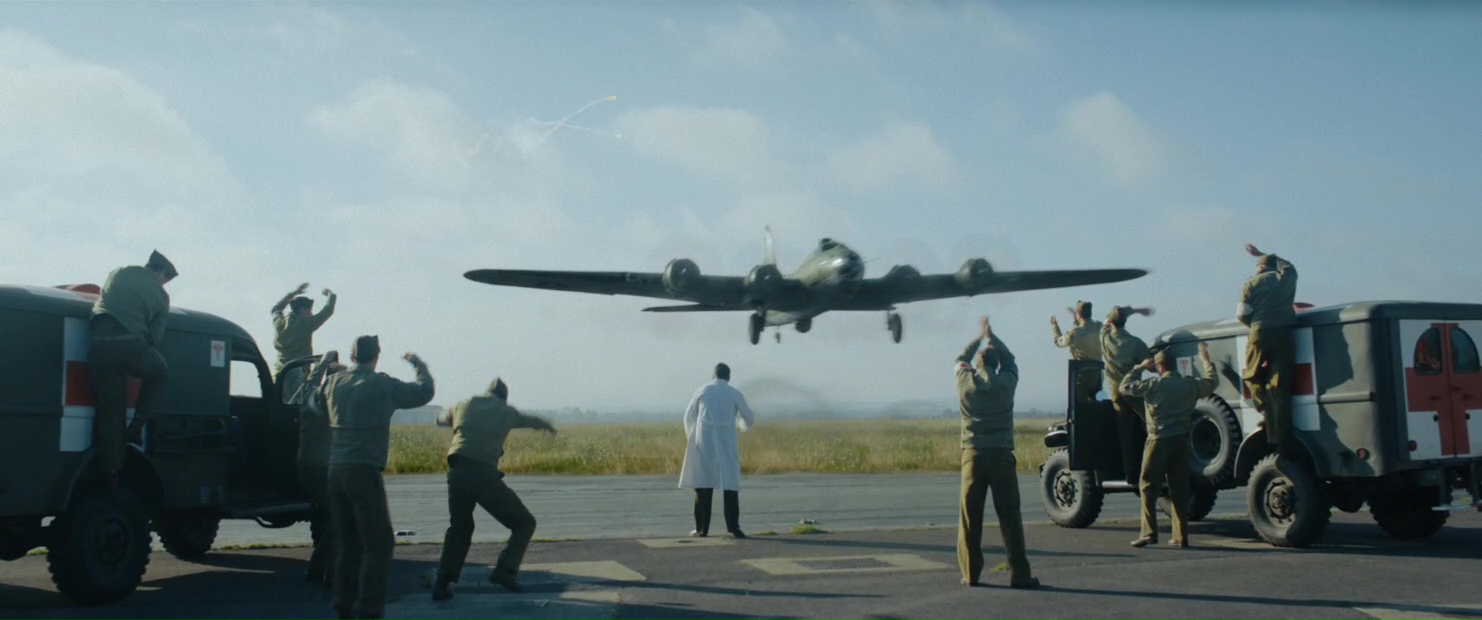
Instead, we are treated to Crosby’s philandering with Wingate/Westgate, his fatigue in the run-up to the Normandy landings (D-Day itself is reduced to 24 seconds of video), but also gripping scenes revealing the captivity of 100th Groupers (such as Cleven and Egan) at Stalag Luft III, and some lackluster, rushed scenes showing how air crews and replacements fared during a series of major combat missions against Berlin (“Big B”, as the crews knew it) in March 1944.
The Berlin missions, conducted between 3 and 9 March, was an epic battle that wiped out scores of airmen from both sides. Morale in the Eighth hit a new low for the first time since the autumn of 1943. The name “Berlin” was enough to cause spasms of fear among US bomber crews. When asked if they were scared, one B-17 crewman rasped: “Scared? Hell, yes, we were scared! We were puckered!”
Many missing bombers, believed shot down, began turning up in neutral countries such as Sweden and Switzerland, their crews desperate to escape the war, even if it meant internment. At least 4,000 American airmen were interned in Switzerland by the end of the war.
During a 6 March 1944 mission to Berlin at least three Fortresses diverted to Sweden after taking hits; with the crews not returned until after September 1944. In April 1944, 20 US aircrews chose refuge in Sweden and 32 in Switzerland – a situation in contrast to the period between 30 December 1943 and 29 February 1944, when only five crews chose internment over duty. (Richard Davis, Spaatz and the Air War in Europe, pg. 379)
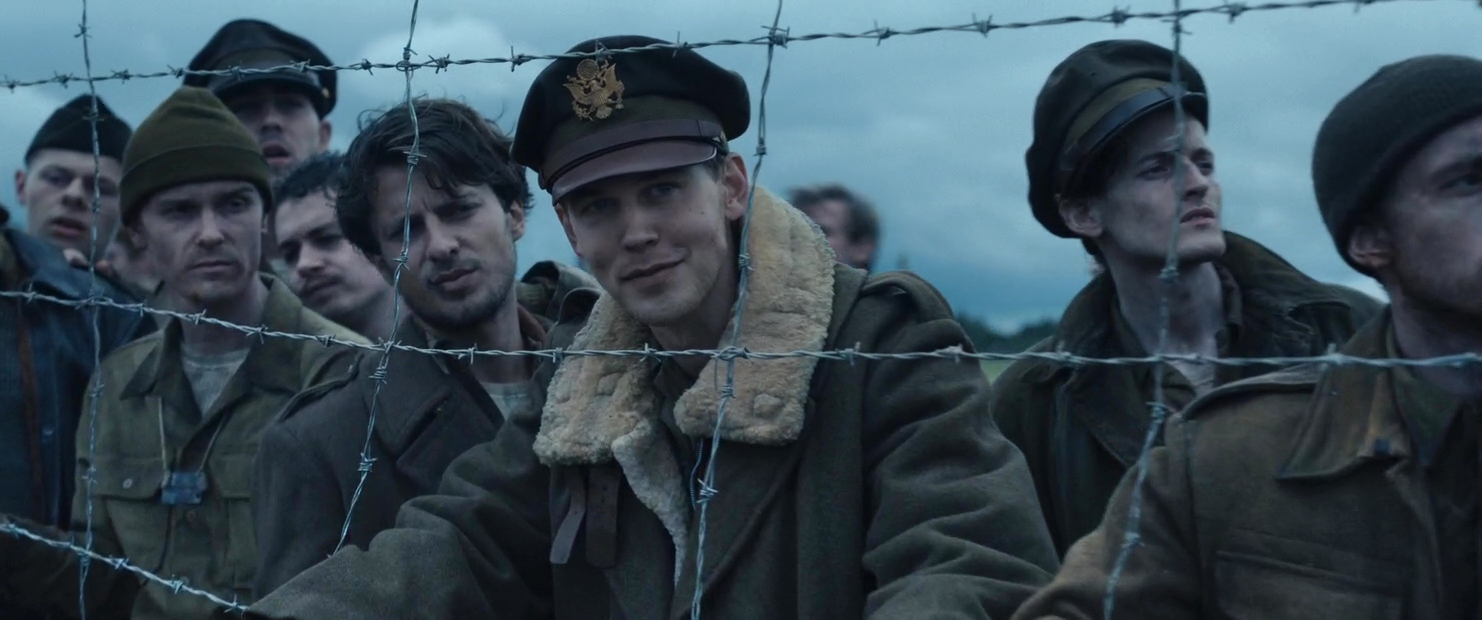
On 13 March, General Carl Spaatz (the commander of US Strategic Air Forces in Europe) and Major General Jimmy Doolittle (who had replaced Eaker as commander of the 8th Air Force), visited the 100th Bomb Group, and saw first-hand how far morale had fallen.
During dinner at the officer’s mess, both generals were confronted by an irate and drunk Second Lieutenant who swaggered up to Doolittle and poked him in the chest. “You think we don’t know what you’re here for? Well, let me tell you we do. You’re here to improve our morale and if there’s anythin’ goin’ to ruin our morale it’s havin’ a bunch of generals around here tryin’ to fix it.” (Davis, pg. 381).
Missed opportunities
On Wednesday, March 8, the Americans returned to Berlin. Rosenthal and his crew participated in this operation (which was Mission No. 82 for the 100th Bomb Group). It is episode 7, and the perfect opportunity to focus on the other “masters of the air,” the USAAF fighter pilots and in their new long-range fighter, the North American P-51B Mustang.
Luftwaffe opposition was as fierce as before. The episode shows nearly a hundred P-51Bs racing to head off German fighters who found that they no longer controlled the airspace over their country. The sight lifts the spirits of the American bomber crews.
“Our fighters are gonna punch us through,” Rosenthal says with confidence.


During the 8 March 1944 engagement, a real-life partnership emerged between two American pilots from the US 4th Fighter Group (the longest-serving and most veteran of the 8th Air Force’s fighter groups in England). In the thick of combat, Lieutenant John Godfrey and Captain Donald Gentile (pronounced Gentilly), joined together to become a deadly fighting two-some.
Both men were veterans. Gentile, a first-generation Italian-American, was already an ace and was in fierce competition with other USAAF fighter pilots to break the standing US ace record of 26 kills, set by Captain Eddie Rickenbacker in World War I.
Enmeshed in a gigantic dogfight over Berlin, Godfrey and Gentile together shot down six German fighters. The engagement turned Godfrey into an ace. The American and British press sensationalized the pair, who then proceeded to destroy nine German fighters in the following two weeks.
In the final episode, Rosenthal says in a voiceover that the western Allies and the Russians were closing in on the Third Reich from all sides and that the 8th Air Force was able to fly uncontested over the skies of Berlin by February 1945 as the Luftwaffe had been destroyed. “We were now the true masters of the air,” Rosenthal says.
But there is no transition in the series showing how this was achieved. It is a missed opportunity.
In reality, the Luftwaffe lost a staggering 1,652 fighter aircraft in daylight combat over the Reich between January and June 1944, according to a report by the German Inspector General of Fighters on 17 August 1944. Another 298 fighter aircraft had also gone missing. More importantly 952 valuable German pilots and flight crews had been killed, with another 339 missing and 717 wounded. (Alfred Price, Battle over the Reich Vol 2, pg. 219)
As Adolf Galland, the Inspector General of Fighters, wrote:
[The US fighters] by being no longer glued to the slow-moving bomber formation, took action into their own hands. Wherever our fighters appeared, the Americans hurled themselves at them. They went over to low-level attacks on our airfields. Nowhere were we safe from them, and we had to skulk on our own bases. During take-off, assembling, climbing and approaching the bombers, when we were in contact with them, on our way back, during landing, and even after that the American fighters attacked with overwhelming superiority.
Galland, Adolf, The First and the Last, New York: Bantam Books, 1987, pg. 221
Focusing on Godfrey and Gentile in this episode would have allowed Masters to examine this critical and final phase of the air war while covering the struggles of the fighter pilots. Both Godfrey and Gentile were interesting subjects. Godfrey was later shot down in August 1944 and incarcerated at Stalag Luft III – as were many of the 100th Group POWs. After the war, he rose to become a senator in the Rhode Island senate. The soft-spoken, self-effacing Gentile, as a character, could have been used to explore the immigrant experience of America.
Instead, the writers chose to focus on the Tuskegee airmen of the 332nd Fighter Group, the famed “Red Tails”, who belonged to the US 15th Air Force operating out of Italy.
The Red Tails
The Red Tails were a good group and they decisively proved their skill in 1949, after the war, by winning the US air force’s first postwar gunnery competition at Las Vegas (in the propeller aircraft category). Incidentally, the US 4th Fighter Group was also a winner that year (in the jet aircraft category). (Dr. Daniel L. Haulman, Misconceptions about the Tuskegee Airmen, Air Force Historical Research Agency, 2016, pg. 59)
During the war, the 332nd held its own from June 1944 to April 1945 when it was operational in the frontlines of the air war. It was credited with the destruction of 94 enemy airplanes in the air during this period, which made it the fifth top-scoring group among the seven USAAF fighter groups operating with the 15th Air Force. (USAF Historical Study No. 85, USAF Credits for the Destruction of Enemy Aircraft, World War II (Washington, DC: Office of Air Force History, 1978))
The eighth episode shows the Red Tails attacking a German radar unit at Toulon, southern France, on 12 August 1944, with new P-51D Mustangs. In the sequence that follows, three out of the four attacking Mustangs are shot down. Two pilots died. The third, 2nd Lt. Richard D Macon (played by Josiah Cross), bailed out but fractured his neck.
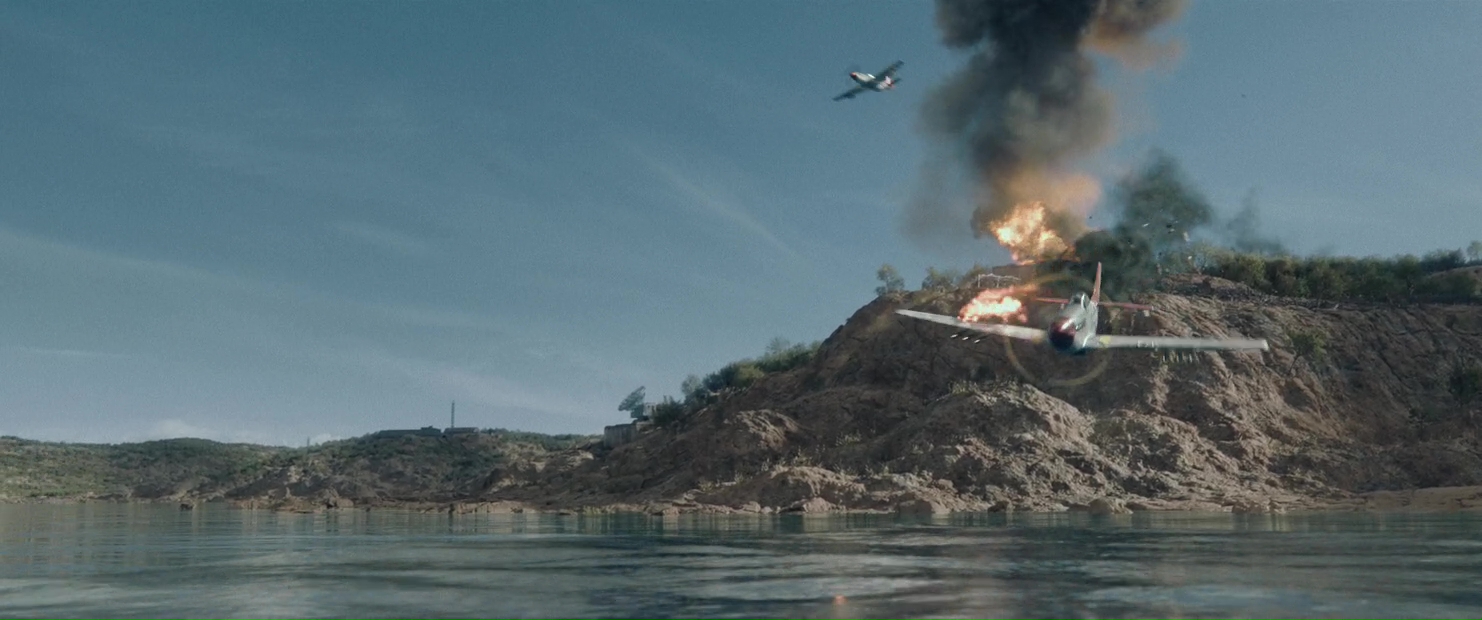
In a separate attack on radar stations at Toulon Harbor, 2nd Lt. Alexander Jefferson (played by Branden Cook), was also shot out of the sky. He bailed out and landed in the midst of the German 20mm Flak position that had destroyed his aircraft, as he wrote later in his biography, Red Tail Captured, Red Tail Free (2017). Jefferson’s compelling book itself could be the basis for another series or a movie about the Tuskegee Airmen and the Red Tails.
Jefferson was taken to a small villa east of Toulon. A German officer was seated at a glass table on the veranda.
“I saluted because he had rank on his shoulders,” Jefferson wrote. “In perfect English, the German officer said, ‘Have a seat, lieutenant, and thanks for the Lucky Strikes! [cigarettes]’.”
Both Jefferson and the German were wary of each other. The German officer cautiously asked Jefferson about life in the United States. It emerged that the German had been at the University of Michigan where Jefferson had obtained a PhD.
Then the German began talking about Jazz, “about the Howard Theater and the Crystal Caverns nightclub in Washington, where all the black jazz artists appeared, and then he started talking about Detroit’s Paradise Valley…and his whole demeanor changed, and he became much friendlier…I sat listening while he smoked my Lucky Strikes and excitedly told me about his Detroit experiences, especially about all the fun he had while drinking and carousing with the local [black] girls,” Jefferson recalled. (Jefferson, pg. 62)
“At first, he had rubbed my feelings a little raw, hearing him speak about the ‘good’ loving he received from our black girls back home,” Jefferson said. But then it dawned on him that the German’s stateside experiences had destroyed any hate that the Nazi regime could have filled in him towards Americans and especially African-Americans.
“In the end,… I was truly thankful for [the] efforts [of those girls] on behalf of the war,” Jefferson said.
(Jefferson, Red Tail Captured, Red Tail Free, pg. 63)
Jefferson was reunited with Macon and Captain Robert H Daniels (who was also shot down in a separate attack).
All three men expected the worst from their German rank-and-file guards who were to take them to a Luftwaffe POW transit camp. “We had heard that the Germans considered blacks to be apes and all kinds of other stereotypes. We knew what they thought about Jews. We had encountered some racism in Italy, although we later found out that was mostly due to white American soldiers telling the Italians terrible things about us,” Jefferson wrote. “But our two regular army Wehrmacht guards saw us as officers, even celebrities.” (Jefferson, pg. 63)
None of this is shown in Masters, with its ham-fisted, truncated tribute to the Red Tails. But it leads directly to a scene where both Jefferson and Macon are asked by a Luftwaffe interrogator why African-Americans who are the subject of such racism and prejudice stateside would fight for a country like the United States of America.
After careful thought, Macon answered: “Do you know any other country that’s better? I know what my country’s shortcomings are. And I know it is trying hard to become what it says it’s supposed to be.”
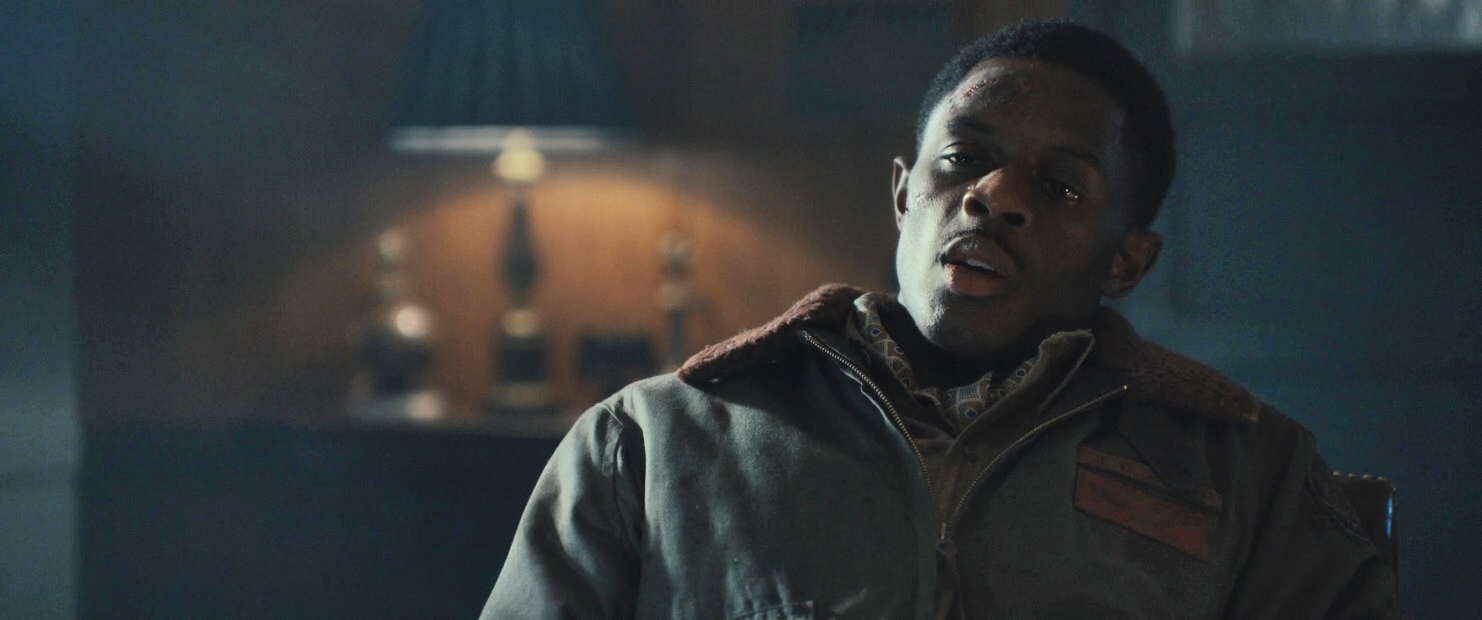
It can be argued that the Red Tail pilots were included in the show to segue to this powerful statement. Their presence becomes secondary after.
Their arrival at Stalag Luft III is met with racist jeers but also some scattered respect. The show curiously also presents the 100th Group POWs as being unwelcoming of these fellow airmen as peers. Cruickshank, Hambone, Captain Benny deMarco and even Cleven appear uncomfortable at seeing the black pilots. Egan is ambivalent. Of course, the writers ensure that the ice is broken and everyone becomes chums of a kind.
Jefferson never mentions meeting the 100th Group POWs in his book, although he and the other Red Tails may have fleetingly encountered them. Both groups of men were in Stalag Luft III’s south compound. (Jefferson, pg. 84)
The final episode is possibly the finest of the series. It is also the episode where the show finally stops pulling its punches and starts presenting in rapid-fire, memorable scenes with outstanding dialogue and acting that does not refrain from examining the human condition at war.
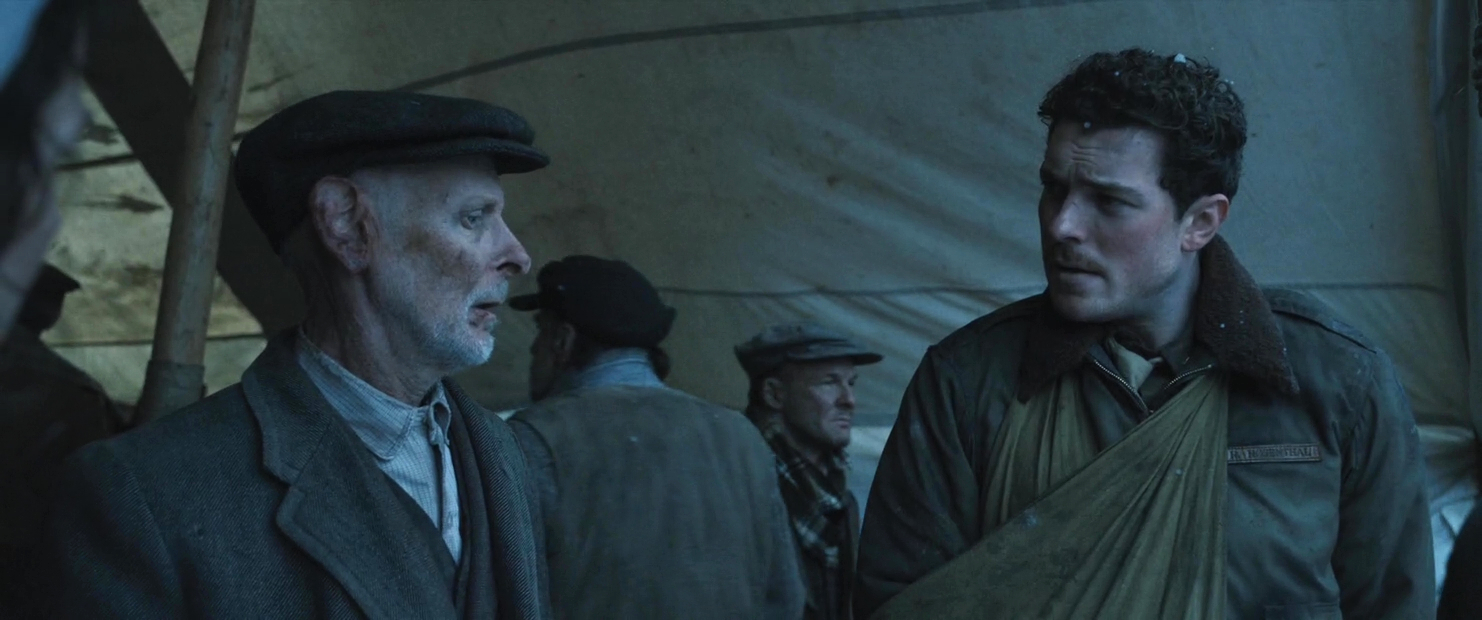
The episode shows the hurried evacuation of Stalag Luft III from Sagan as the Soviet Red Army pushed westwards towards the Oder River even as Rosenthal who had been shot down over the Oder River, links up with Russian forces and encounters evidence of the holocaust.
Later, after he is returned to England, Rosenthal has a quiet drink with Crosby.
“We are here to fight the monsters, Croz,” Rosenthal says. “It has made us do some tough things, but we had to. There is no other way. The things these people (the Germans/Nazis) are capable of…they got it coming. Trust me.” These words have echoes of a speech that President Roosevelt made to Congress in 1943: “We believe that the Nazis and the Fascists have asked for it. And we are going to give it to them.” (See They’re Going To Get It – Roosevelt (1943))
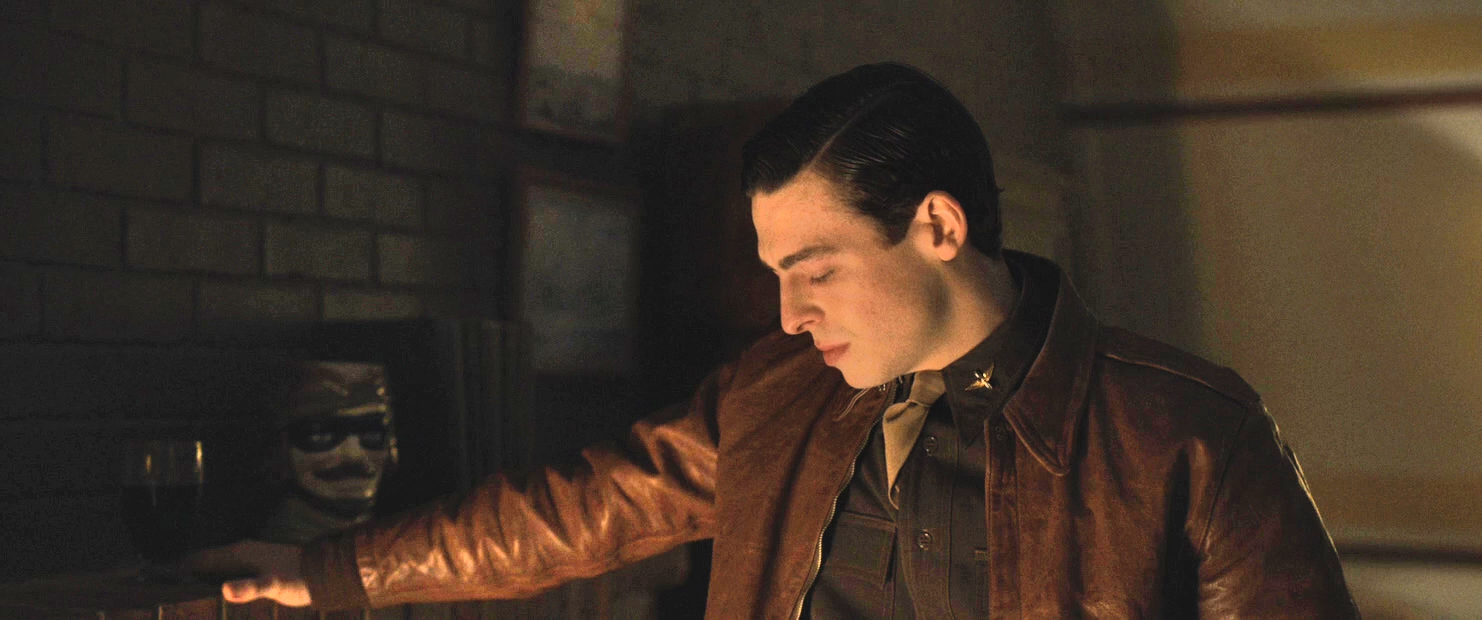
In this scene is an Easter egg from the 1949 film Twelve O ‘Clock High — the porcelain head in the background (with the bandit-like mask). In the 1949 film, the prop is used to inform the bomber group that a mission has been scheduled. (Masters of the Air)
Cleven and a handful of others escape but Egan is not so lucky. He and the rest of the Stalag Luft III POWs (nearly 10,000 of them) are marched to Stalag VII-A Moosburg in Bavaria, a sprawling camp already packed with nearly 65,000 POWs. For the first time, diversity makes sense in this show as Moosburg contained men from across the globe: Americans, Britons, Russians, Yugoslavs, Italians, French and their North African colonials, plus men from the British Empire: the Caribbean islanders, Australians, sub-Saharan Africans, Syrians, Palestinians (Jews and Arabs), Indians, South Africans and New Zealanders.
The scenes succeed in showing how the rise of Nazism had thrust entire generations of fighting men, from far-flung hemispheres, together in a land they would have not seen otherwise.
In the background of the scenes of Moosburg are smatterings of Indians, Caribbean islanders and Africans wearing the blue tunics of the British Royal Air Force (RAF) or the slouch hats of the British imperial armies. The camp is liberated shortly after by the tanks and infantry of the US Army’s 14th Armored Division in what is a rousing scene.
In the below photo sequence, Major Gustav Simoleit (the German deputy commandant of Stalag Luft III and commandant of Stalag VIIA Moosburg), played by Robert Hands, offers to shake the hand of US Lt-Colonel James W Lann, commander of the US 47th Tank Battalion (played by John Schwab). A stone-faced Lann refuses to shake the German’s hand. The scene is historically accurate.
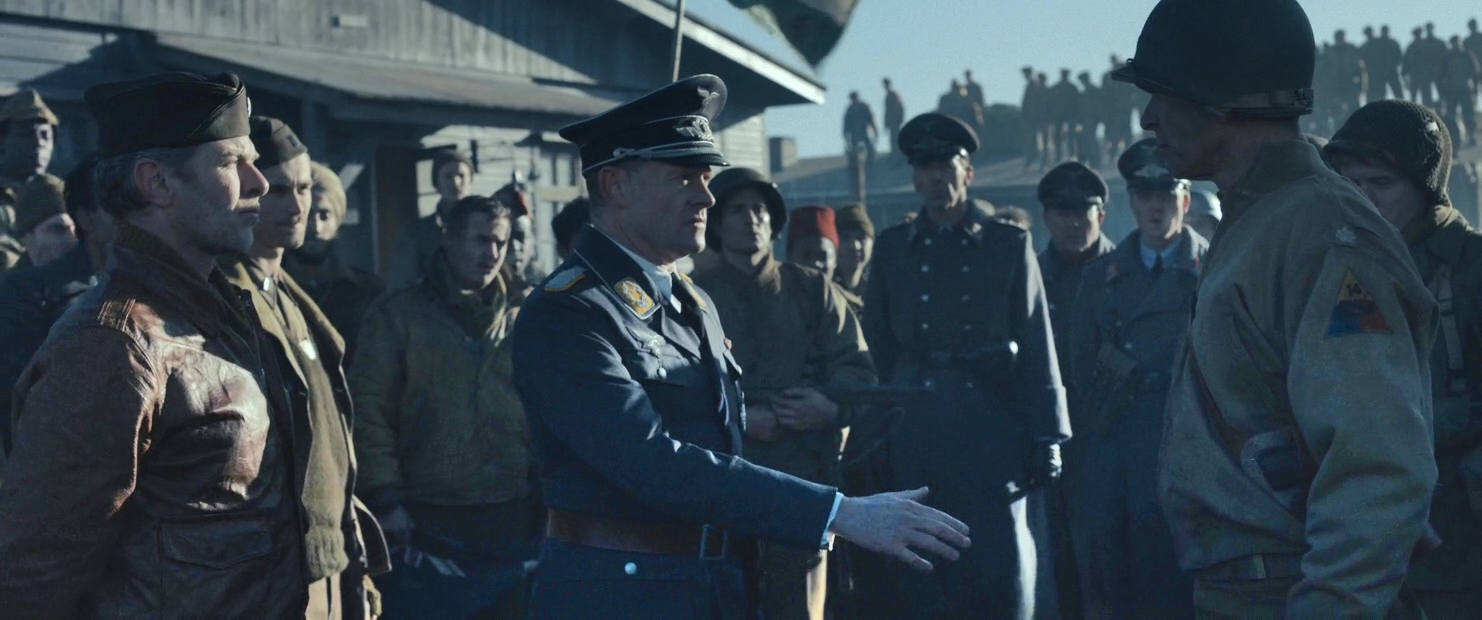
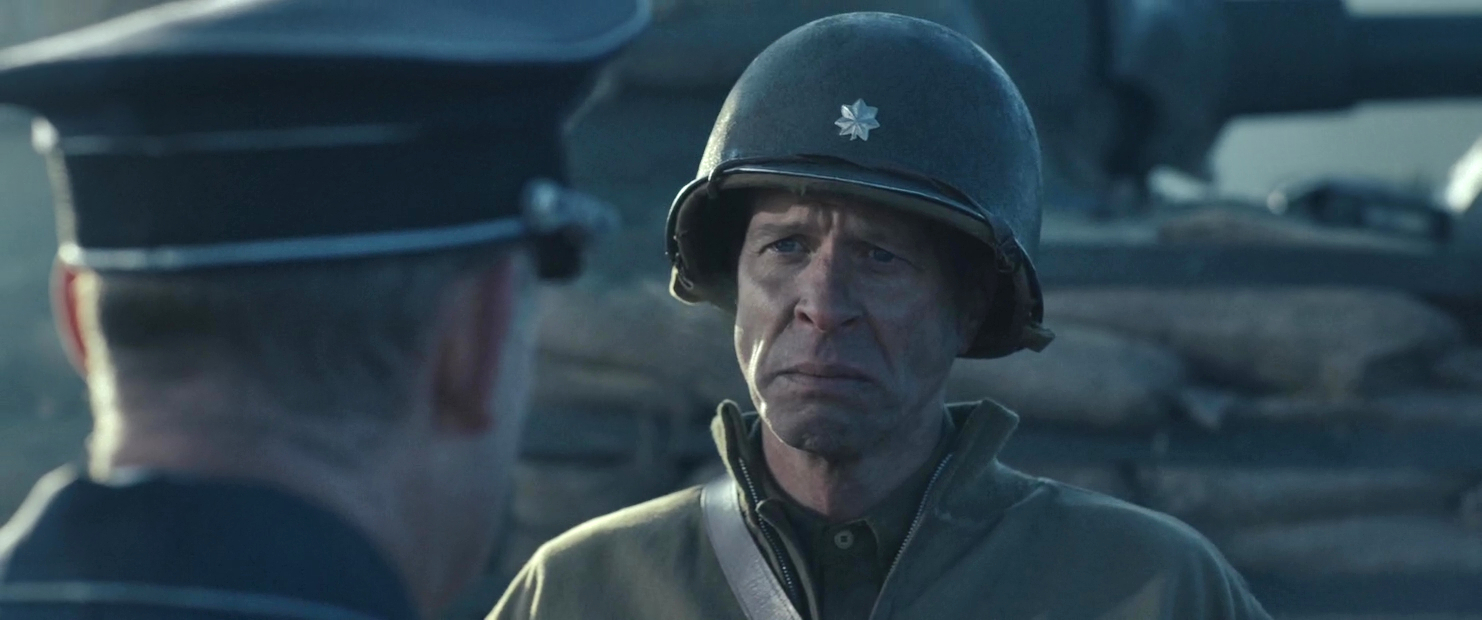
Although it is not properly mentioned in the show, the US officer in the far left foreground (in the upper image) is supposed to be Lt-Colonel Albert “Bub” Clark (played by Sam Hazeldine), one of the senior officers of Stalag Luft III’s American POW contingent from the South Compound. Clark, a Texan, was shot down and captured on 26 July 1942 during his first operational combat mission. (Walton Marilyn Jeffers & Michael C Eberhardt, From Interrogation to Liberation: Stalag Luft III – The Road to Freedom, Bloomington: AuthorHouse LLC, 2014) (Images credit: Masters of the Air)
With the end of the war in Europe, the 100th Bomb Group prepares to leave Britain. The planes take off one-by-one, to the farewells of despondent and grateful Britons. They descend into the skies and head homewards, past the rising sun, symbolizing the dawn of the American century.
Despite its shortcomings, WWII history such as Masters of the Air is of vital importance as the last of the greatest generation which fought or lived during the period of the war will pass away in the next half decade, severing our link with living history.
After they are gone, all we will have is the written text, the photograph, the moving picture and the recorded, spoken word as evidence of this moment in time – the most monumental event of modern human history which not only changed the world but defined who we are and what we can be as a species.

 Achilles the Heel
a clear analyse about a series that in all honesty didn’t appeal to me.
This was a great read and a good analyse of a series with little ambition,
INTERESTING TO WATCH BUT STILL FAR BELOW BAND OF BROTHERS AND THE PACIFIC REGARDING SUSPENSE ACTION AND EMOTIONAL MIMIC SHOWN BY THE ACTORS !!!!!!
Indeed, the characterizations were unfortunately weak.
Pingback: Aces over Berlin – Achilles the Heel