The Role of the French Resistance

Even as the Germans struggled to collate accurate intelligence on the situation in Britain, the Allies had an invaluable information gathering service in the form of an army in the shadows, the French resistance.
However, the effectiveness of some groups was questionable. Several groups had been infiltrated and smashed by the Germans, as had Allied spy networks run by Britain Special Operations Executive (SOE). Just how effective was the French resistance on D-Day?
By D-Day, there were an estimated 100,000 people in the resistance (about 10% were women), waiting for the call to arms. (Ian Sumner, The French Army 1939–45 (2), Osprey, 1998; pg. 37) When the call came, they went into action, cutting telephone lines, destroying railways tracks, gathering critical information about German movements to the frontline, and in many cases, doing their best to hinder the movement of German forces into Normandy.
The French Resistance Plan for D-Day (Terry Crowdy, French Resistance Fighter, Osprey, 2007; pg 51)
- Plan Vert: Sabotaging the railway system.
- Plan Tortue: Sabotaging the road network.
- Plan Violet: Destroying phone lines.
- Plan Bleu: Destroying power lines.
- Plan Rouge: Attacking German ammunition dumps.
- Plan Noir: Attacking enemy fuel depots.
- Plan Jaune: Attacking the command posts of the occupying forces
“Plan Vert” was particularly effective. The Resistance destroyed 577 railroads and 1,500 locomotives, three-quarters of the trains available in northern France. As part of “Plan Tortue,” they also destroyed 30 roads and, in concert with British bombers, destroyed 18 of the 24 bridges over the northern stretch of the River Seine.
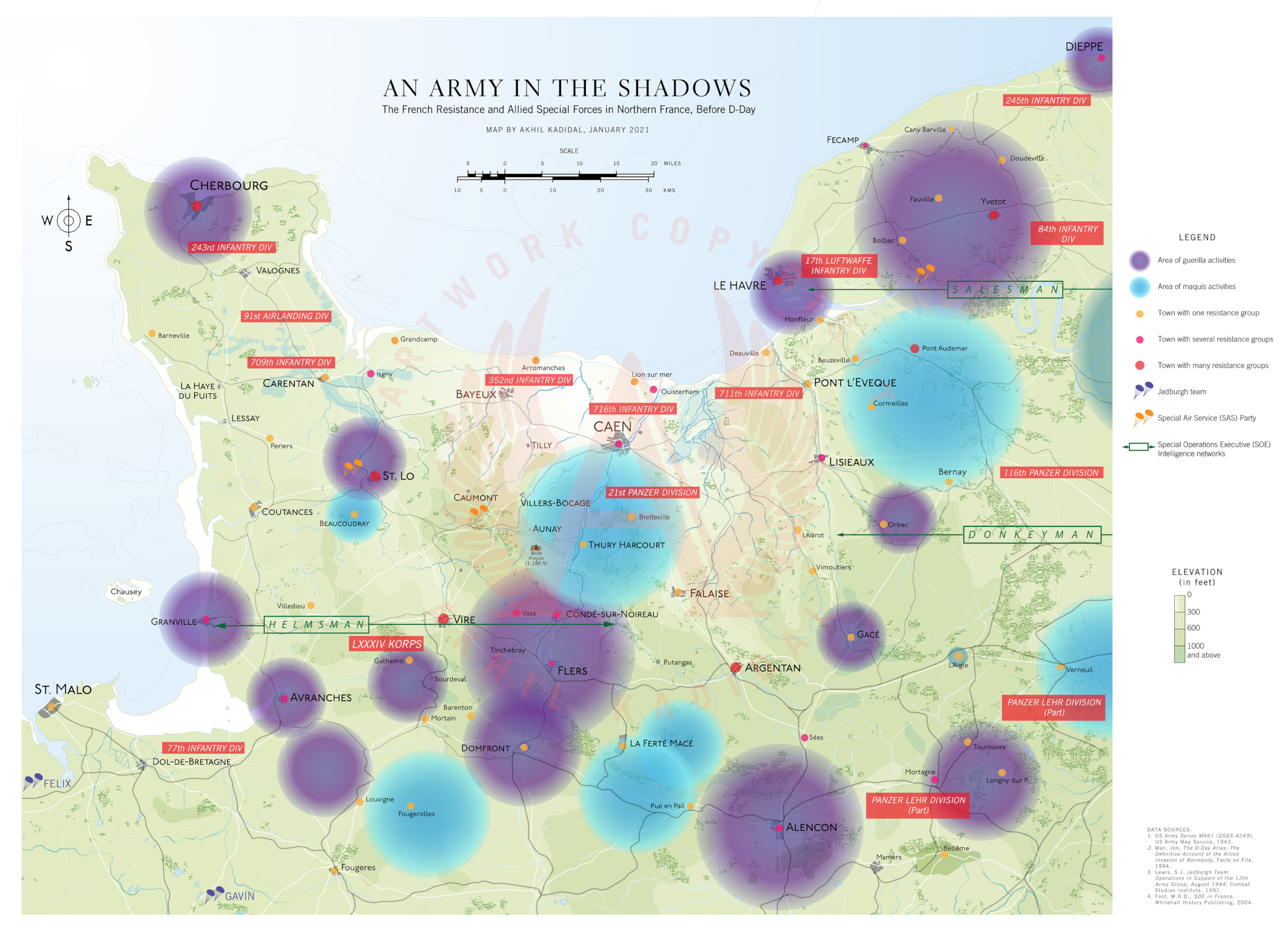
As D-Day approached, resistance fighters began to cooperate closely with British SOE and American Jedburgh teams. After the Allied invasion transpired, some resistance attempted conventional combat operations, which resulted in casualties and triggered hunt-and-destroy operations by the Germans which routed several cells.
However, the presence of the resistance in Normandy itself was limited and many Allied units which landed on D-Day would later complain that the coastal villages and towns were full of collaborators feeding information to the Germans. (Georges Bernage, Gold, Juno and Sword, Heimdal, 2003; pg 157)

Many of the resisters were revised in postwar French history as a bonafide army whose contribution to Normandy campaign and the liberation of France was greater than the Allied armies themselves.
This was a result of the machinations of Charles De Gaulle, or (“Joan of Arc”in pants” as Churchill called him) (From I.M. Masikii to the USSR People’s Commissariate for Foreign Affairs, https://ciaotest.cc.columbia.edu/olj/iarj/iarj_01_05a.html) De Gaulle arguably sought to exorcise the trauma of defeat and Nazi occupation from the French history of the war years.
That involved downsizing the number of collaborators in France, which amounted to a vast majority of the population while reinventing those in the resistance as an army in waiting.
As the historian Robert Gildea wrote:
It was a founding myth that allowed the French to reinvent themselves and hold their heads high in the post-war period. There were several elements to this narrative. First, that there was a continuous thread of resistance, beginning on 18 June 1940, when an isolated de Gaulle in London issued his order to resist via the BBC airwaves, and reaching its climax on 26 August 1944, when he marched down the Champs-Élysées, acclaimed by the French people. Second, that while a ‘handful of wretches’ had collaborated with the enemy, a minority of active resisters had been supported in their endeavors by the vast majority of the French people. A third element was that, although the French were indebted to the Allies and some foreign resisters for their military assistance, the French had liberated themselves and restored national honor, confidence and unity.
Gildea, Fighters in the Shadows, Faber & Faber, 2015; Introduction, Section 8, Para 4
The truth was complex, but that is another story. (See my documentation of the Liberation of Paris)

 Achilles the Heel