
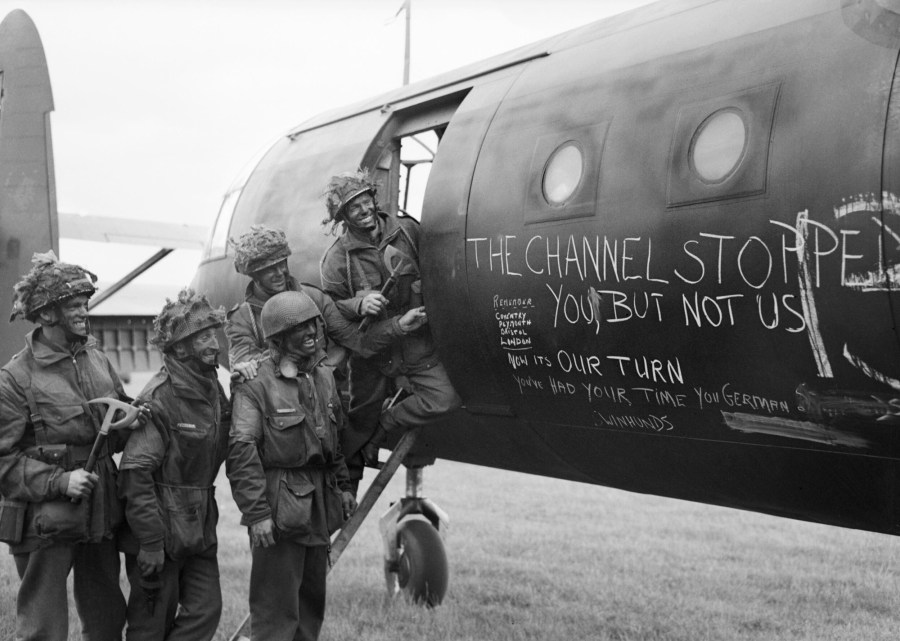
It is on the beaches that the fate of the invasion
will be decided and, what is
more, in the first 24 hours.
– Field Marshal Erwin Rommel
Adolf Hitler could see the future in 1943. “If they attack in the west that will decide the war,” he said. (Max Hastings, Overlord, Ch 2, Section 1, Para 190) This was no exaggeration. Over the past three years, the Germany had lost heavily.
The Eastern Front had consumed 1.51 million German lives alone up to the start of 1944 (not counting captured or maimed), according to the German historian Rudiger Overmans (See Deutsche militärische Verluste im Zweiten Weltkrieg, Oldenburg, 2000). The Russians, who had taken greater losses, were still advancing. Between the invasion of Russia on 22 June 1941 and to end of May 1944, the Germans lost 1,860,046 men in the east (Overmans, Table 59: Gesamtverluste an der Ostfront, pg. 277)
Between May 1943 and November 1944, the Wehrmacht alone lost another 145,027 men in Italy (Burkhart Müller-Hillebrand, Das Heer 1933–1945. Entwicklung des organisatorischen Aufbaues, Vol III, Der Zweifrontenkrieg. Das Heer vom Beginn des Feldzuges gegen die Sowjetunion bis zum Kriegsende. Mittler, Frankfurt am Main 1969; pg. 265). The only respite Germany could get was to defeat the cross-Channel when it came.
If the invasion was thwarted in 1944, Hitler believed that the Allies would be forced to wait another year before trying again. This could give Germany the opportunity to concentrate its forces and finish off the Russians. By then, Hitler argued, secret weapons and the Me262 jet fighters would be coming off the production lines in sufficient numbers, enabling his forces to beat back the western allies, when they returned in 1945.
But when General Alfred Jodl, Chief of the Operations Staff at German High Command told Oberbefehlshaber West (OB West or Western Front HQ), toured the western defenses in January 1944, he found that touted Atlantic wall was incomplete. Jodl also discovered that every division in France had been depleted in the constant diversion of manpower to the Russian Front. The Germans had 59 divisions in the France and the Low countries by the time of the invasion (out of which, some 41 were arrayed along the western coastline). Seventeen divisions were in Normandy and Brittany. Only eight of were along the Normandy coast or in position to counter a potential invasion.
Hitlerjugend
Among these was the 12th SS Hitler Youth (Hitlerjugend) division, which had a manpower strength of nearly 20,500 troops and 66 Panther tanks, which made it one of the strongest divisions in Europe – on any side. Its troops were largely young and idealistic young Nazis whose high morale made them dangerous opponents.
Continue reading “Normandy 2, Decision to Go” Achilles the Heel