Like prodigals returning home, a column of soldiers from a Free French armored division entered the Nazi-occupied city of Paris. It was the night of 24 August 1944.
They were the first Allied combat forces in the capital in four years but their numbers were paltry – only 172 men and three tanks. The column’s mission was paramount: to set up an advanced combat perimeter in the city.
This was intended to boost the morale of the population which had become ensnared in a popular revolt against the Germans for five days. But the column commander, a thick-set, amiable French captain named Raymond Dronne, knew that the mission had more at stake. The detachment was expected to link up with the French resistance and help the rest of their division (the Free French Deuxième Division Blindée or 2nd Armored Division), to prevent what many feared would be Germany’s total destruction of Paris.
The fear was not unfounded. The German dictator, Adolf Hitler, had ordered the German commander of the city, General Dietrich von Choltitz, to leave the capital a sea of ruins. The order was not unprecedented. The Germans had systematically obliterated other cities in Russia and in Europe. At that moment, at the other end of Europe, German forces were obliterating the Polish capital of Warsaw of its resistants, block by block, building by building.
It was 8.45 pm when Captain Dronne’s troops entered Paris through the undefended Porte d’Italie, one of the ancient gateways of the nearly 2,000-year-old city. Seeing the unfamiliar tanks and the strangely garbed men, the locals ran and hid. Then they saw the French tricolor on the sides of the vehicles and erupted into wild celebration. Pushing past the jubilant crowds, the detachment headed towards the city hall, the ornately decorated Hôtel de Ville. The building was, for Dronne, a “symbol of Paris’ freedoms.”
News of the unit’s arrival at the Hôtel de Ville spread like wildfire throughout Paris — triggering a storm of emotions among the people. Church bells began to ring. But the new liberators remained vigil.
All around them were nearly 20,000 German troops, with their leader in Berlin determined to destroy a city which he had likened to the beating heart of France.
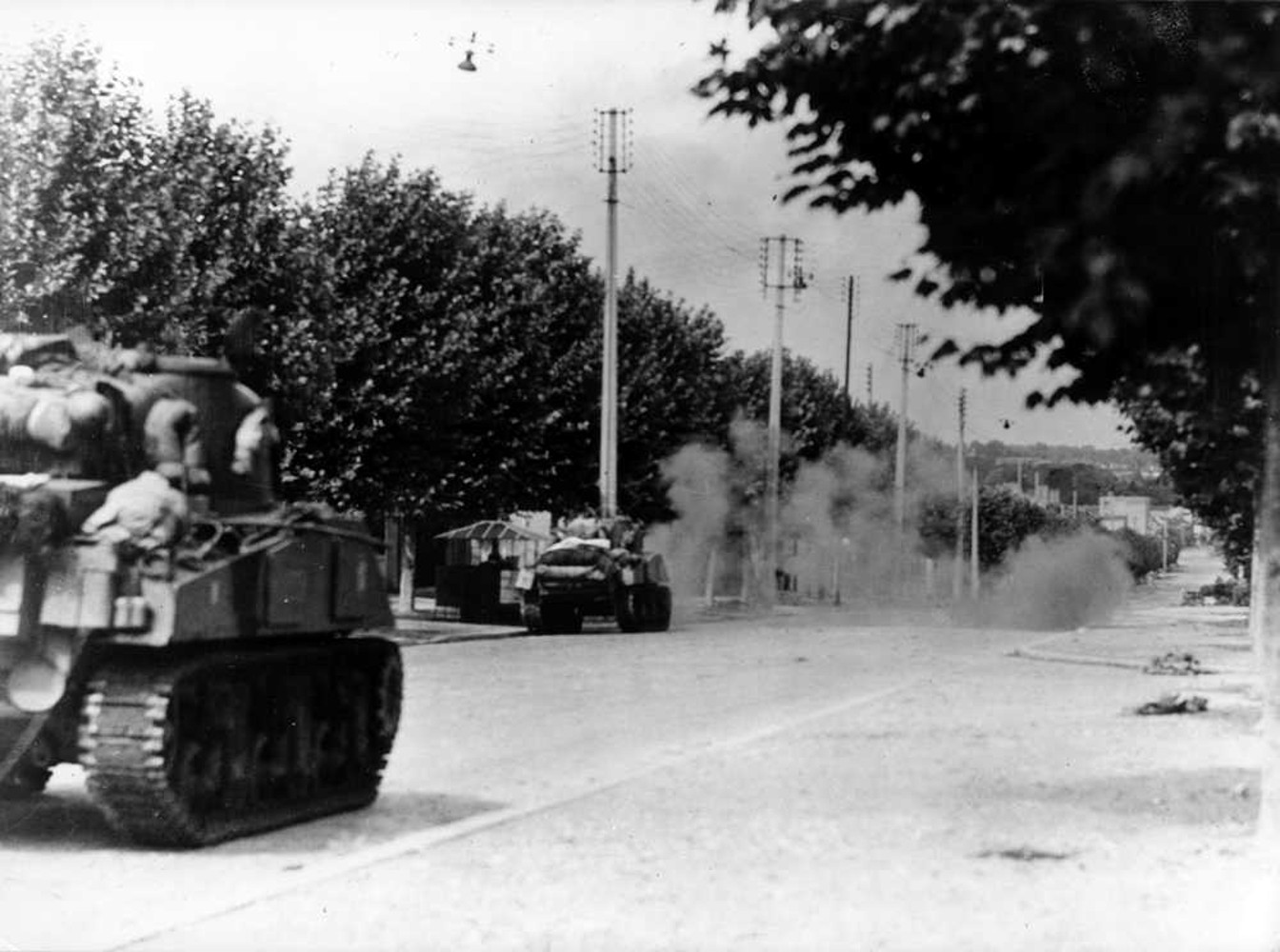
Putz’s battlegroup began to encounter serious resistance as it approached the industrial town of Antony, a suburb of Paris. The Germans had focused their defense into a small triangle running from Antony to the massive hulk of the Fresnes prison to the crossroads at Croix de Berny.
Antony was liberated quickly enough by one column of Free French driving up the Route Nationale 20 (RN20). A second column emerged from the old Chartres Road.
But then an 88mm cannon strategically positioned at the Berny crossroads turned its barrel on the arriving Free French.
The 1st Platoon of the 9th Company of the Régiment de marche du Tchad (RMT) under a Spaniard, 2nd Lt. Vincente Montoya (just 21 years old), arrived in front of a butcher’s shop on the right side of the highway. Montoya, a former infantry officer in the old Spanish Republican Army, had distinguished himself in Normandy. He had already won the French Croix de Guerre medal with the silver star for heroics.
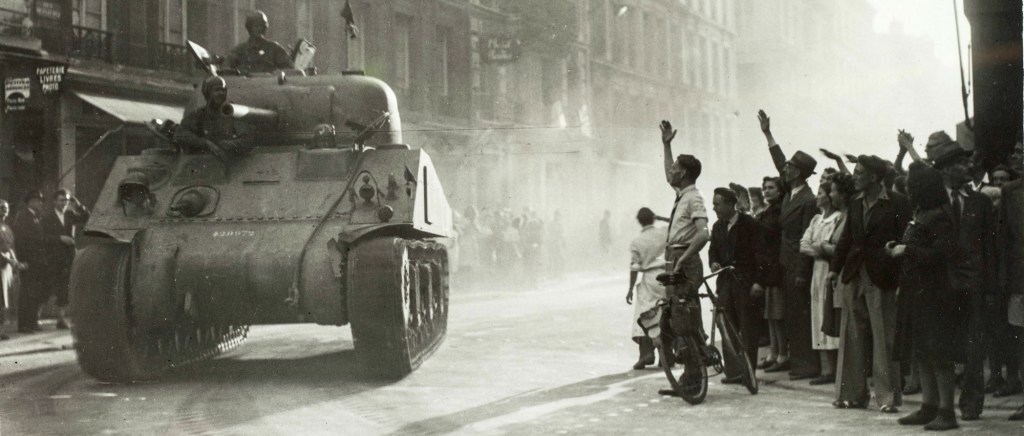
Divisional Sherman tanks roar along the Avenue d’Orléans in Antony. They would soon be halted by an 88mm cannon deployed near the intersection of National Highway 186. (US National Archives and Records Administration)
Known as the “Nueve,” the 9th Company was a unique unit. Some 146 of its 164 troops were Spanish or of Spanish extraction (at least four were Spaniards born in Morocco). The company’s halftracks carried the names of the long-lost battlefields of the Spanish Civil War: Guadalajara, Teruel, Ebro, Santander, Brunete, Guernica … Other halftracks carried French nicknames, such Resistance, Nous Voilà, Cap Serrat and Rescousse. Dronne’s own Jeep carried the French phrase: Mort aux Cons (Death to Cunts). (Mesquida, loc.1993, 40%)
The company had disembarked on the hallowed ground of France at Magdalena Beach, near Sainte-Mère-l’Église on 4 August. This area has been “Utah Beach” on D-Day. The disembarkation operation was slow. The men had sung the “La Cucaracha” in derision.
Nearly all of the sergeants and lieutenants in the company were Spanish. Second-in-command was Lt. Amado Granell, a 45-year-old Valencian and a former member of the Spanish foreign legion.
Having joined the legion as a minor without the consent of his parents, Granell had left the army in 1922 with the rank of sergeant. After settling in Alicante as a cycle shop owner, he began participating in labor union movements in the interwar period.
Dronne’s second-in-command of the 9th Company was Lt. Amado Grannell. He is seen here leading a patrol from Xaffévillers to Ménarmont in the Vosges much later in 1944, after the liberation of Paris. Curiously, he is armed with a German MP.40 submachinegun. (Musée du général Leclerc/Musée Jean Moulin, Paris Musées)
When the Spanish Civil War erupted in 1936, Granell joined the Levante battalion in which he eventually became a Captain. By December 1938, he was the commander of a brigade. But with the opposing Nationalist forces of General Francisco Franco on the verge of victory in 1939, Granell left Spain. He found passage on the Stanbrook, the last English merchant ship to leave Alicante before the nationalists arrived. All Granell had were a few possessions and his machine gun, Dronne recalled in 1964.
When the Stanbrook arrived in Oran, Granell (like nearly all Spanish exiles) was shunted by the French into a disciplinary camp. After the Allies landed in Morocco, he was able to join the Corps Francs d’Afrique in December 1942. During the Tunisian campaign, he met Major Joseph Putz who offered him the opportunity to join the 2e DB under the command of General Leclerc. In this way, he had come to join the Nueve. Such experiences were not alien to many others in the company. (https://www.24-aout-1944.org/La-journee-du-24-Aout-1944/)
The 18 non-Spaniards in the company comprised one Brazilian, one Mexican, two Portuguese, six Frenchmen, one Italian anti-fascist, one Argentine, one Romanian and three German anti-Nazis (including Staff Sergeant Johann “Juanito” Reiter, the scion of an officer in the Kaiser’s army who the Nazis had murdered). (Data compiled by author & Dronne, A Spanish Company in the Battle for France and Germany, loc. 107, 15%) Reiter had been a cadet in Munich during the Weimar Republic. He had subsequently seen action in the Spanish Civil War as part of the General Staff of the Lenin Column. (Antonio San Román Sevillano, August 24-25, 1944: The liberation of Paris) This column was made up mostly of individuals from the Catalonian Partido Obrero de Unificación Marxista (POUM) – the same group that the British writer, George Orwell, had served with.
Rounding out the non-Spaniards were two Armenians, including Private Bedros Krikor Pirlian, a tailor from Istanbul, who had become Dronne’s aide). Some two or three of the group were stateless individuals, according to Dronne. (Data compiled by author & Dronne, A Spanish Company in the Battle for France and Germany, loc. 107, 15%)
A group photo of the 9th Company when it was in England. Unfortunately, I have not been able to identify many of the men in this photograph.Continue reading “Paris 1944, 2. Carnage”→






 Achilles the Heel