Out of the Blue: The Unraveling of Operation Market-Garden

Warfare is a product of the worst of human excesses and in World War II, Operation Market-Garden was almost no different, if not for its nobility of purpose, and civility in battle. The British-US operation was an ambitious effort to hasten the end of the war by the Christmas of 1944. Instead, it went so wrong that eight decades later historians are still trying to understand what failed and why.

Conducted in the last autumn of the war, the operation aspired to propel the Allies through the eastern Netherlands and over the sprawling Rhine River (the last, great natural obstacle to Germany). From there, the Allies had a spring-board from which they could strike into Germany and attack its capital, Berlin. That dream collapsed around the destruction of the elite British 1st Airborne Division at the Dutch city of Arnhem.

That failure, occurring at the height of Allied military fortunes in the war, provided a stunning reminder of the old von Moltke1 maxim that, “no plan of operation survives first contact with the enemy” – Especially, a hastily developed plan that assumed that the Nazis were already beaten.

Market-Garden became better known to the general public in the postwar period. In 1946, a British film, Theirs is the Glory, filmed with 1st Airborne Division veterans in the ruins of the actual battlefield, opened to public acclaim. However, the film did little to dispel the public’s misconception that only the British Army was involved in a struggle which in reality, had also cost two US airborne divisions dearly. 
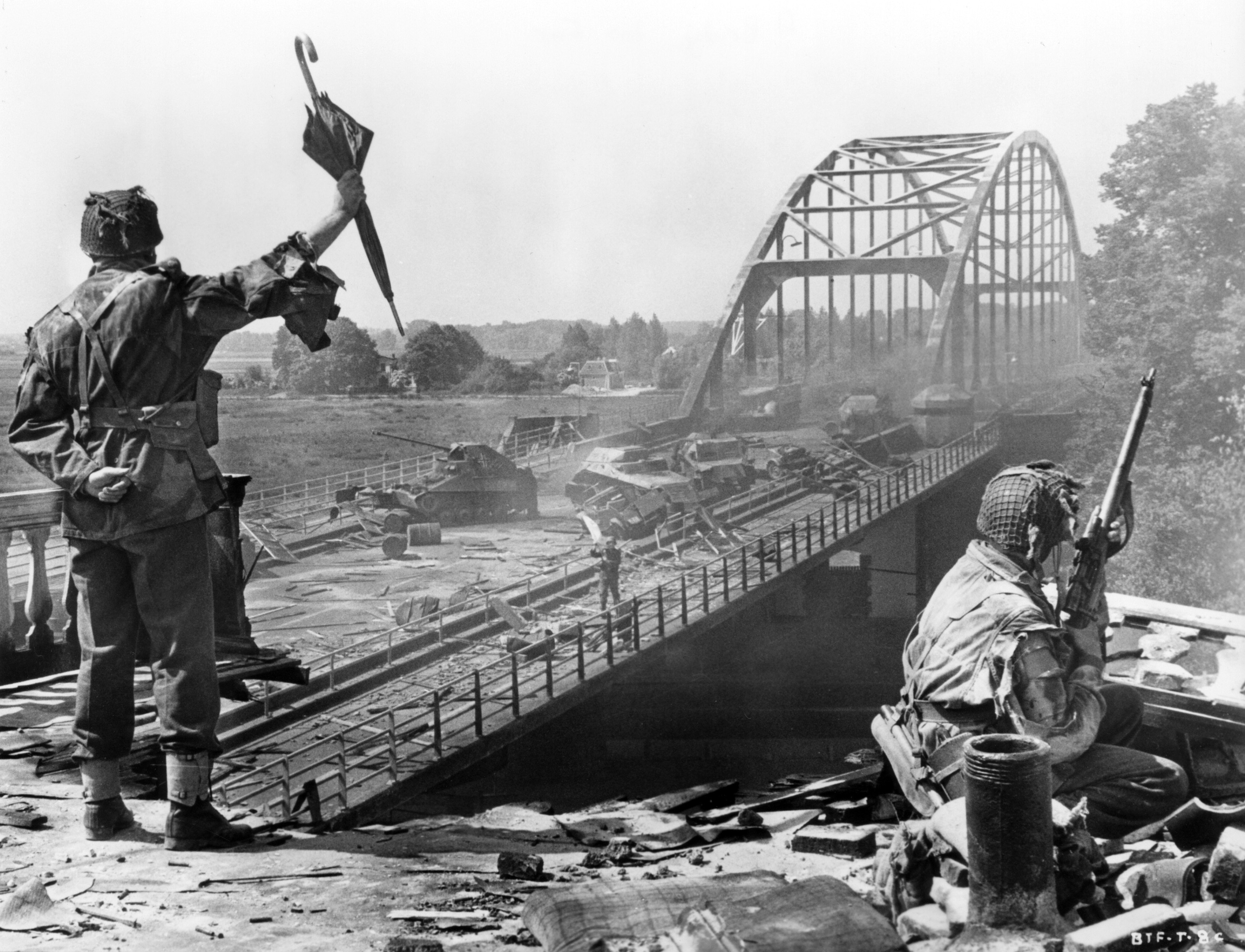
The unexpected failure of Operation Market-Garden, despite the courage of its Allied protagonists, is a reminder of the old maxim that “no plan of operation survives first contact with the enemy.” This photograph, showing a scene from the 1977 film, A Bridge Too Far, evokes real-life incidents of defiance and courage which occurred during the operation. (Michael Ochs Archives/Getty Images)

A spate of memoirs by British commanders and minor histories followed.

Then came the 1974 history, A Bridge Too Far by the Irish-American journalist, Cornelius Ryan. This book gave the US airborne their dues, while creating a stunning picture of heroism, sacrifice, and stupidity. A later reprint provided this writer’s introduction to the battle, as a teen.

Despite its depth, the book did not provide all the answers. Without detailed maps on the subject, following the complexity of the battles becomes difficult, especially the convoluted battle of Arnhem. For years (until recently, I confess), I failed to grasp what had really happened and where, during obtuse battles fought in esoteric places called Ginkel, Grave, Renkum, Beek, Wolfheze, Son, and Mook. 

Could these have also been the names of comic characters of another childhood? They might have been.

A 1977 film adaptation of Ryan’s book, made with a gamut of stars from Hollywood and Pinewood, reinforced some of the deficiencies of the book, including the myth that the operation failed because the 1st Airborne landed on two fully operational Waffen-SS armored divisions.

If Market-Garden has cemented itself in the public consciousness over the decades, it is because of its daring, and because of its humanistic objectives. Allied combat operations, especially in northwest Europe, were acts of liberation, fought to restore democracies and democratic institutions.2 At its essence, Market-Garden aspired to achieve this grand goal.

Cheering crowds greet British troops entering the Belgian capital, Brussels, on 4 September 1944. Wherever Allied troops went in western Europe, they were met by euphoric local populations effusing thanks for liberating them from the Nazis. No other campaigns or wars in human history have triggered such mass gratitude. (Imperial War Museum (IWM) BU483)

While the operation caused horror and tragedy, it also brought out the best in people. The heroism and sacrifice of its Allied protagonists triggered enduring gratitude from the Dutch. Surprisingly, it also elicited sentiments of honor, even decency from the Nazi combat cadre, the Waffen-SS — in spite of their moral decline which was nearly complete after five years of war and six years of nationalized racial indoctrination.

The operation’s failure, however, has caused it to be refought hundreds of times in books and films, fed by public curiosity.

Will I do some refighting of my own in the words that follow? A little. My larger objective was to use primary source statistical data (and select secondary sources) to recreate the battles through maps, infographics, and analysis. The intention is to offer a new and clear perspective of the operation.


  1. The Gamble
    1. Making the Case for Airborne Operations
  2. The Politics of Warriors
    1. Poor Air Support
    2. In-fighting among Air Commanders
  3. Stacked Dominoes
    1. German Battlegroups Form
  4. All Hell Breaks Loose
    1. The Statistical Data of Operation Market
    2. The Red Devils
    3. Controversial Plan for Arnhem
    4. Tip of the Spear
    5. Making for the Arnhem Bridge
      1. Rapid German Reaction
    6. Urquhart Missing
  5. Arnhem, the Alamo
    1. Destroying Gräbner
  6. The 8nd Airborne and a Narrow Run Thing
    1. Gavin, Golden boy
    2. Confused Orders
    3. Capturing the Grave and Canal bridges
    4. Erroneous information
    5. Distracting the Airborne
    6. Capturing the Nijmegen Bridge
    7. The Waal Crossing
    8. Jan van Hoof
    9. Rage against the Guards
  7. The US 101st Airborne’s Frontier War
    1. The 101st Airborne at Arnhem?
    2. Maximum Force
    3. The Germans Go After the Weak links
  8. Point of No Return
    1. Tanks come for the British
    2. Defiant to the End
    3. Sosabowski’s Choice
    4. Out with a Whimper
      1. Allied Casualties, 17 to 25 September 1944
    5. German Pyrrhic Victory
  9. Aftermath
    1. Lessons from a Historic Failure
    2. Guilt and Betrayal
  10. Footnotes
  11. Credits & Bibliography
    1. Major Sources

The Gamble

Against a defeated and demoralized enemy almost any reasonable risk is justified and the success attained by the victor will ordinarily be measured in the boldness, almost foolhardiness, of his movements – Dwight D Eisenhower

By the start of September 1944, the Allies found themselves nearly the masters of northwestern Europe. The tattered remnants of Germany’s primary battle force in the region, Army Group B, were in headlong retreat after their defeat in Normandy.

The Allies were in pursuit, sweeping through northern France. Paris fell on 25 August and the Allies approached Belgium. Up to early September, one-third of British General Bernard “Monty” Montgomery’s 21st Army Group3 were clearing German forces from ports along the English Channel while the rest pushed into Belgium.

But the Allied advance was congealing. The Anglo-Americans armies were outrunning their supply lines. Nearly every port recovered from the hands of the Germans was in ruins. This limited the amount of supplies that could be landed.

Many operational ports were also in or near Normandy, which was receding into the distance as the frontlines radiated out towards Germany. The British captured the valuable deep water port at Antwerp on 4 September. But the harbor was unusable because German troops held the approaches, along the Scheldt River estuary, and especially on Walcheren island.

Compounding the problem was growing German resistance.

Lieutenant General Brian Horrocks, the commander of the British Army’s XXX (30) Corps would later note (with hindsight), that the Germans were no longer in retreat by September 1944, and that Allied troops were fighting again. (Horrocks interview, World at War, “Pincers,” Episode 19)
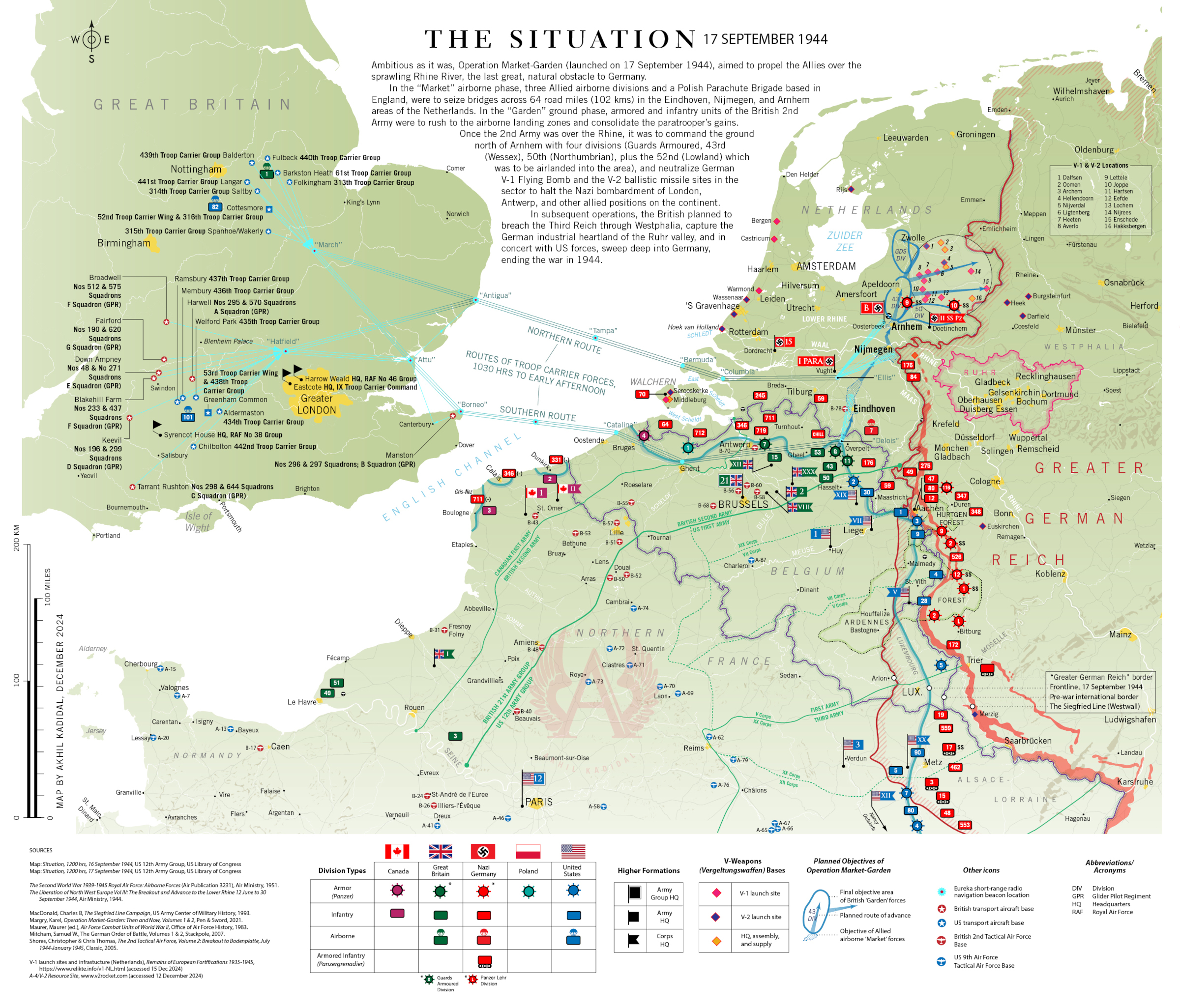
By September 1944, four Allied armies were poised along the border with Germany, trying to find a way in. Operation Market-Garden was to be their ticket in. On 17 September, three Allied airborne division took off from England and headed to the Netherlands. ©Akhil Kadidal
Continue reading “Out of the Blue: The Unraveling of Operation Market-Garden”

The Battle of the Bulge

Masthead - Battle of the Bulge

Mapping the Ardennes offensive proved much arduous than my earlier work on Normandy and D-Day.

Admittedly, I knew little about the Ardennes, cloaked as it was, under a tangle of oak, willow, conifers, poplar and beech. What I did know about this great campaign came from scattered readings and for having seen the great 1965 turkey The Battle of Bulge, the significantly better Battleground (1949), and the two-odd episodes of Band of Brothers which portrayed US airborne at the besieged market town of Bastogne.

Part of the challenges is that the landscape of the Ardennes is a difficult place to wrap the mind around, populated as it is with places with impossible names like Houffalize, Foy, Soy, Wiltz, Champs, Saint-Vith, La Gleize, the vaguely wookie-sounding Neiderwampach, Sibret, Butgenbach and a rather pleasant-sounding village named Bra.

The battles here were monstrous; the brainchild of a despot grasping at straws for a last victory which he believed would reverse the course of the war. However, the finer details of the battle contain an almost supernatural quality: of phantom, snowsuit-clad Germans passing in an out of US lines, of American paratroopers holding frozen ground against titanic German tanks appearing of the mist, of foxlike English-speaking Germans sowing discord behind the lines, of diehard SS commandos wielding captured US Army equipment and uniforms to punch through Allied lines and a fog which hung like a pall for the first nine days of the battle.

Yet, the alien, hard edges of the Battle of the Bulge are softened somewhat by the pop-culture icons who found themselves in the midst of this struggle — men like the late, affable actor Charles Durning, who possibly survived an SS war crime outside the town of Malmedy, and the author, Kurt Vonnegut of Indianapolis, who, as a member of the green US 106th Infantry Division, fell into the German bag after his regiment was overrun by swarms of Teutonic armor and infantry.

This, I suspect comes to down to our human need to identify something familiar out of the monochromatic visions which emerge from literature and photography. Arguably, cartography is one way to cut through this hermetic barrier. Words may have the ability to evoke powerful scenes, but maps have the power to crystallize text onto a landscape we can visualize in our mind’s eye.

—————

The initial set of three maps took over 30 days to create. Several contemporary books were consulted to figure out how events transpired, including Antony Beevor’s Ardennes 1944, which proved to be singularly useless. In the end, I went back to the original sources: US Army historical documents, manuscripts, dispatches and books including Hugh Cole’s excellent The Ardennes: Battle of the Bulge (US Army, 1965).

The Front Explodes

The Battle of the Bulge - 16-19 Dec 44
Brodie - Winter
A group of US soldiers huddle in a frigid wind in this wartime drawing by Sergeant Howard Brodie, an artist for “Yank” magazine.

Allied optimism that the war would be over by the Christmas of 1945 was nearly quashed as Christmas approached and the war in Europe looked as though it had no immediate end in sight. The US First Army settled to rest and regroup in the Ardennes Forest in Belgium, an area considered as being a relatively quiet sector of the front. Many of its units were in strung-out shape after enduring relentless combat since the Normandy campaign. But in what was probably the greatest intelligence lapse by the Allies in the war, the Germans were able to assemble, in secret, three entire armies (or over 275,000 men) along the 60-mile long Ardennes front.

Six soldiers from the US 7th Armored Division patrolling St. Vith during the Battle of the Bulge. (Photo by Galerie Bilderwelt/Getty Images)

The Life and Death of Kampfgruppe Peiper

The Battle of the Bulge - Kampfgruppe Peiper

Events of the 1965 film The Battle of the Bulge largely depicted the movement west of the 1st SS Panzer Division, which had orders to reach to the Meuse River. In real life, the SS was badly delayed by the inability of other units to clear the way – a problem compounded by poor roads which were in no state to support an armored advance. On several occasions, commanders reported mud coming up the decking of tanks.

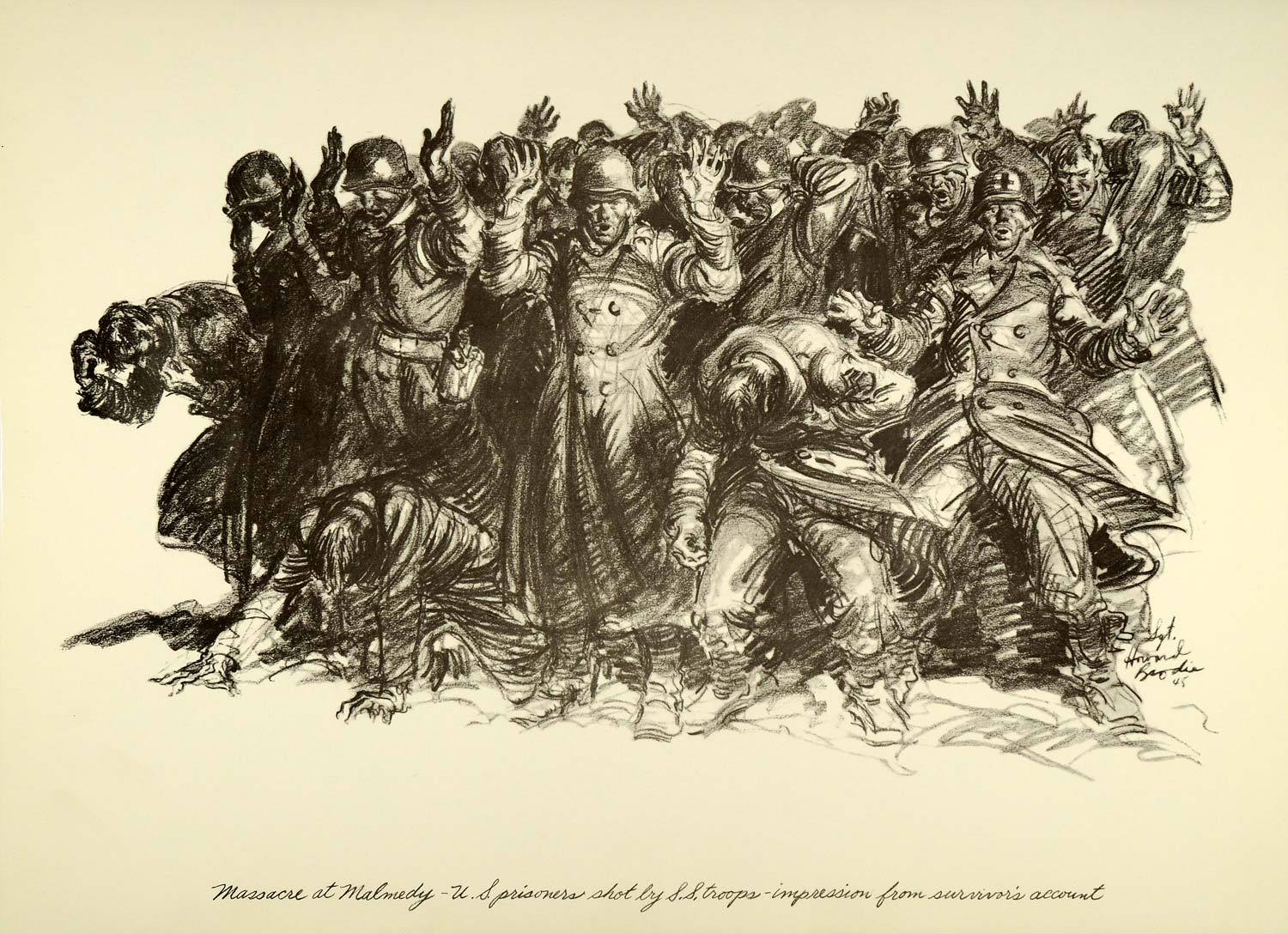
As the pressure mounted, the SS began to act on an order supposedly handed down from high command, instructing units not to take prisoners, lest they slow down the momentum of the advance. A series of atrocities by SS troops ensued, particularly by Kampfgruppe Peiper, led by an ambitious young veteran of the Russian front, 29-year-old Joachim Peiper.

82d Airborne Trooper - Bra (AP)
Captured SS Trooper (Bra, belgium)

Among the evocative photographs to come out of the Battle of the Bulge were these two images. Here, two paratroopers of the US 82nd Airborne Division bring a young SS captive in at the point of a Tommy gun. These pictures were taken at Bra, Belgium on December 24, 1944. (Both photographs taken by the Associated Press)

Brodie - Malmedy MassacreSgt. Howard Brodie’s depiction of how the “Malmedy Massacre” went down.

The Bastion

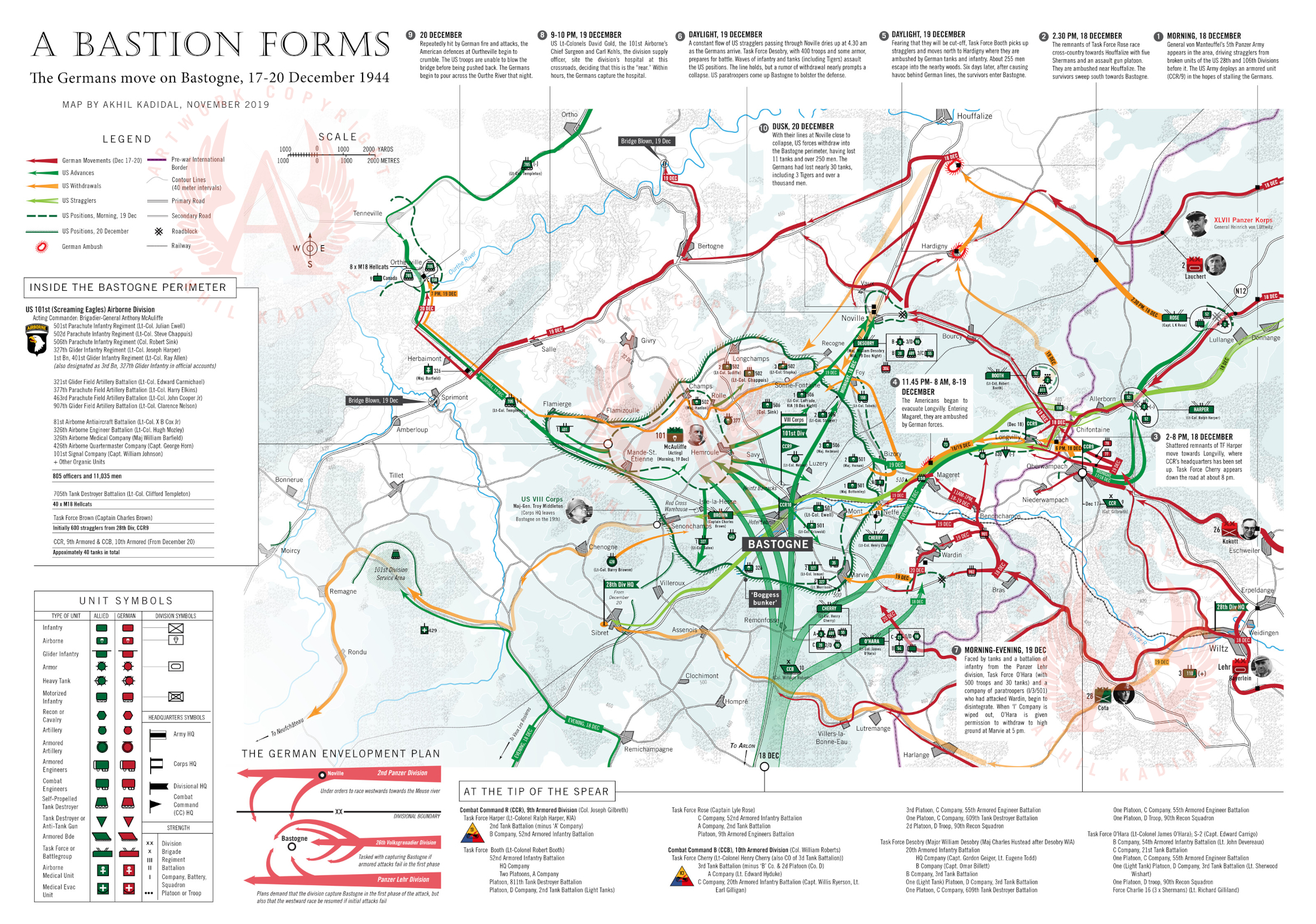
As the Germans swept deeper into the Ardennes, the Belgian town of Bastogne, occupying a key position on the rail and network in the region, came under threat. Bastogne was nearly undefended until the 48th hour of the German offensive. In desperation, the Americans rushed a tank unit (Combat Command R from the 9th Armored Division) to stall the incoming Germans until reinforcements could be pushed into Bastogne. The only other units available were paratrooper divisions recovering from an abortive campaign in Holland that September. The US 101st Airborne Division was alerted to advance into the sector, but being a parachute division, it had no attached armor and a grave shortage of bazookas.

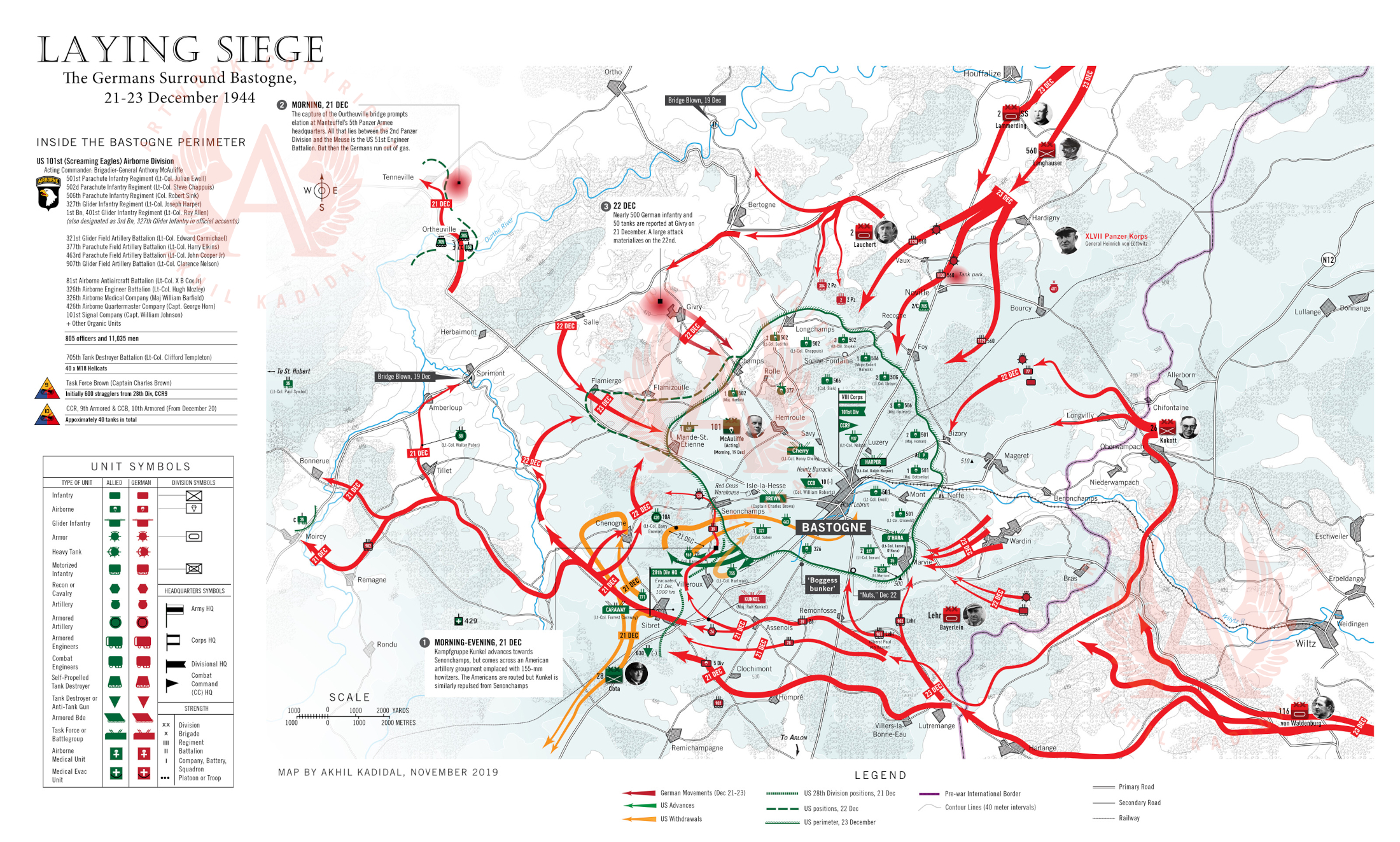
A second tank force (this time from the 10th Armored Division) also raced to defend Bastogne. By dusk on the 19th, the area around Bastogne was embroiled in combat. By December 22, American troops within the Bastogne perimeter realized that they were surrounded. Meantime, the Germans, torn between their desire to stay on course towards the Meuse River and their inclination to nullify Bastogne, mounted a series of penny packet attacks against the perimeter which achieved little and wasted valuable time.

Bastigne Chow (Corbis WW20077)A group of paratroopers from the 101st Airborne Division get some hot chow near the frontline. The discovery of a large Red Cross warehouse within the Bastogne perimeter early in the siege, allowed the besieged paratroopers the luxury of hot pancakes on most mornings. (Corbis)

Continue reading “The Battle of the Bulge”