Out of the Blue: The Unraveling of Operation Market-Garden

Warfare is a product of the worst of human excesses and in World War II, Operation Market-Garden was almost no different, if not for its nobility of purpose, and civility in battle. The British-US operation was an ambitious effort to hasten the end of the war by the Christmas of 1944. Instead, it went so wrong that eight decades later historians are still trying to understand what failed and why.

Conducted in the last autumn of the war, the operation aspired to propel the Allies through the eastern Netherlands and over the sprawling Rhine River (the last, great natural obstacle to Germany). From there, the Allies had a spring-board from which they could strike into Germany and attack its capital, Berlin. That dream collapsed around the destruction of the elite British 1st Airborne Division at the Dutch city of Arnhem.

That failure, occurring at the height of Allied military fortunes in the war, provided a stunning reminder of the old von Moltke1 maxim that, “no plan of operation survives first contact with the enemy” – Especially, a hastily developed plan that assumed that the Nazis were already beaten.

Market-Garden became better known to the general public in the postwar period. In 1946, a British film, Theirs is the Glory, filmed with 1st Airborne Division veterans in the ruins of the actual battlefield, opened to public acclaim. However, the film did little to dispel the public’s misconception that only the British Army was involved in a struggle which in reality, had also cost two US airborne divisions dearly. 
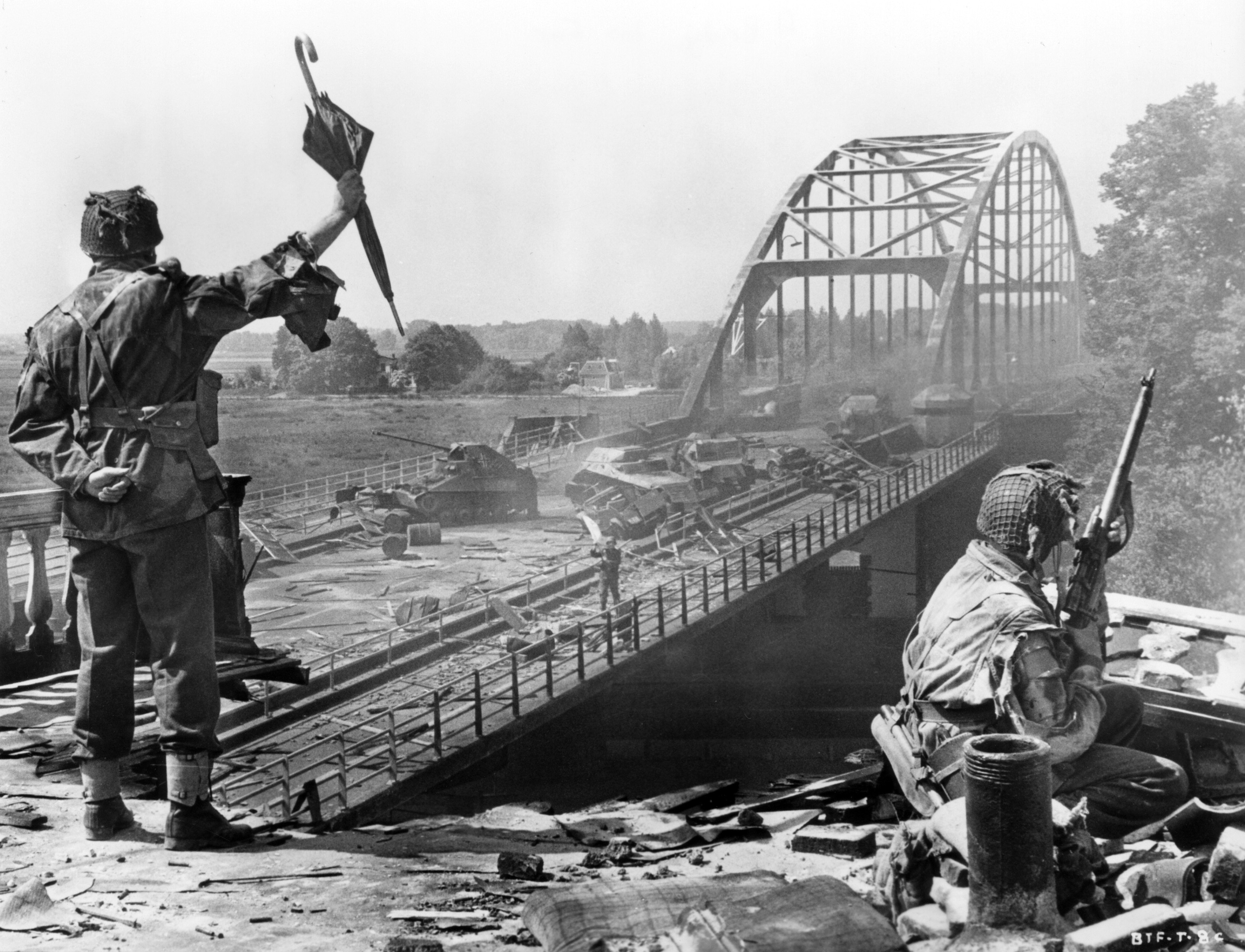
The unexpected failure of Operation Market-Garden, despite the courage of its Allied protagonists, is a reminder of the old maxim that “no plan of operation survives first contact with the enemy.” This photograph, showing a scene from the 1977 film, A Bridge Too Far, evokes real-life incidents of defiance and courage which occurred during the operation. (Michael Ochs Archives/Getty Images)

A spate of memoirs by British commanders and minor histories followed.

Then came the 1974 history, A Bridge Too Far by the Irish-American journalist, Cornelius Ryan. This book gave the US airborne their dues, while creating a stunning picture of heroism, sacrifice, and stupidity. A later reprint provided this writer’s introduction to the battle, as a teen.

Despite its depth, the book did not provide all the answers. Without detailed maps on the subject, following the complexity of the battles becomes difficult, especially the convoluted battle of Arnhem. For years (until recently, I confess), I failed to grasp what had really happened and where, during obtuse battles fought in esoteric places called Ginkel, Grave, Renkum, Beek, Wolfheze, Son, and Mook. 

Could these have also been the names of comic characters of another childhood? They might have been.

A 1977 film adaptation of Ryan’s book, made with a gamut of stars from Hollywood and Pinewood, reinforced some of the deficiencies of the book, including the myth that the operation failed because the 1st Airborne landed on two fully operational Waffen-SS armored divisions.

If Market-Garden has cemented itself in the public consciousness over the decades, it is because of its daring, and because of its humanistic objectives. Allied combat operations, especially in northwest Europe, were acts of liberation, fought to restore democracies and democratic institutions.2 At its essence, Market-Garden aspired to achieve this grand goal.

Cheering crowds greet British troops entering the Belgian capital, Brussels, on 4 September 1944. Wherever Allied troops went in western Europe, they were met by euphoric local populations effusing thanks for liberating them from the Nazis. No other campaigns or wars in human history have triggered such mass gratitude. (Imperial War Museum (IWM) BU483)

While the operation caused horror and tragedy, it also brought out the best in people. The heroism and sacrifice of its Allied protagonists triggered enduring gratitude from the Dutch. Surprisingly, it also elicited sentiments of honor, even decency from the Nazi combat cadre, the Waffen-SS — in spite of their moral decline which was nearly complete after five years of war and six years of nationalized racial indoctrination.

The operation’s failure, however, has caused it to be refought hundreds of times in books and films, fed by public curiosity.

Will I do some refighting of my own in the words that follow? A little. My larger objective was to use primary source statistical data (and select secondary sources) to recreate the battles through maps, infographics, and analysis. The intention is to offer a new and clear perspective of the operation.


  1. The Gamble
    1. Making the Case for Airborne Operations
  2. The Politics of Warriors
    1. Poor Air Support
    2. In-fighting among Air Commanders
  3. Stacked Dominoes
    1. German Battlegroups Form
  4. All Hell Breaks Loose
    1. The Statistical Data of Operation Market
    2. The Red Devils
    3. Controversial Plan for Arnhem
    4. Tip of the Spear
    5. Making for the Arnhem Bridge
      1. Rapid German Reaction
    6. Urquhart Missing
  5. Arnhem, the Alamo
    1. Destroying Gräbner
  6. The 8nd Airborne and a Narrow Run Thing
    1. Gavin, Golden boy
    2. Confused Orders
    3. Capturing the Grave and Canal bridges
    4. Erroneous information
    5. Distracting the Airborne
    6. Capturing the Nijmegen Bridge
    7. The Waal Crossing
    8. Jan van Hoof
    9. Rage against the Guards
  7. The US 101st Airborne’s Frontier War
    1. The 101st Airborne at Arnhem?
    2. Maximum Force
    3. The Germans Go After the Weak links
  8. Point of No Return
    1. Tanks come for the British
    2. Defiant to the End
    3. Sosabowski’s Choice
    4. Out with a Whimper
      1. Allied Casualties, 17 to 25 September 1944
    5. German Pyrrhic Victory
  9. Aftermath
    1. Lessons from a Historic Failure
    2. Guilt and Betrayal
  10. Footnotes
  11. Credits & Bibliography
    1. Major Sources

The Gamble

Against a defeated and demoralized enemy almost any reasonable risk is justified and the success attained by the victor will ordinarily be measured in the boldness, almost foolhardiness, of his movements – Dwight D Eisenhower

By the start of September 1944, the Allies found themselves nearly the masters of northwestern Europe. The tattered remnants of Germany’s primary battle force in the region, Army Group B, were in headlong retreat after their defeat in Normandy.

The Allies were in pursuit, sweeping through northern France. Paris fell on 25 August and the Allies approached Belgium. Up to early September, one-third of British General Bernard “Monty” Montgomery’s 21st Army Group3 were clearing German forces from ports along the English Channel while the rest pushed into Belgium.

But the Allied advance was congealing. The Anglo-Americans armies were outrunning their supply lines. Nearly every port recovered from the hands of the Germans was in ruins. This limited the amount of supplies that could be landed.

Many operational ports were also in or near Normandy, which was receding into the distance as the frontlines radiated out towards Germany. The British captured the valuable deep water port at Antwerp on 4 September. But the harbor was unusable because German troops held the approaches, along the Scheldt River estuary, and especially on Walcheren island.

Compounding the problem was growing German resistance.

Lieutenant General Brian Horrocks, the commander of the British Army’s XXX (30) Corps would later note (with hindsight), that the Germans were no longer in retreat by September 1944, and that Allied troops were fighting again. (Horrocks interview, World at War, “Pincers,” Episode 19)
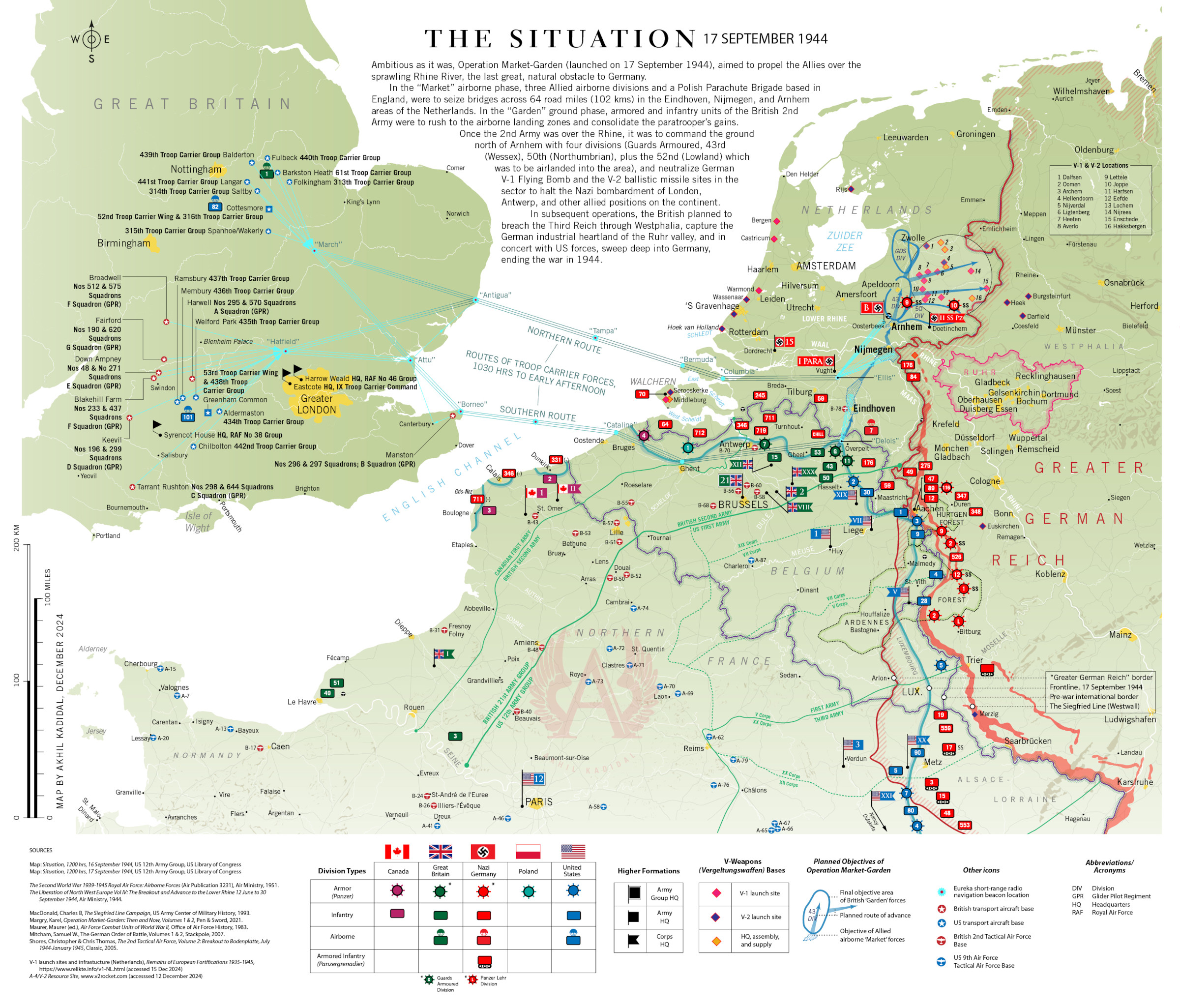
By September 1944, four Allied armies were poised along the border with Germany, trying to find a way in. Operation Market-Garden was to be their ticket in. On 17 September, three Allied airborne division took off from England and headed to the Netherlands. ©Akhil Kadidal
Continue reading “Out of the Blue: The Unraveling of Operation Market-Garden”

Normandy 1, Prelude to Battle

Not soon after the United States entered World War II and became a core member of the western Alliance, Washington began to consider ways to invade Nazi-occupied Europe, “Fortress Europa.” The pressure was especially high on the Franklin D Roosevelt administration to launch the invasion before the end of 1942.

But two years would pass before an invasion could be launched, with the delay in time being directly commensurate with the scale of the challenge.

Initially, the US military had few troops available to invade the continent. Only in mid-1942 was US Army Chief of Staff, General George C Marshal, able to initiate a buildup of US forces in Britain for the return to Europe. The buildup, codenamed Operation “Bolero” had the twin objective of allowing Marshal to assemble troops in England to justify Washington’s “Germany First” policy while simultaneously silencing the US Navy, which sought greater resources, troops and equipment for the Pacific Theater of Operations (PTO).

However, the British, especially Prime Minister Winston Churchill, were apprehensive about a cross-channel invasion in 1942 or even 1943 – a prospect made all the more uneasy by the disastrous Dieppe raid of August 1942.

The Dieppe action was an amphibious operation by commandos that was to be a testbed case for a cross-channel assault and prove to the Russians and Josef Stalin that the western alliance was serious about eventually launching a second front in Europe. (Carlo d’Este, Decision in Normandy, Chapter 2, Section 13, Para 29). Unfortunately, the landing in northwestern France, led to most of the Allied landing forces being killed or captured.

That failure strained the Anglo-American alliance as the Americans were then forced to contribute troops and resources to what they considered as “sideshow operations” in the Mediterranean Theater that were so dear to Churchill’s heart. American involvement in the Mediterranean was also driven by the US army’s comparative combat inexperience in 1942 (when compared to Great Britain), which meant that the United States had to follow England’s lead, and so the US found itself engaged in various landings and campaigns — in Algeria, in Tunisia, in Sicily and finally in mainland Italy.

US resentment was growing, fueled by suspicion that Americans were fighting and dying in campaigns for the benefit of Britain which planned to re-establish its Mediterranean empire after the war. From the British perspective, the Mediterranean campaign was to remind the world that England was not yet out of the war and capable of hitting back at the Third Reich.

Continue reading “Normandy 1, Prelude to Battle”

Masters of the Air: The Historical Context

Since the finale of the WWII TV show “Masters of the Air” aired weeks ago, hundreds of media articles have emerged, talking about the “true stories” behind the show. Most are incomplete, repetitive. The following piece will try to provide a historical context to the events portrayed in the show, accompanied by the usual raft of custom infographics.

Please be advised that the following contains spoilers.


Some of the greatest war stories ever told are of units on the brink of destruction and among them, in the European theater of war in World War II, is the tale of the American 100th Bomb Group. The group’s story is now the subject of a new TV drama produced by Steven Spielberg and Tom Hanks as a follow-on to their critically acclaimed Band of Brothers (1998) and The Pacific (2010), in what could be the final salvo of their World War II trilogy.

Assembled stateside in June 1942 and shipped out to England in February 1943, the 100th Bomb Group was part of a massive military experiment: the first daylight strategic bombing campaign of an adversary.

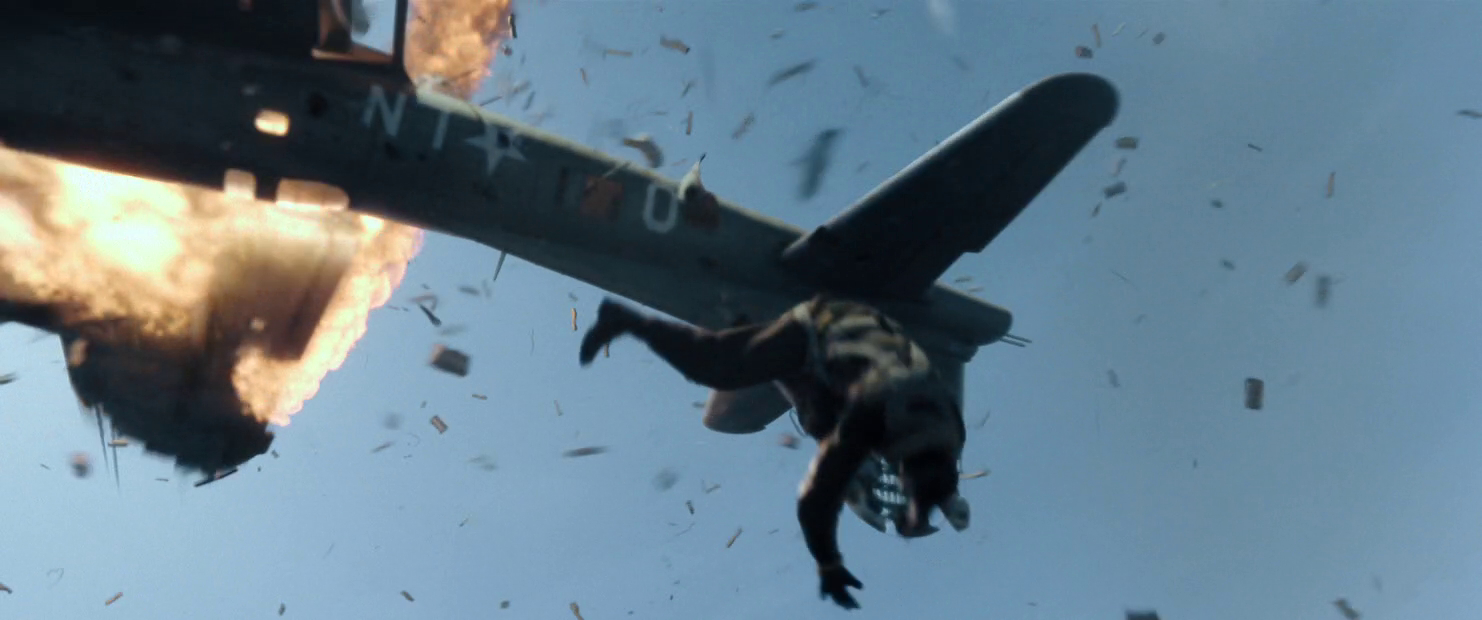
The unforgiving air war. (Masters of the Air)

This placed it dead center in an unforgiving war fought at 25,000 feet, at temperatures of -50 Fahrenheit against a Nazi foe with some of the finest technology and combat veterans that could be mustered. The Nazis had declared “Total War” (Der Totale Krieg) in February 1943, a state of being meant to achieve victory in the war in the shortest time space by enhancing home front activities and combat operations. Facing such an enemy, the 100th, as an ill-disciplined unit with cavalier officers, became ill-fated and subject to such bloodletting that it became known as “The Bloody Hundredth.”

Masters of the Air (2024), supposedly based on the Donald L Miller history of the same name, tries to be a soaring finale to the Spielbergian view of the American WWII experience, the “good war”: decency versus barbarism, can-do initiative versus clumsy totalitarianism. 

Origins

The 100th was a core member of the England-based American 8th Air Force (the “Mighty Eighth”) which tried to blast the German war machine off the face of the map. The Eighth’s “ships,” as the men called their Boeing B-17 heavy bombers, represented a view of American masculinity: strong, rugged, resplendent with gleaming Plexiglas, bristling with guns, an extension of the old west, and decorated with all manner of squadron heraldry and artwork, primarily Disney cartoon characters or gaudy pinup girls. In fact, the rule of thumb appeared to be: the gaudier the art, the better. 

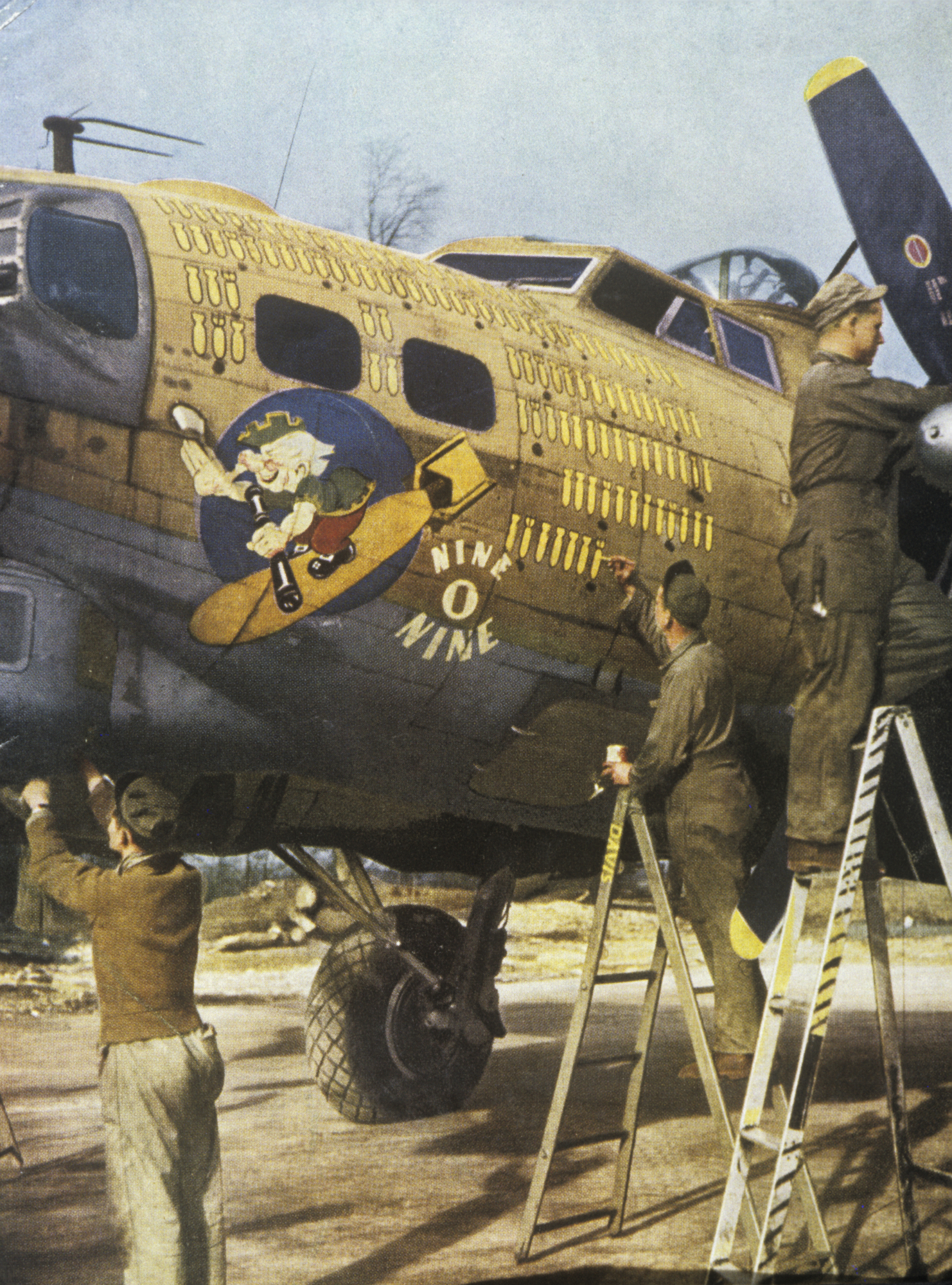
Men of the 91st Bomb Group paint a relatively tame nose art on a B-17 Flying Fortress nicknamed “Nine-O-Nine” at Bassingbourn in 1944. Nose art formed a vital component of the aircrews’ esprit d’corps. (Imperial War Museum)

Some men called their machines, “flying porcupines,” but the US Army Air Force (USAAF) preferred the name, “The Flying Fortress.” The B-17’s raiding partner was the Consolidated B-24 Liberator which gets zero screen time in the TV series.

Across B-17 and B-24 bases, the “ops” always began the same: a fleet of jeeps racing towards planes assigned on the mission, men with anxious faces and shouting voices. A green flare launched from the control tower indicating to men in the cigar-shaped hulks that the moment had come. They were to return once again to the lion’s den where some had gone before and had never lived to tell the tale.

In the spring of 1943, when the 100th appeared on the scene, 8th Air Force was a neophytic army, the US Army Air Force’s (USAAF’s) newest progeny. Its inception on 1 February 1942 had come with a twin caveat: sustain the primary American air effort against Nazi Germany and validate the controversial pre-war concept of strategic bombing.

The Eighth’s leading elements arrived in England shortly after – a scant two months after the Japanese attack on Pearl Harbor.

In comparison to tactical air power, tested on the battlefields of France in the latter part of World War I, strategic air warfare was a new idea. As US historians put it: “Strategic bombing bears the same relationship to tactical bombing as a cow does to the pail of milk. To deny immediate aid and comfort to the enemy, tactical considerations dictate upsetting the bucket. To ensure eventual starvation, the strategic move is to kill the cow.”

The 8th Air Force’s singular objective was to incapacitate Germany by air before the first American troops set foot on occupied Europe. This, it did not achieve, but without the Eighth’s presence, Allied victory over Nazi Germany would have been more costly and less assured. The Eighth’s war was spread across an unprecedented and bloody 39 months, battle-torn and replete with massive losses. The Eighth suffered more deaths than the entire US Marine Corps (USMC) did during the Pacific campaign, Miller writes.

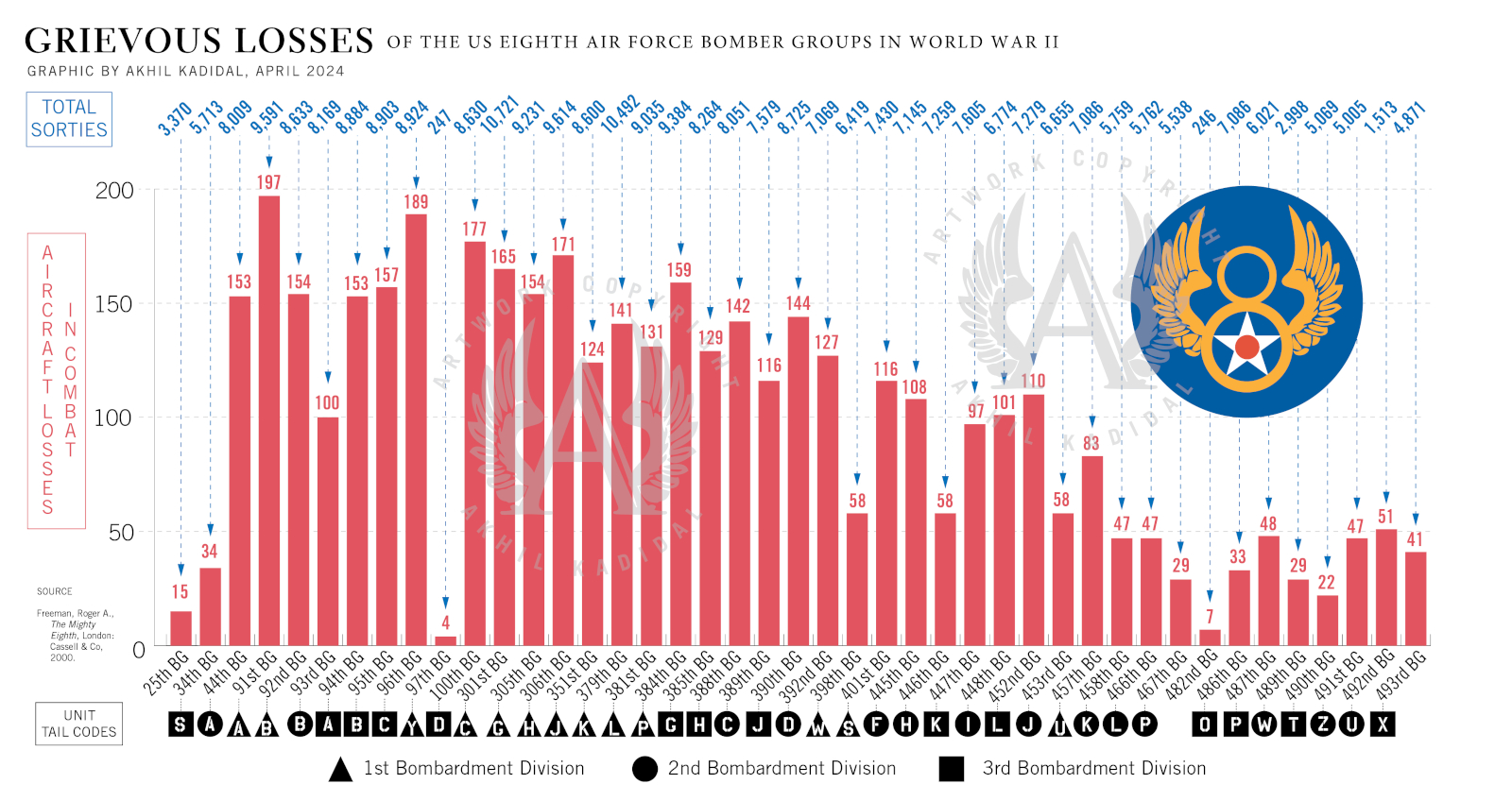
The statistics are sobering. The Eighth lost at least 6,333 aircraft of all kinds in combat during the war, 26,000 men killed in action, 18,000 men wounded and 28,000 men captured. The 100th Bomb Group alone lost 177 bombers in combat and suffered 1,756 casualties. (See Roger Freeman’s 8th Air Force War Diary, Eighth Air Force History & Statistical summary of Eighth Air Force operations European theater, 17 Aug. 1942 – 8 May 1945, HQ Eighth Air Force, June 1945) The USMC’s total fatalities in World War II were between 19,733 and 24,511 personnel. (USMC University/National WWII Museum

This chart shows how many aircraft in each bomber group in the 8th Air Force were lost in combat during the war. The loss of a bomber also meant the loss of the 10-man crew onboard, although sometimes, fortunate crew members evaded capture and returned to England. (Akhil Kadidal)
Continue reading “Masters of the Air: The Historical Context”

No Retreat: The Battle of Lanzerath 1944

How this research began…

I do not consider myself an expert on the “Battle of the Bulge.” The battle is dense and eventful. But I thought I knew enough about the Ardennes offensive to elevate me above the rank of battle hound. Then I read Alex Kershaw’s “The Longest Winter” and discovered the actions of the Intelligence & Reconnaissance Platoon of the 394th Infantry. As with some of my work, this post is centered around a map of the engagement. During the course of the research, I discovered that two of the GIs (PFC Bill James of White Plains (NY) and PFC Risto Milosevich of Los Angeles (CA) were students of my alma mater, Tarleton State (Texas A&M).


Lanzerath, 16 December 1944. The initial situation

A shortage of manpower in the US military at the twilight of World War II forced the army to transfer some of its best and brightest college-educated draftees who were training to become technical experts and officers to frontline units in 1944 as enlisted personnel. 

As members of the US Army Specialized Training Program (ASTP), the draftees were to be employed as high-grade technicians and specialists. However, on 1 April 1944, many were reassigned to infantry, airborne, or armored units. Eighteen such men found themselves in a so-called Intelligence and Reconnaissance (I&R) Platoon of the US 394th Infantry Regiment in the European Theater of Operations, in the winter of 1944. 

Isolated, in a forward position in eastern Belgium, amid snowy, near sub-zero conditions , the platoon found itself snarled in a maelstrom of combat during the opening blows of what would become known as the “Battle of the Bulge.”


Isolated Location

The 394th Infantry Regiment’s I&R Platoon had been posted to an unremarkable hilltop overlooking the Ardennes village of Lanzerath, a few thousand yards from the German frontier on 10 December 1944. Like in the rest of the Ardennes Forest, the platoon’s deployment was regarded as being in a “quiet sector” with scant presence of the hostile German military.

The core role of I&R Platoons in the US Army was to gather detailed information about enemy forces and the terrain in locations that US Arm rifle companies and battalions could not easily access. But in being posted to Lanzerath, the 394th’s I&R Platoon was also expected to fulfill another, more critical role: plugging a gap in the US lines.

The platoon’s parent unit, the US 99th Infantry Division, was a rookie to the wilds of the western European campaign. Known later as the “Battle Babies”, the division arrived on the continent on 6 November 1944, having missed the Normandy campaign and the subsequent Allied breakout across France. Posted to the Ardennes, the division’s inexperience was exacerbated by the fact that it was forced to string its three infantry regiments (393rd, 394th and 395th) out across a 25-mile front, along forest-covered hills.

US army doctrine stipulated that a infantry battalion could cover 800 yards of a frontline. But the 99th’s nine infantry battalions were each covering between 830-1,000 yards. This made it near impossible for US patrols to cover the gaps.

By 14 November, all of the 99th’s battalions and companies were on the frontline barring the 3d Battalion of the 394th Infantry, which was held in a divisional reserve near the boundary with US V and VIII Corps, near the so-called “Losheim gap”, a particularly thinly held part of the frontline.

With only two battalions under his command, Colonel Don Riley of the 394th Infantry Regiment, tried to plug potential holes in his perimeter with small units. One worry was the village of Lanzerath which commanded a road leading westwards, deeper into American lines. The village was the responsibility of the neighboring US Army units such as VIII Corps and the US 14th Cavalry Group. 

However, the 394th Infantry lacked combat troops to occupy the village in force and so Riley employed the I&R platoon to provide advanced warning of a German advance or attack in the area. In command of the 394th’s I&R Platoon was First Lieutenant Lyle Bouck Jr, just 20 years old but not an ASTPer. Instead, he was a pre-war army volunteer who had risen through the ranks to become an officer.

“Our I&R Platoon was ‘temporarily’ moved into the resulting gap with orders to investigate and report any observed enemy activity,” a former platoon member, Private G Vernon Leopold, told US Congress in 1981.

The platoon’s location at Lanzerath occupied a veritable no-man’s land between two US Army Corps. 

Lanzerath itself was unremarkable, having fewer than ten houses with wooden framework construction that could not withstand enemy fire. However, the village was situated about 300 yards south of a key road junction that connected Buchholz Station to the town of Losheimergraben. Northwest of Losheimergraben lay a major road network which would become a primary route of advance for the German Sixth Panzer Armee (Tank Army) during Operation “Wacht am Rhein” (The Watch on the Rhine) which would go down in the annals of history as the “Battle of the Bulge.”

The Sixth Panzer Armee was under an old veteran, SS Oberst-Gruppenfuhrer (General) Josef ” Sepp” Dietrich who intended to use the road network to reach the Belgian city of Liége.

As night fell on western Europe on 15 December, neither Lt. Bouck nor his men suspected that they had an engagement with history in the morning.

One of the 105,000 ASTP trainees to be reassigned to combat divisions was the postwar giant of postmodernism, Kurt Vonnegut, who was assigned to the doomed 106th Infantry Division. Like the men of the I&R Platoon in the 394th Regiment, Vonnegut was also an I&R member, of the 423rd Regiment.

Mapping Normandy: A Brief History of the Campaign

This page provides a brief history of the Normandy campaign through 19 maps. A viewing of the old film The Longest Day at the age of 12 or 13 first stoked my interest in the campaign. The battle for Normandy, in my febrile mind, represented a classic struggle of good versus evil, broadly speaking anyway. But if I grew up suitably enlivened to contribute something to the collective body of work on the campaign, it was tempered by the realization that most of what can be said has already been written or depicted.

Where the historical treatment of Normandy has lagged, however, is in maps. It is difficult to build a sense of location and understand the physical implications of strategic maneuvers without compelling maps. The history of Normandy is replete with insufficient maps. I wanted to try to address that.

The maps below were created in 2018, over the course of six or seven months. They represent my first serious effort at complex mapmaking. The project was also, to a degree, about self-education.

An Overall look at Operation Neptune


The prospect of returning militarily to France aroused feelings of anxiety within British Prime Minister Winston Churchill, haunted as he was by the specter of another Allied defeat in France followed by a Dunkirk-like evacuation of the survivors. For years, he had postponed a cross-channel invasion of western France by cajoling and manipulating his American allies into military expeditions in the Mediterranean. He had assured Washington DC that a strike through the soft underbelly of Italy could pierce Nazi Germany. By 1943, however, the United States was convinced that the Third Reich could only be defeated through a direct assault on Hitler’s “Atlantic Wall”, an incomplete line of coastal fortifications which threaded from southwestern France to Norway.

Allied planners, however, knew that coastal defenses, no matter how dense, offered little impediment to an amphibious assault. An Allied plan began to coalesce. Twelve Allied divisions (roughly 156,000 men) were nominated to pummel their way into German-occupied Normandy and hew an iron beachhead from which Allied troops could range deeper into Nazi-occupied Europe.

The invasion, D-Day, was launched on 6 June 1944.

Churchill spent much of 5/6 June in a state of angst, fearing that the invasion, codenamed Operation Neptune would fail, dealing the western alliance a critical setback that force them to marshal manpower for another invasion in late 1945 or 1946 — by which time Hitler could have used his western reserves to smash the Soviets on the eastern front.

Yet, the bulk of Germany’s forces along the Norman coast were tired, rear-echelon units with substandard equipment. The most combat-effective division in the area was the 12,734-strong German 352nd Infantry Division, which had almost no combat experience (50% of its officers were green while the rank and file was largely made up of teenagers from the Hannover area). Only the presence of a hardened cadre of veterans from the Eastern Front peaked the division’s fighting prowess to acceptable levels. Many of the infantry and static divisions in the area were inferior, with the exception of the 709th Infantry Division under the experienced Lt. General Karl-Wilhelm von Schlieben, also a veteran of the Russian front.

Von Schlieben’s command, however, was less than stellar, being largely composed of men regarded as unsuitable for frontline service. The average age of a soldier in the 709th was 36 and their training had been minimal. Russian defectors padded out the infantry even though their combat effectiveness was questionable. The unit’s left flank, however, was bolstered by the German 91st Airlanding Division. Although green, the 91st Division was motivated and willing to fight.

The Allied armada, which left England on June 5, would take 17 hours to cross the English Channel while Allied paratroopers flew out after dusk to secure the flanks of the invasion zone, west of the Norman capital Caen and on the Cotentin peninsula, in order to stem the flow of German reinforcements into the beachhead assault zone.

At midnight, 13,348 Allied paratroopers began to descend onto Normandy, confusing German high command and infusing chaos among scattered German garrisons. Just after dawn, at 6 am, the Allied invasion fleet hove into sight off the Norman coast.


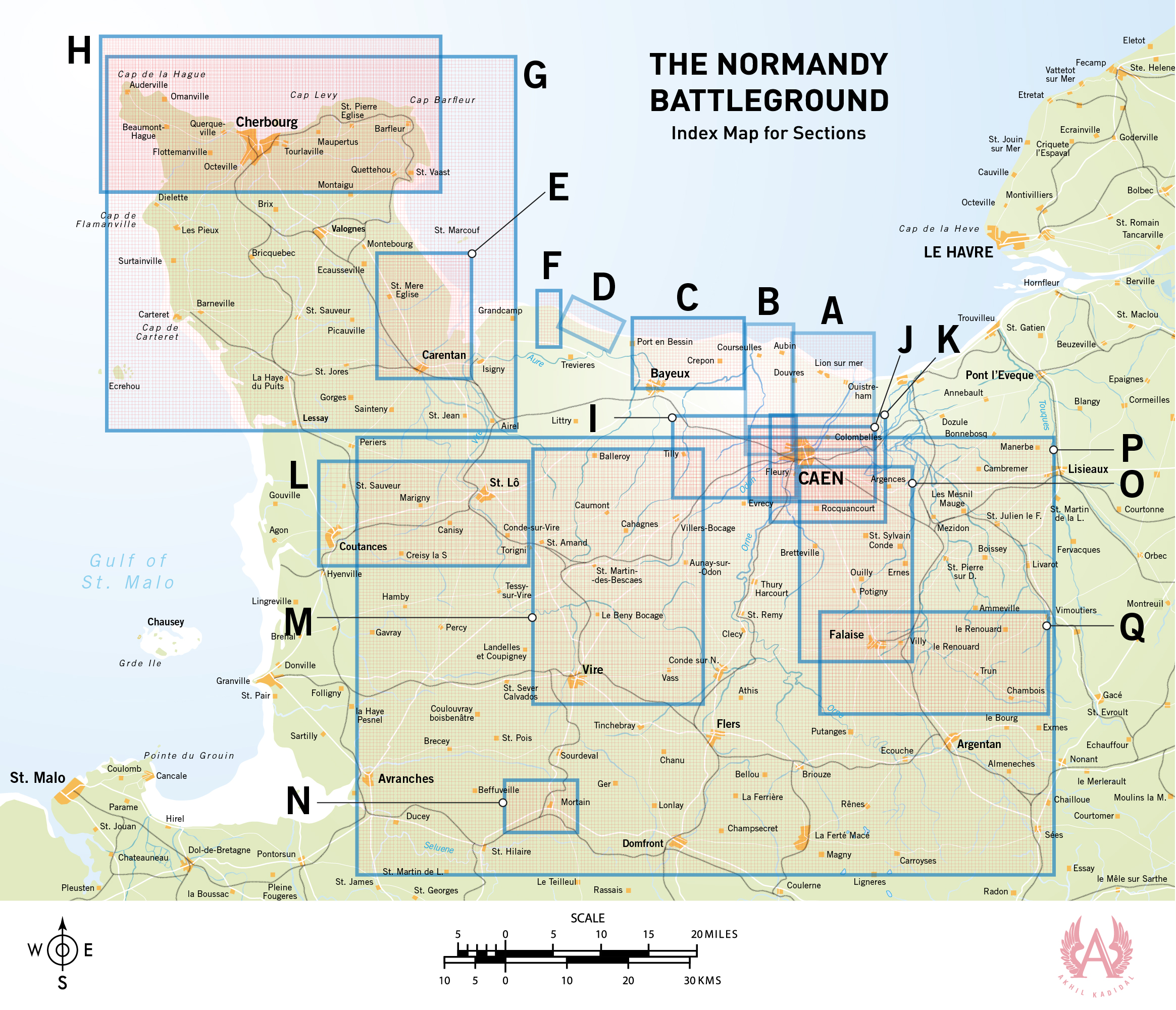
Sword Juno Gold Omaha Pointe-du-Hoc Utah Cotentin Cherbourg Epsom Charnwood Goodwood Cobra Bluecoat Mortain Totalize Falaise1 Falaise2

A. Sword Beach
B. Juno Beach
C. Gold Beach
D. Omaha Beach
E. Utah Beach
F. Pointe-du-Hoc
G. Advancing through the Cotentin Peninsula
H. Capturing Cherbourg
I. The British break the back of the German SS
J. The Allies capture half of Caen
K. A British Schwerpunkt Meets its Match
L. An American Cobra in Normandy
M. Operation Bluecoat
N. The Mortain Counterattack
O. The Big Push (Towards Falaise)
P. The Falaise Pocket
Q. Closing the Falaise Pocket


A | Sword Beach

I was an anglophile in my childhood and the actions of the British Army in the 20th century were an endless source of fascination. Great Britain and her military were exotic, replete with alluring organizational structures, practices, decorum, and traditions.

It was therefore predictable that my early interest in the Battle of Normandy hinged on the actions of the British Army, especially in the “Sword Beach” sector.

A crucially important sector, troops hitting “Sword Beach” were meant to roll up into the Norman capital, Caen (population 54,000 in 1944), whose great road hub would have facilitated an easy advance deep into Nazi-occupied France and to Paris, 149 miles away.

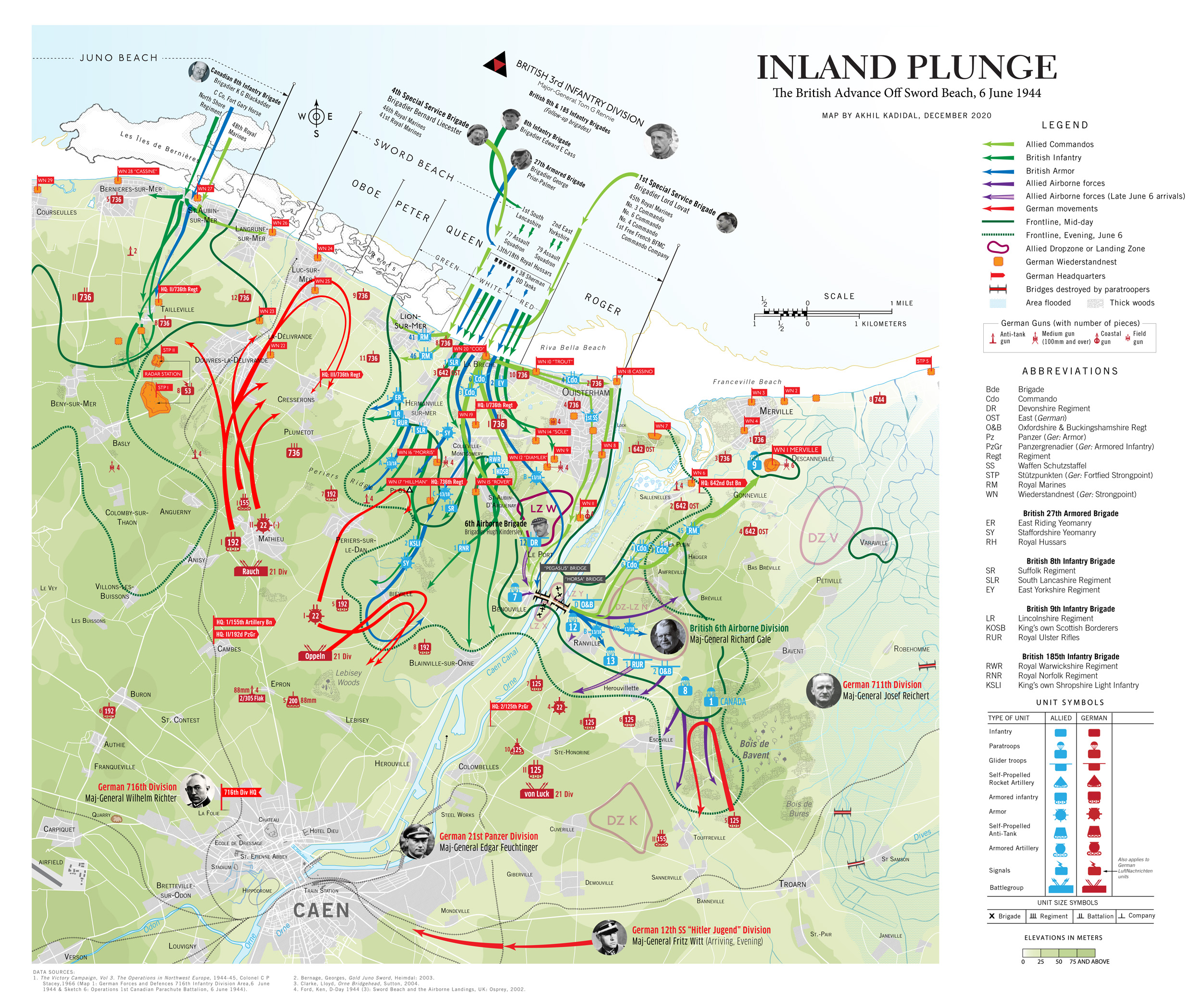
The unit handed the task was the British 3rd Infantry Division, the oldest command unit in the British Army with exploits ranging back to the Battle of Waterloo in the 19th Century. Bolstered by 4,000 commandos, plus an independent armored brigade with 212 tanks and the paratroopers of the 6th Airborne Division on their right flank, the 3rd Infantry Division pushed towards Caen on the morning of June 6, sweeping aside German resistance. Then, at midday, the sole German armored division in the area, the 21st Panzer, placed itself between the British and the city.

The 21st Panzer, once a fabled stalwart of the North African war two years ago was now a toothless tiger, replete with misfits and recruits — although 2,000 original members, having been hospitalized for wounds in North Africa, had returned to strengthen its ranks. Evidence of the 21st Panzer’s diminished standing was manifest by the fact that it had, until recently, been equipped with old, obsolete French tanks captured in 1940. By D-Day, it had been outfitted with the Panzer IV, a medium battle tank that was an even match for the Allied Sherman.

The German divisional commander, Major General Edgar Feuchtinger, behaved as though the running of his division was something of a chore, if not punishment. He spent more time lavishing attention on his mistress in Paris, than on working to get his division to full operational status.

In fact, Feuchtinger was once again philandering in Paris when the Allied invasion materialized, enraging his superior, Lt. General Hans Speidel, the Chief of Staff of Army Group B. As a chastened Feuchtinger raced back to Normandy on the afternoon of the 6th, the division activated itself and sent out patrols.

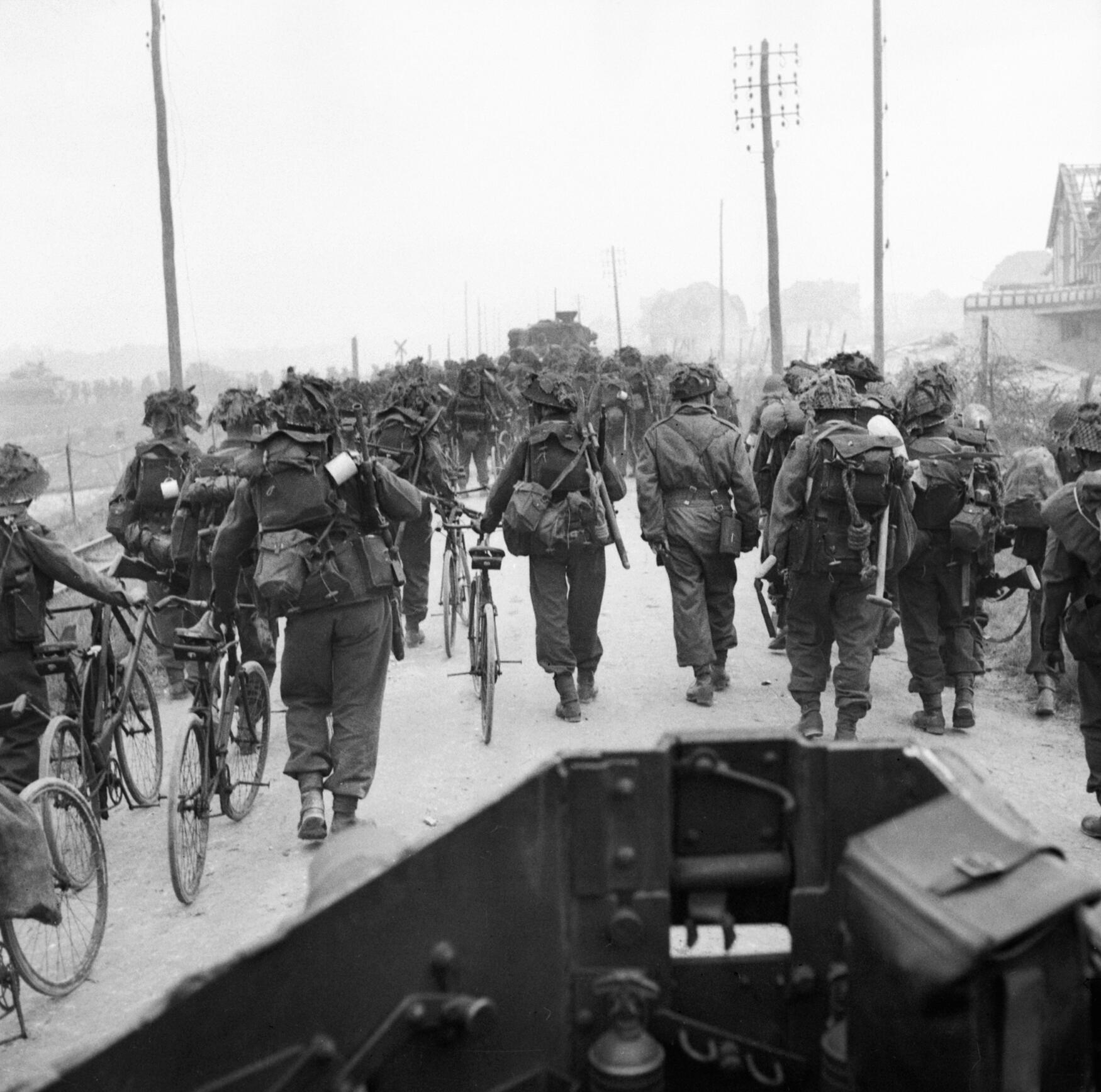
British tanks and Infantry streaming towards Caen began taking heavy fire as they reached the Periers Ridge, a stretch of high ground before the villages of Periers-sur-le-Dan and Bieville. Instead of smashing through, the infantry of the British 1st South Lancashire Regiment and the Shermans of the 13/18th Royal Hussars dug in. Aside from a smattering of German infantry and strung-out screens of antitank guns, there was virtually nothing between them and the city. They could have well been in Caen by mid-afternoon. But the commander of the British 8th Infantry Brigade, Brigadier Edward Cass, preferring to wait for reinforcements. It would prove a fateful decision.

Troops from the British 3rd Infantry Division press on towards Caen on D-Day. (IWM)

Meantime, senior German officers were scrambling to deploy their armored reserves scattered around central and southern France.

At 9 am, nearly two hours after the beach landings, Field Marshal Gerd von Rundstedt, the head of OberKommando West, attempted to rush the 12th SS (Hitler-Jugend) Panzer Division and the elite Panzer Lehr Division into the invasion zone. He was stalled by Field Marshal Alfred Jodl, the German Chief of Operations Staff in Berlin, who argued that only Hitler had the authority to move these units. But Hitler, a habitual late riser, was still asleep and would not awake before noon. When he did, he flew into a rage at the news of the Allied invasion. By when the armored units finally began to move, it was 4 pm.

By this time, British thrusts towards Caen and Lion sur-Mer had stalled, prompting them to give up on their plan to link up with Canadian troops fighting in the neighboring “Juno Beach” sector. Rushing through this gap, tanks and infantry of the 21st Panzer reached the coast intact.

“The future of Germany may very well rest on your shoulders,” a senior officer had told their commander, Colonel von Oppeln-Bronikowski. “If you don’t push the British back, we’ve lost the war.”

But the 21st Panzer would find it difficult, if not impossible, to prevail. At 6 pm, von Oppeln-Bronikowski’s men were horrified to see a swarm of Allied transport aircraft tugging gliders headed in their direction at 6 pm. Afraid that his unit would be cut-off by gliders landing all around them, Oppeln-Bronikowski called a retreat. Caen, however, would remain in German hands for the next five weeks, becoming a thorn in the Allied side and costing the lives of thousands of troops.

The above map was arduous to make, in that it took nearly 10 hours to produce. Instead of separating the various component actions of June 6 into three entities — the airborne landings, the main beach assault and the push inland and the German counterattack — I sought to encompass every aspect of the eastern British sector into a single map. However, in comparison to my map of “Utah” Beach which can be found further below, this map was also frustrating to create because of a paucity of information.

For example, I did not have the luxury of detailed information about the drop patterns of British airborne units from official British sources — unlike the US military which liberally proffers information about the activities of the 82d and 101st Airborne Divisions on Normandy’s Cotentin Peninsula.

Movements of land forces were established through careful research and by consulting several books on Normandy, specifically Georges Bernage’s Gold Juno Sword (2007).

Continue reading “Mapping Normandy: A Brief History of the Campaign”