Out of the Blue: The Unraveling of Operation Market-Garden

Warfare is a product of the worst of human excesses and in World War II, Operation Market-Garden was almost no different, if not for its nobility of purpose, and civility in battle. The British-US operation was an ambitious effort to hasten the end of the war by the Christmas of 1944. Instead, it went so wrong that eight decades later historians are still trying to understand what failed and why.

Conducted in the last autumn of the war, the operation aspired to propel the Allies through the eastern Netherlands and over the sprawling Rhine River (the last, great natural obstacle to Germany). From there, the Allies had a spring-board from which they could strike into Germany and attack its capital, Berlin. That dream collapsed around the destruction of the elite British 1st Airborne Division at the Dutch city of Arnhem.

That failure, occurring at the height of Allied military fortunes in the war, provided a stunning reminder of the old von Moltke1 maxim that, “no plan of operation survives first contact with the enemy” – Especially, a hastily developed plan that assumed that the Nazis were already beaten.

Market-Garden became better known to the general public in the postwar period. In 1946, a British film, Theirs is the Glory, filmed with 1st Airborne Division veterans in the ruins of the actual battlefield, opened to public acclaim. However, the film did little to dispel the public’s misconception that only the British Army was involved in a struggle which in reality, had also cost two US airborne divisions dearly. 
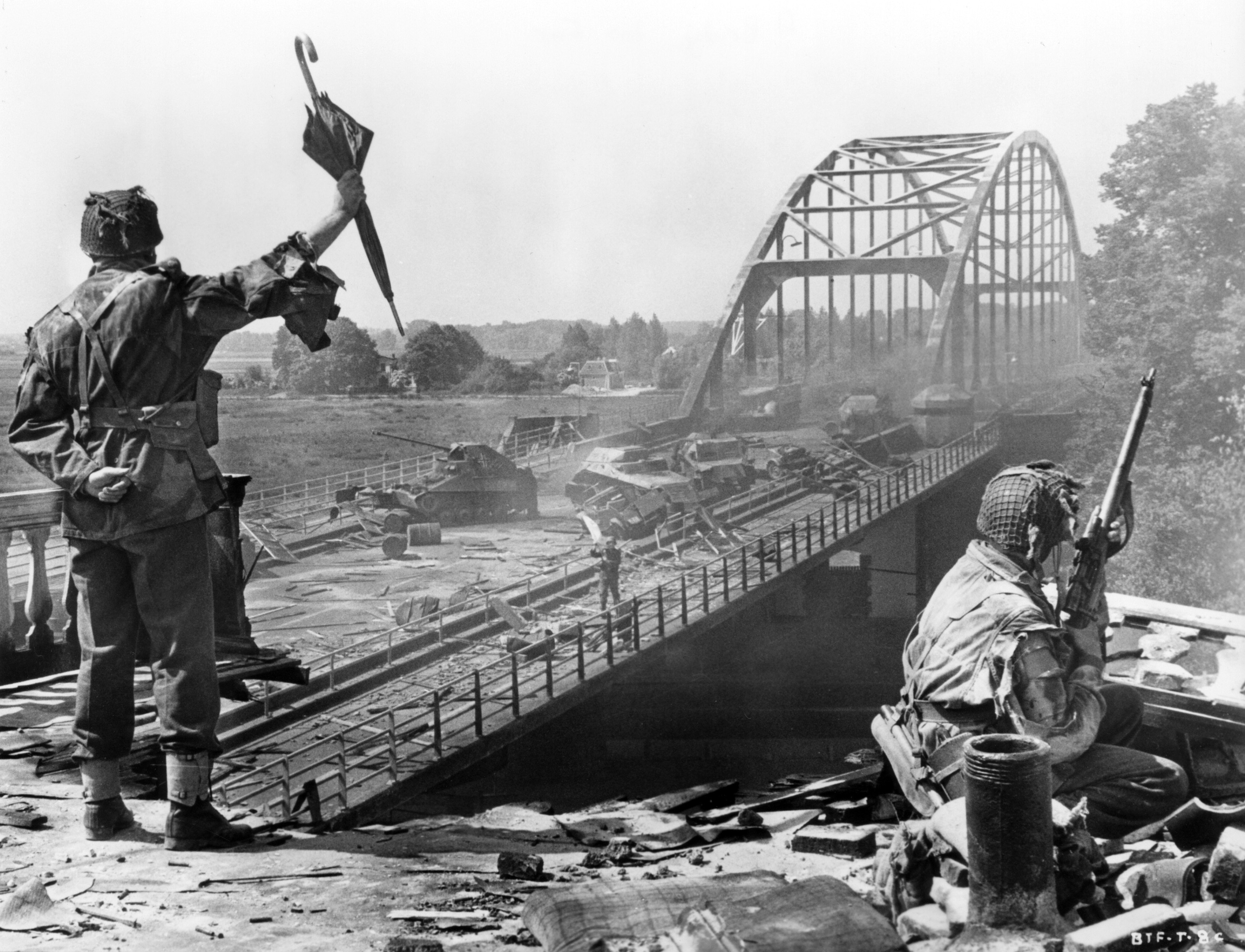
The unexpected failure of Operation Market-Garden, despite the courage of its Allied protagonists, is a reminder of the old maxim that “no plan of operation survives first contact with the enemy.” This photograph, showing a scene from the 1977 film, A Bridge Too Far, evokes real-life incidents of defiance and courage which occurred during the operation. (Michael Ochs Archives/Getty Images)

A spate of memoirs by British commanders and minor histories followed.

Then came the 1974 history, A Bridge Too Far by the Irish-American journalist, Cornelius Ryan. This book gave the US airborne their dues, while creating a stunning picture of heroism, sacrifice, and stupidity. A later reprint provided this writer’s introduction to the battle, as a teen.

Despite its depth, the book did not provide all the answers. Without detailed maps on the subject, following the complexity of the battles becomes difficult, especially the convoluted battle of Arnhem. For years (until recently, I confess), I failed to grasp what had really happened and where, during obtuse battles fought in esoteric places called Ginkel, Grave, Renkum, Beek, Wolfheze, Son, and Mook. 

Could these have also been the names of comic characters of another childhood? They might have been.

A 1977 film adaptation of Ryan’s book, made with a gamut of stars from Hollywood and Pinewood, reinforced some of the deficiencies of the book, including the myth that the operation failed because the 1st Airborne landed on two fully operational Waffen-SS armored divisions.

If Market-Garden has cemented itself in the public consciousness over the decades, it is because of its daring, and because of its humanistic objectives. Allied combat operations, especially in northwest Europe, were acts of liberation, fought to restore democracies and democratic institutions.2 At its essence, Market-Garden aspired to achieve this grand goal.

Cheering crowds greet British troops entering the Belgian capital, Brussels, on 4 September 1944. Wherever Allied troops went in western Europe, they were met by euphoric local populations effusing thanks for liberating them from the Nazis. No other campaigns or wars in human history have triggered such mass gratitude. (Imperial War Museum (IWM) BU483)

While the operation caused horror and tragedy, it also brought out the best in people. The heroism and sacrifice of its Allied protagonists triggered enduring gratitude from the Dutch. Surprisingly, it also elicited sentiments of honor, even decency from the Nazi combat cadre, the Waffen-SS — in spite of their moral decline which was nearly complete after five years of war and six years of nationalized racial indoctrination.

The operation’s failure, however, has caused it to be refought hundreds of times in books and films, fed by public curiosity.

Will I do some refighting of my own in the words that follow? A little. My larger objective was to use primary source statistical data (and select secondary sources) to recreate the battles through maps, infographics, and analysis. The intention is to offer a new and clear perspective of the operation.


  1. The Gamble
    1. Making the Case for Airborne Operations
  2. The Politics of Warriors
    1. Poor Air Support
    2. In-fighting among Air Commanders
  3. Stacked Dominoes
    1. German Battlegroups Form
  4. All Hell Breaks Loose
    1. The Statistical Data of Operation Market
    2. The Red Devils
    3. Controversial Plan for Arnhem
    4. Tip of the Spear
    5. Making for the Arnhem Bridge
      1. Rapid German Reaction
    6. Urquhart Missing
  5. Arnhem, the Alamo
    1. Destroying Gräbner
  6. The 8nd Airborne and a Narrow Run Thing
    1. Gavin, Golden boy
    2. Confused Orders
    3. Capturing the Grave and Canal bridges
    4. Erroneous information
    5. Distracting the Airborne
    6. Capturing the Nijmegen Bridge
    7. The Waal Crossing
    8. Jan van Hoof
    9. Rage against the Guards
  7. The US 101st Airborne’s Frontier War
    1. The 101st Airborne at Arnhem?
    2. Maximum Force
    3. The Germans Go After the Weak links
  8. Point of No Return
    1. Tanks come for the British
    2. Defiant to the End
    3. Sosabowski’s Choice
    4. Out with a Whimper
      1. Allied Casualties, 17 to 25 September 1944
    5. German Pyrrhic Victory
  9. Aftermath
    1. Lessons from a Historic Failure
    2. Guilt and Betrayal
  10. Footnotes
  11. Credits & Bibliography
    1. Major Sources

The Gamble

Against a defeated and demoralized enemy almost any reasonable risk is justified and the success attained by the victor will ordinarily be measured in the boldness, almost foolhardiness, of his movements – Dwight D Eisenhower

By the start of September 1944, the Allies found themselves nearly the masters of northwestern Europe. The tattered remnants of Germany’s primary battle force in the region, Army Group B, were in headlong retreat after their defeat in Normandy.

The Allies were in pursuit, sweeping through northern France. Paris fell on 25 August and the Allies approached Belgium. Up to early September, one-third of British General Bernard “Monty” Montgomery’s 21st Army Group3 were clearing German forces from ports along the English Channel while the rest pushed into Belgium.

But the Allied advance was congealing. The Anglo-Americans armies were outrunning their supply lines. Nearly every port recovered from the hands of the Germans was in ruins. This limited the amount of supplies that could be landed.

Many operational ports were also in or near Normandy, which was receding into the distance as the frontlines radiated out towards Germany. The British captured the valuable deep water port at Antwerp on 4 September. But the harbor was unusable because German troops held the approaches, along the Scheldt River estuary, and especially on Walcheren island.

Compounding the problem was growing German resistance.

Lieutenant General Brian Horrocks, the commander of the British Army’s XXX (30) Corps would later note (with hindsight), that the Germans were no longer in retreat by September 1944, and that Allied troops were fighting again. (Horrocks interview, World at War, “Pincers,” Episode 19)
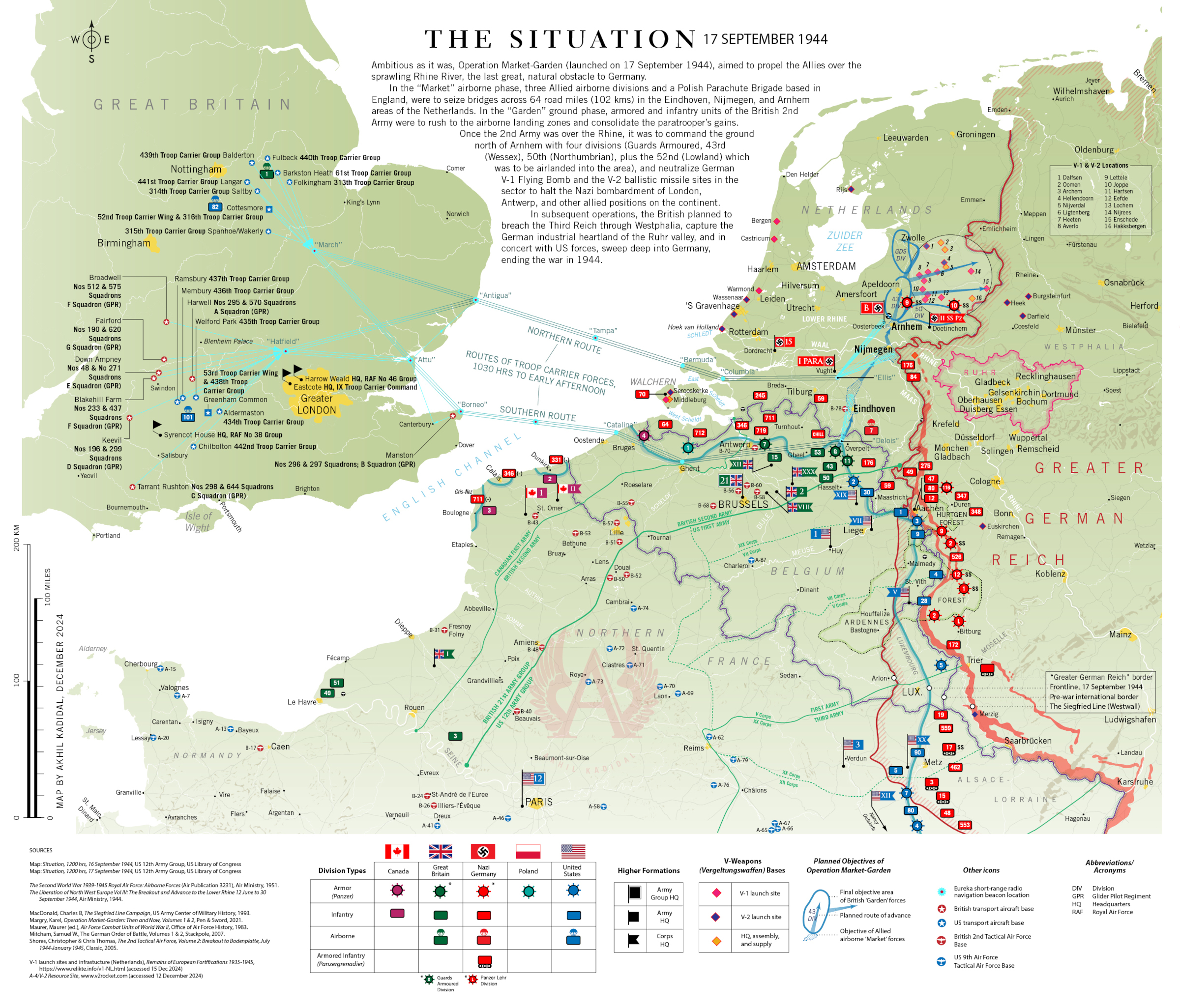
By September 1944, four Allied armies were poised along the border with Germany, trying to find a way in. Operation Market-Garden was to be their ticket in. On 17 September, three Allied airborne division took off from England and headed to the Netherlands. ©Akhil Kadidal
Continue reading “Out of the Blue: The Unraveling of Operation Market-Garden”

No Retreat: The Battle of Lanzerath 1944

How this research began…

I do not consider myself an expert on the “Battle of the Bulge.” The battle is dense and eventful. But I thought I knew enough about the Ardennes offensive to elevate me above the rank of battle hound. Then I read Alex Kershaw’s “The Longest Winter” and discovered the actions of the Intelligence & Reconnaissance Platoon of the 394th Infantry. As with some of my work, this post is centered around a map of the engagement. During the course of the research, I discovered that two of the GIs (PFC Bill James of White Plains (NY) and PFC Risto Milosevich of Los Angeles (CA) were students of my alma mater, Tarleton State (Texas A&M).


Lanzerath, 16 December 1944. The initial situation

A shortage of manpower in the US military at the twilight of World War II forced the army to transfer some of its best and brightest college-educated draftees who were training to become technical experts and officers to frontline units in 1944 as enlisted personnel. 

As members of the US Army Specialized Training Program (ASTP), the draftees were to be employed as high-grade technicians and specialists. However, on 1 April 1944, many were reassigned to infantry, airborne, or armored units. Eighteen such men found themselves in a so-called Intelligence and Reconnaissance (I&R) Platoon of the US 394th Infantry Regiment in the European Theater of Operations, in the winter of 1944. 

Isolated, in a forward position in eastern Belgium, amid snowy, near sub-zero conditions , the platoon found itself snarled in a maelstrom of combat during the opening blows of what would become known as the “Battle of the Bulge.”


Isolated Location

The 394th Infantry Regiment’s I&R Platoon had been posted to an unremarkable hilltop overlooking the Ardennes village of Lanzerath, a few thousand yards from the German frontier on 10 December 1944. Like in the rest of the Ardennes Forest, the platoon’s deployment was regarded as being in a “quiet sector” with scant presence of the hostile German military.

The core role of I&R Platoons in the US Army was to gather detailed information about enemy forces and the terrain in locations that US Arm rifle companies and battalions could not easily access. But in being posted to Lanzerath, the 394th’s I&R Platoon was also expected to fulfill another, more critical role: plugging a gap in the US lines.

The platoon’s parent unit, the US 99th Infantry Division, was a rookie to the wilds of the western European campaign. Known later as the “Battle Babies”, the division arrived on the continent on 6 November 1944, having missed the Normandy campaign and the subsequent Allied breakout across France. Posted to the Ardennes, the division’s inexperience was exacerbated by the fact that it was forced to string its three infantry regiments (393rd, 394th and 395th) out across a 25-mile front, along forest-covered hills.

US army doctrine stipulated that a infantry battalion could cover 800 yards of a frontline. But the 99th’s nine infantry battalions were each covering between 830-1,000 yards. This made it near impossible for US patrols to cover the gaps.

By 14 November, all of the 99th’s battalions and companies were on the frontline barring the 3d Battalion of the 394th Infantry, which was held in a divisional reserve near the boundary with US V and VIII Corps, near the so-called “Losheim gap”, a particularly thinly held part of the frontline.

With only two battalions under his command, Colonel Don Riley of the 394th Infantry Regiment, tried to plug potential holes in his perimeter with small units. One worry was the village of Lanzerath which commanded a road leading westwards, deeper into American lines. The village was the responsibility of the neighboring US Army units such as VIII Corps and the US 14th Cavalry Group. 

However, the 394th Infantry lacked combat troops to occupy the village in force and so Riley employed the I&R platoon to provide advanced warning of a German advance or attack in the area. In command of the 394th’s I&R Platoon was First Lieutenant Lyle Bouck Jr, just 20 years old but not an ASTPer. Instead, he was a pre-war army volunteer who had risen through the ranks to become an officer.

“Our I&R Platoon was ‘temporarily’ moved into the resulting gap with orders to investigate and report any observed enemy activity,” a former platoon member, Private G Vernon Leopold, told US Congress in 1981.

The platoon’s location at Lanzerath occupied a veritable no-man’s land between two US Army Corps. 

Lanzerath itself was unremarkable, having fewer than ten houses with wooden framework construction that could not withstand enemy fire. However, the village was situated about 300 yards south of a key road junction that connected Buchholz Station to the town of Losheimergraben. Northwest of Losheimergraben lay a major road network which would become a primary route of advance for the German Sixth Panzer Armee (Tank Army) during Operation “Wacht am Rhein” (The Watch on the Rhine) which would go down in the annals of history as the “Battle of the Bulge.”

The Sixth Panzer Armee was under an old veteran, SS Oberst-Gruppenfuhrer (General) Josef ” Sepp” Dietrich who intended to use the road network to reach the Belgian city of Liége.

As night fell on western Europe on 15 December, neither Lt. Bouck nor his men suspected that they had an engagement with history in the morning.

One of the 105,000 ASTP trainees to be reassigned to combat divisions was the postwar giant of postmodernism, Kurt Vonnegut, who was assigned to the doomed 106th Infantry Division. Like the men of the I&R Platoon in the 394th Regiment, Vonnegut was also an I&R member, of the 423rd Regiment.