Out of the Blue: The Unraveling of Operation Market-Garden

Warfare is a product of the worst of human excesses and in World War II, Operation Market-Garden was almost no different, if not for its nobility of purpose, and civility in battle. The British-US operation was an ambitious effort to hasten the end of the war by the Christmas of 1944. Instead, it went so wrong that eight decades later historians are still trying to understand what failed and why.

Conducted in the last autumn of the war, the operation aspired to propel the Allies through the eastern Netherlands and over the sprawling Rhine River (the last, great natural obstacle to Germany). From there, the Allies had a spring-board from which they could strike into Germany and attack its capital, Berlin. That dream collapsed around the destruction of the elite British 1st Airborne Division at the Dutch city of Arnhem.

That failure, occurring at the height of Allied military fortunes in the war, provided a stunning reminder of the old von Moltke1 maxim that, “no plan of operation survives first contact with the enemy” – Especially, a hastily developed plan that assumed that the Nazis were already beaten.

Market-Garden became better known to the general public in the postwar period. In 1946, a British film, Theirs is the Glory, filmed with 1st Airborne Division veterans in the ruins of the actual battlefield, opened to public acclaim. However, the film did little to dispel the public’s misconception that only the British Army was involved in a struggle which in reality, had also cost two US airborne divisions dearly. 
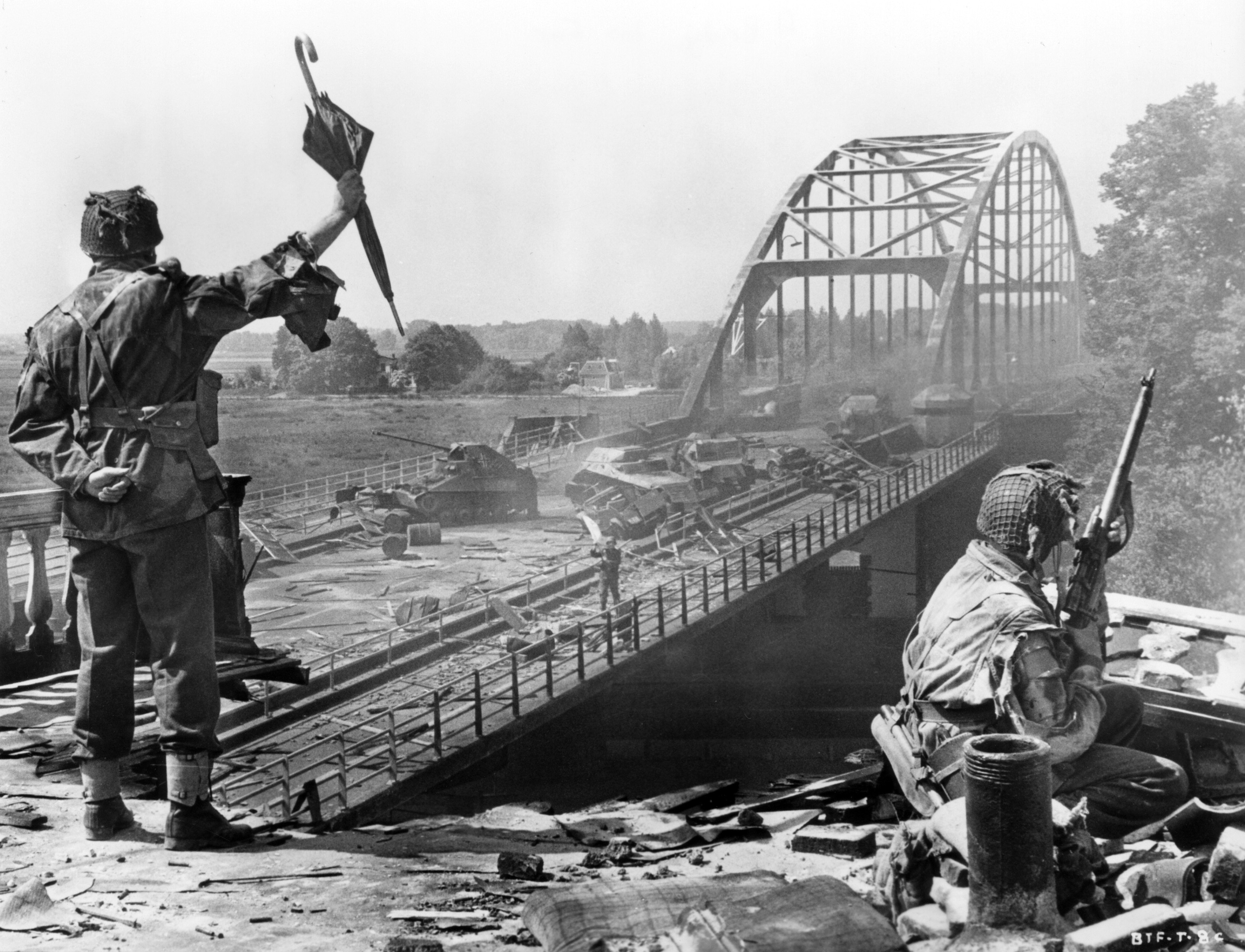
The unexpected failure of Operation Market-Garden, despite the courage of its Allied protagonists, is a reminder of the old maxim that “no plan of operation survives first contact with the enemy.” This photograph, showing a scene from the 1977 film, A Bridge Too Far, evokes real-life incidents of defiance and courage which occurred during the operation. (Michael Ochs Archives/Getty Images)

A spate of memoirs by British commanders and minor histories followed.

Then came the 1974 history, A Bridge Too Far by the Irish-American journalist, Cornelius Ryan. This book gave the US airborne their dues, while creating a stunning picture of heroism, sacrifice, and stupidity. A later reprint provided this writer’s introduction to the battle, as a teen.

Despite its depth, the book did not provide all the answers. Without detailed maps on the subject, following the complexity of the battles becomes difficult, especially the convoluted battle of Arnhem. For years (until recently, I confess), I failed to grasp what had really happened and where, during obtuse battles fought in esoteric places called Ginkel, Grave, Renkum, Beek, Wolfheze, Son, and Mook. 

Could these have also been the names of comic characters of another childhood? They might have been.

A 1977 film adaptation of Ryan’s book, made with a gamut of stars from Hollywood and Pinewood, reinforced some of the deficiencies of the book, including the myth that the operation failed because the 1st Airborne landed on two fully operational Waffen-SS armored divisions.

If Market-Garden has cemented itself in the public consciousness over the decades, it is because of its daring, and because of its humanistic objectives. Allied combat operations, especially in northwest Europe, were acts of liberation, fought to restore democracies and democratic institutions.2 At its essence, Market-Garden aspired to achieve this grand goal.

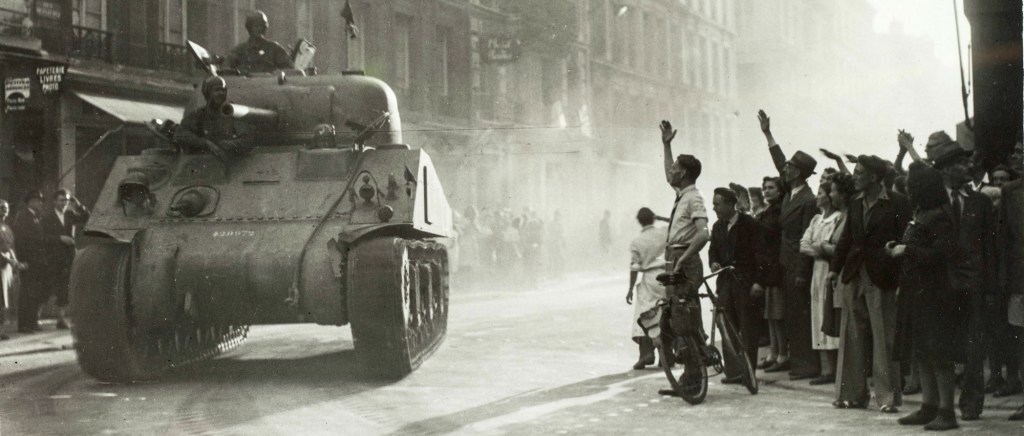
Cheering crowds greet British troops entering the Belgian capital, Brussels, on 4 September 1944. Wherever Allied troops went in western Europe, they were met by euphoric local populations effusing thanks for liberating them from the Nazis. No other campaigns or wars in human history have triggered such mass gratitude. (Imperial War Museum (IWM) BU483)

While the operation caused horror and tragedy, it also brought out the best in people. The heroism and sacrifice of its Allied protagonists triggered enduring gratitude from the Dutch. Surprisingly, it also elicited sentiments of honor, even decency from the Nazi combat cadre, the Waffen-SS — in spite of their moral decline which was nearly complete after five years of war and six years of nationalized racial indoctrination.

The operation’s failure, however, has caused it to be refought hundreds of times in books and films, fed by public curiosity.

Will I do some refighting of my own in the words that follow? A little. My larger objective was to use primary source statistical data (and select secondary sources) to recreate the battles through maps, infographics, and analysis. The intention is to offer a new and clear perspective of the operation.


  1. The Gamble
    1. Making the Case for Airborne Operations
  2. The Politics of Warriors
    1. Poor Air Support
    2. In-fighting among Air Commanders
  3. Stacked Dominoes
    1. German Battlegroups Form
  4. All Hell Breaks Loose
    1. The Statistical Data of Operation Market
    2. The Red Devils
    3. Controversial Plan for Arnhem
    4. Tip of the Spear
    5. Making for the Arnhem Bridge
      1. Rapid German Reaction
    6. Urquhart Missing
  5. Arnhem, the Alamo
    1. Destroying Gräbner
  6. The 8nd Airborne and a Narrow Run Thing
    1. Gavin, Golden boy
    2. Confused Orders
    3. Capturing the Grave and Canal bridges
    4. Erroneous information
    5. Distracting the Airborne
    6. Capturing the Nijmegen Bridge
    7. The Waal Crossing
    8. Jan van Hoof
    9. Rage against the Guards
  7. The US 101st Airborne’s Frontier War
    1. The 101st Airborne at Arnhem?
    2. Maximum Force
    3. The Germans Go After the Weak links
  8. Point of No Return
    1. Tanks come for the British
    2. Defiant to the End
    3. Sosabowski’s Choice
    4. Out with a Whimper
      1. Allied Casualties, 17 to 25 September 1944
    5. German Pyrrhic Victory
  9. Aftermath
    1. Lessons from a Historic Failure
    2. Guilt and Betrayal
  10. Footnotes
  11. Credits & Bibliography
    1. Major Sources

The Gamble

Against a defeated and demoralized enemy almost any reasonable risk is justified and the success attained by the victor will ordinarily be measured in the boldness, almost foolhardiness, of his movements – Dwight D Eisenhower

By the start of September 1944, the Allies found themselves nearly the masters of northwestern Europe. The tattered remnants of Germany’s primary battle force in the region, Army Group B, were in headlong retreat after their defeat in Normandy.

The Allies were in pursuit, sweeping through northern France. Paris fell on 25 August and the Allies approached Belgium. Up to early September, one-third of British General Bernard “Monty” Montgomery’s 21st Army Group3 were clearing German forces from ports along the English Channel while the rest pushed into Belgium.

But the Allied advance was congealing. The Anglo-Americans armies were outrunning their supply lines. Nearly every port recovered from the hands of the Germans was in ruins. This limited the amount of supplies that could be landed.

Many operational ports were also in or near Normandy, which was receding into the distance as the frontlines radiated out towards Germany. The British captured the valuable deep water port at Antwerp on 4 September. But the harbor was unusable because German troops held the approaches, along the Scheldt River estuary, and especially on Walcheren island.

Compounding the problem was growing German resistance.

Lieutenant General Brian Horrocks, the commander of the British Army’s XXX (30) Corps would later note (with hindsight), that the Germans were no longer in retreat by September 1944, and that Allied troops were fighting again. (Horrocks interview, World at War, “Pincers,” Episode 19)
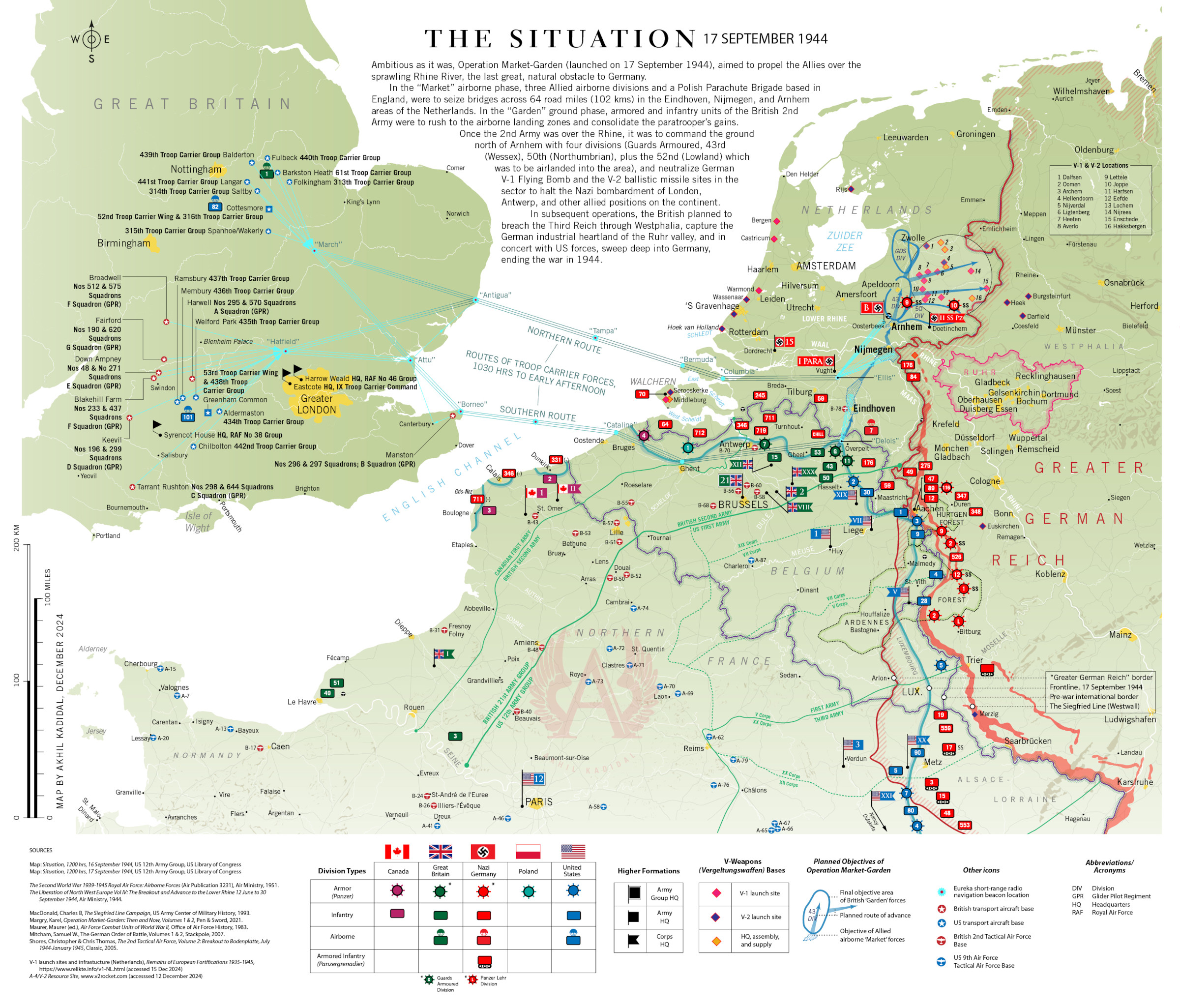
By September 1944, four Allied armies were poised along the border with Germany, trying to find a way in. Operation Market-Garden was to be their ticket in. On 17 September, three Allied airborne division took off from England and headed to the Netherlands. ©Akhil Kadidal
Continue reading “Out of the Blue: The Unraveling of Operation Market-Garden”

Normandy 2, Decision to Go

It is on the beaches that the fate of the invasion
will be decided and, what is
more, in the first 24 hours.

– Field Marshal Erwin Rommel

Adolf Hitler could see the future in 1943. “If they attack in the west that will decide the war,” he said. (Max Hastings, Overlord, Ch 2, Section 1, Para 190) This was no exaggeration. Over the past three years, the Germany had lost heavily.

The Eastern Front had consumed 1.51 million German lives alone up to the start of 1944 (not counting captured or maimed), according to the German historian Rudiger Overmans (See Deutsche militärische Verluste im Zweiten Weltkrieg, Oldenburg, 2000). The Russians, who had taken greater losses, were still advancing. Between the invasion of Russia on 22 June 1941 and to end of May 1944, the Germans lost 1,860,046 men in the east (Overmans, Table 59: Gesamtverluste an der Ostfront, pg. 277)

Between May 1943 and November 1944, the Wehrmacht alone lost another 145,027 men in Italy (Burkhart Müller-Hillebrand, Das Heer 1933–1945. Entwicklung des organisatorischen Aufbaues, Vol III, Der Zweifrontenkrieg. Das Heer vom Beginn des Feldzuges gegen die Sowjetunion bis zum Kriegsende. Mittler, Frankfurt am Main 1969; pg. 265). The only respite Germany could get was to defeat the cross-Channel when it came.

If the invasion was thwarted in 1944, Hitler believed that the Allies would be forced to wait another year before trying again. This could give Germany the opportunity to concentrate its forces and finish off the Russians. By then, Hitler argued, secret weapons and the Me262 jet fighters would be coming off the production lines in sufficient numbers, enabling his forces to beat back the western allies, when they returned in 1945.

But when General Alfred Jodl, Chief of the Operations Staff at German High Command told Oberbefehlshaber West (OB West or Western Front HQ), toured the western defenses in January 1944, he found that touted Atlantic wall was incomplete. Jodl also discovered that every division in France had been depleted in the constant diversion of manpower to the Russian Front. The Germans had 59 divisions in the France and the Low countries by the time of the invasion (out of which, some 41 were arrayed along the western coastline). Seventeen divisions were in Normandy and Brittany. Only eight of were along the Normandy coast or in position to counter a potential invasion.

Hitlerjugend

​Among these was the 12th SS Hitler Youth (Hitlerjugend) division, which had a manpower strength of nearly 20,500 troops and 66 Panther tanks, which made it one of the strongest divisions in Europe – on any side. Its troops were largely young and idealistic young Nazis whose high morale made them dangerous opponents.

Continue reading “Normandy 2, Decision to Go”

Normandy 1, Prelude to Battle

Not soon after the United States entered World War II and became a core member of the western Alliance, Washington began to consider ways to invade Nazi-occupied Europe, “Fortress Europa.” The pressure was especially high on the Franklin D Roosevelt administration to launch the invasion before the end of 1942.

But two years would pass before an invasion could be launched, with the delay in time being directly commensurate with the scale of the challenge.

Initially, the US military had few troops available to invade the continent. Only in mid-1942 was US Army Chief of Staff, General George C Marshal, able to initiate a buildup of US forces in Britain for the return to Europe. The buildup, codenamed Operation “Bolero” had the twin objective of allowing Marshal to assemble troops in England to justify Washington’s “Germany First” policy while simultaneously silencing the US Navy, which sought greater resources, troops and equipment for the Pacific Theater of Operations (PTO).

However, the British, especially Prime Minister Winston Churchill, were apprehensive about a cross-channel invasion in 1942 or even 1943 – a prospect made all the more uneasy by the disastrous Dieppe raid of August 1942.

The Dieppe action was an amphibious operation by commandos that was to be a testbed case for a cross-channel assault and prove to the Russians and Josef Stalin that the western alliance was serious about eventually launching a second front in Europe. (Carlo d’Este, Decision in Normandy, Chapter 2, Section 13, Para 29). Unfortunately, the landing in northwestern France, led to most of the Allied landing forces being killed or captured.

That failure strained the Anglo-American alliance as the Americans were then forced to contribute troops and resources to what they considered as “sideshow operations” in the Mediterranean Theater that were so dear to Churchill’s heart. American involvement in the Mediterranean was also driven by the US army’s comparative combat inexperience in 1942 (when compared to Great Britain), which meant that the United States had to follow England’s lead, and so the US found itself engaged in various landings and campaigns — in Algeria, in Tunisia, in Sicily and finally in mainland Italy.

US resentment was growing, fueled by suspicion that Americans were fighting and dying in campaigns for the benefit of Britain which planned to re-establish its Mediterranean empire after the war. From the British perspective, the Mediterranean campaign was to remind the world that England was not yet out of the war and capable of hitting back at the Third Reich.

Continue reading “Normandy 1, Prelude to Battle”

Masters of the Air: The Historical Context

Since the finale of the WWII TV show “Masters of the Air” aired weeks ago, hundreds of media articles have emerged, talking about the “true stories” behind the show. Most are incomplete, repetitive. The following piece will try to provide a historical context to the events portrayed in the show, accompanied by the usual raft of custom infographics.

Please be advised that the following contains spoilers.


Some of the greatest war stories ever told are of units on the brink of destruction and among them, in the European theater of war in World War II, is the tale of the American 100th Bomb Group. The group’s story is now the subject of a new TV drama produced by Steven Spielberg and Tom Hanks as a follow-on to their critically acclaimed Band of Brothers (1998) and The Pacific (2010), in what could be the final salvo of their World War II trilogy.

Assembled stateside in June 1942 and shipped out to England in February 1943, the 100th Bomb Group was part of a massive military experiment: the first daylight strategic bombing campaign of an adversary.

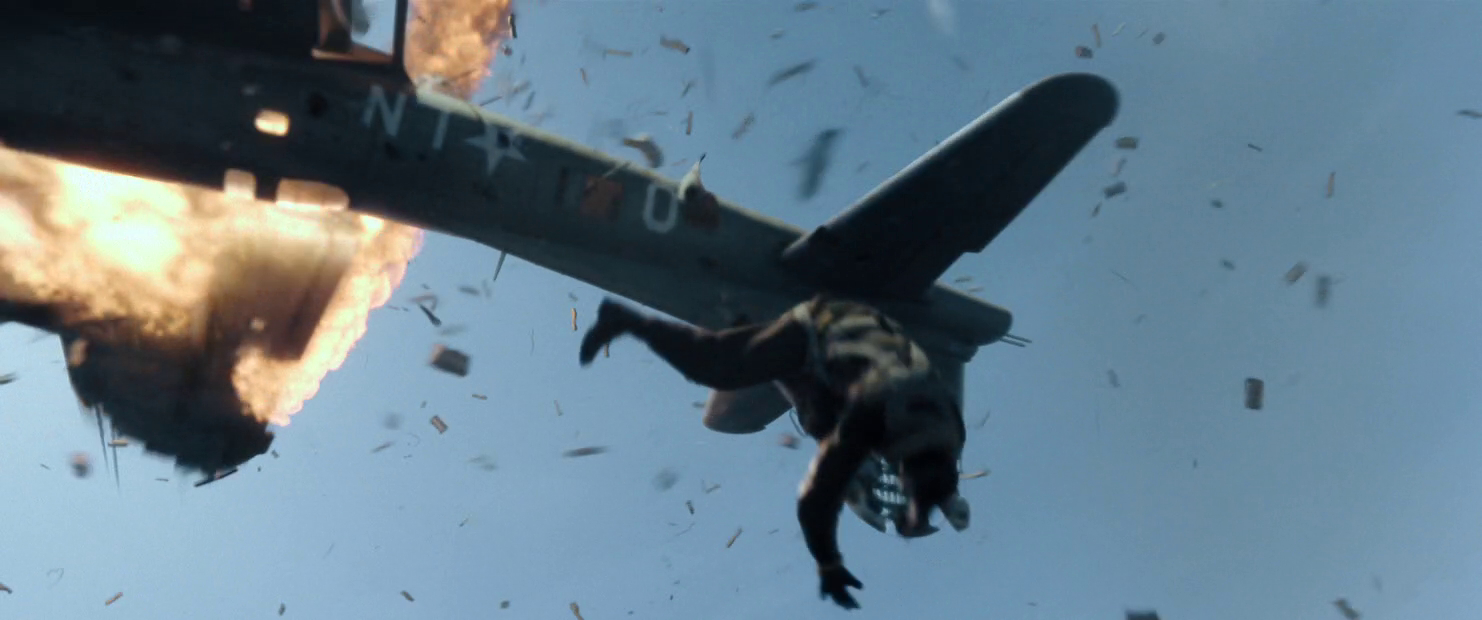
The unforgiving air war. (Masters of the Air)

This placed it dead center in an unforgiving war fought at 25,000 feet, at temperatures of -50 Fahrenheit against a Nazi foe with some of the finest technology and combat veterans that could be mustered. The Nazis had declared “Total War” (Der Totale Krieg) in February 1943, a state of being meant to achieve victory in the war in the shortest time space by enhancing home front activities and combat operations. Facing such an enemy, the 100th, as an ill-disciplined unit with cavalier officers, became ill-fated and subject to such bloodletting that it became known as “The Bloody Hundredth.”

Masters of the Air (2024), supposedly based on the Donald L Miller history of the same name, tries to be a soaring finale to the Spielbergian view of the American WWII experience, the “good war”: decency versus barbarism, can-do initiative versus clumsy totalitarianism. 

Origins

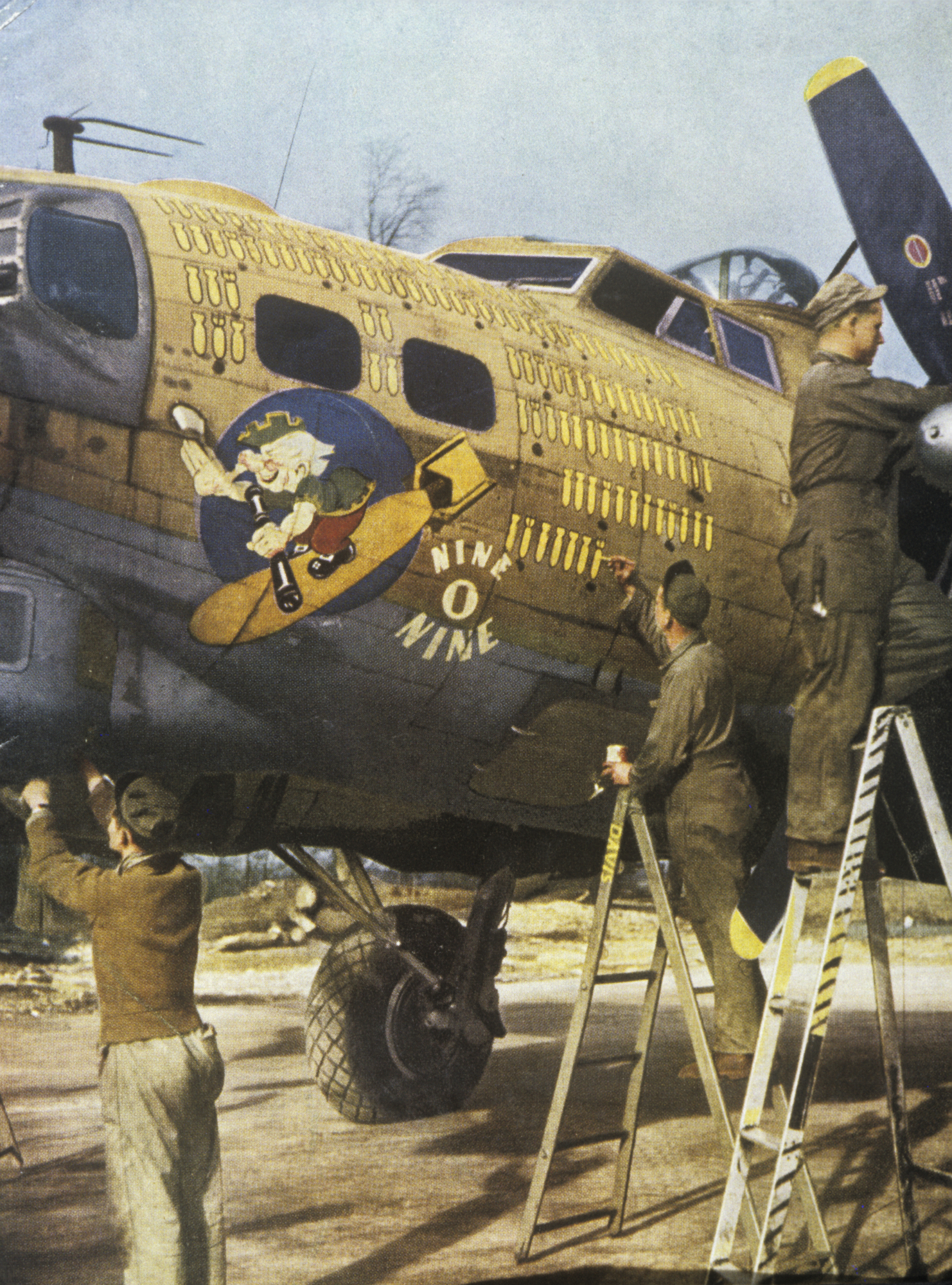
The 100th was a core member of the England-based American 8th Air Force (the “Mighty Eighth”) which tried to blast the German war machine off the face of the map. The Eighth’s “ships,” as the men called their Boeing B-17 heavy bombers, represented a view of American masculinity: strong, rugged, resplendent with gleaming Plexiglas, bristling with guns, an extension of the old west, and decorated with all manner of squadron heraldry and artwork, primarily Disney cartoon characters or gaudy pinup girls. In fact, the rule of thumb appeared to be: the gaudier the art, the better. 

Men of the 91st Bomb Group paint a relatively tame nose art on a B-17 Flying Fortress nicknamed “Nine-O-Nine” at Bassingbourn in 1944. Nose art formed a vital component of the aircrews’ esprit d’corps. (Imperial War Museum)

Some men called their machines, “flying porcupines,” but the US Army Air Force (USAAF) preferred the name, “The Flying Fortress.” The B-17’s raiding partner was the Consolidated B-24 Liberator which gets zero screen time in the TV series.

Across B-17 and B-24 bases, the “ops” always began the same: a fleet of jeeps racing towards planes assigned on the mission, men with anxious faces and shouting voices. A green flare launched from the control tower indicating to men in the cigar-shaped hulks that the moment had come. They were to return once again to the lion’s den where some had gone before and had never lived to tell the tale.

In the spring of 1943, when the 100th appeared on the scene, 8th Air Force was a neophytic army, the US Army Air Force’s (USAAF’s) newest progeny. Its inception on 1 February 1942 had come with a twin caveat: sustain the primary American air effort against Nazi Germany and validate the controversial pre-war concept of strategic bombing.

The Eighth’s leading elements arrived in England shortly after – a scant two months after the Japanese attack on Pearl Harbor.

In comparison to tactical air power, tested on the battlefields of France in the latter part of World War I, strategic air warfare was a new idea. As US historians put it: “Strategic bombing bears the same relationship to tactical bombing as a cow does to the pail of milk. To deny immediate aid and comfort to the enemy, tactical considerations dictate upsetting the bucket. To ensure eventual starvation, the strategic move is to kill the cow.”

The 8th Air Force’s singular objective was to incapacitate Germany by air before the first American troops set foot on occupied Europe. This, it did not achieve, but without the Eighth’s presence, Allied victory over Nazi Germany would have been more costly and less assured. The Eighth’s war was spread across an unprecedented and bloody 39 months, battle-torn and replete with massive losses. The Eighth suffered more deaths than the entire US Marine Corps (USMC) did during the Pacific campaign, Miller writes.

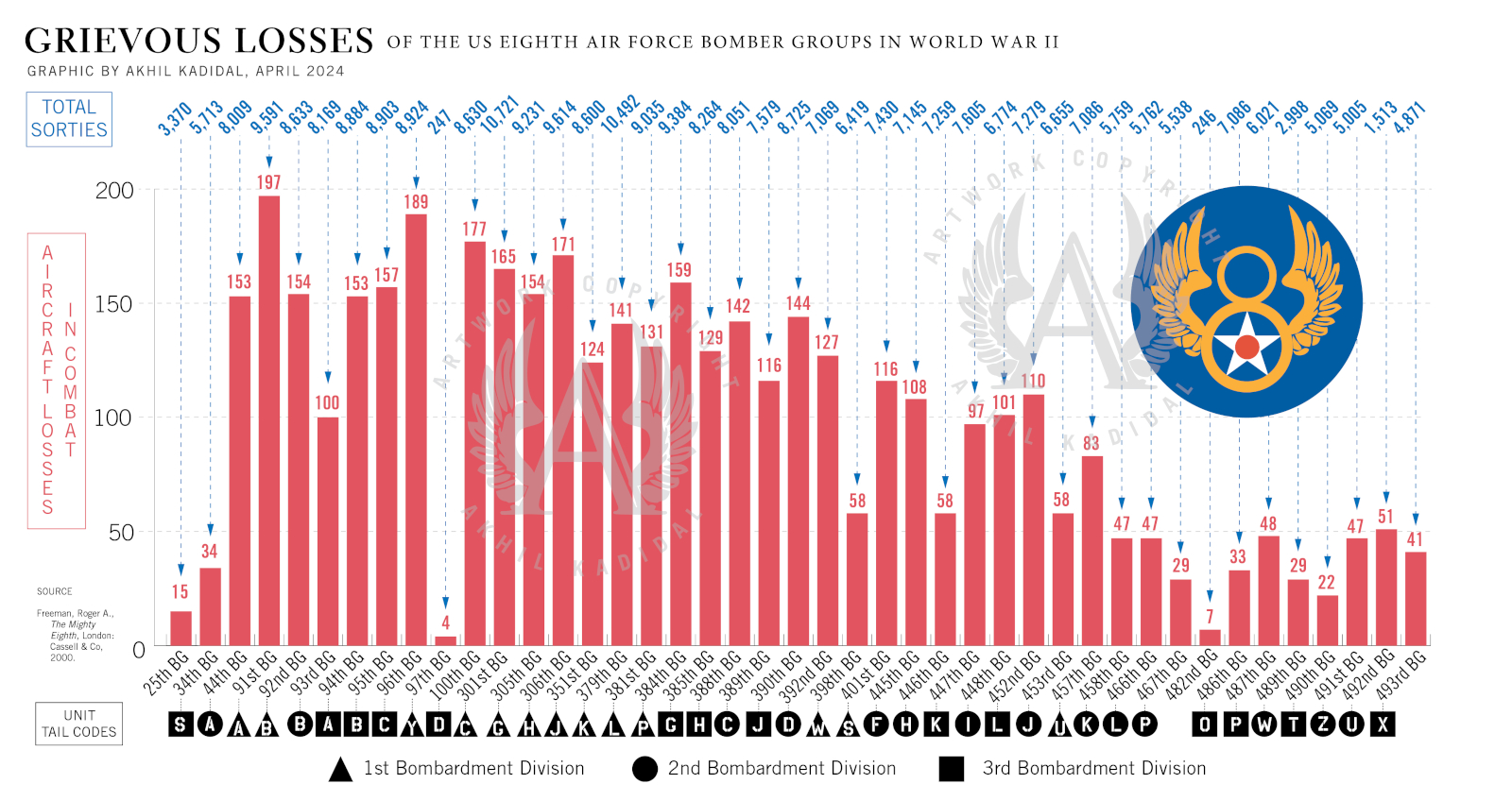
The statistics are sobering. The Eighth lost at least 6,333 aircraft of all kinds in combat during the war, 26,000 men killed in action, 18,000 men wounded and 28,000 men captured. The 100th Bomb Group alone lost 177 bombers in combat and suffered 1,756 casualties. (See Roger Freeman’s 8th Air Force War Diary, Eighth Air Force History & Statistical summary of Eighth Air Force operations European theater, 17 Aug. 1942 – 8 May 1945, HQ Eighth Air Force, June 1945) The USMC’s total fatalities in World War II were between 19,733 and 24,511 personnel. (USMC University/National WWII Museum

This chart shows how many aircraft in each bomber group in the 8th Air Force were lost in combat during the war. The loss of a bomber also meant the loss of the 10-man crew onboard, although sometimes, fortunate crew members evaded capture and returned to England. (Akhil Kadidal)
Continue reading “Masters of the Air: The Historical Context”

Paris 1944, 1. Uprising

Like prodigals returning home, a column of soldiers from a Free French armored division entered the Nazi-occupied city of Paris. It was the night of 24 August 1944.

They were the first Allied combat forces in the capital in four years but their numbers were paltry only 172 men and three tanks. The column’s mission was paramount: to set up an advanced combat perimeter in the city.

This was intended to boost the morale of the population which had become ensnared in a popular revolt against the Germans for five days. But the column commander, a thick-set, amiable French captain named Raymond Dronne, knew that the mission had more at stake. The detachment was expected to link up with the French resistance and help the rest of their division (the Free French Deuxième Division Blindée or 2nd Armored Division), to prevent what many feared would be Germany’s total destruction of Paris.

The fear was not unfounded. The German dictator, Adolf Hitler, had ordered the German commander of the city, General Dietrich von Choltitz, to leave the capital a sea of ruins. The order was not unprecedented. The Germans had systematically obliterated other cities in Russia and in Europe. At that moment, at the other end of Europe, German forces were obliterating the Polish capital of Warsaw of its resistants, block by block, building by building.

It was 8.45 pm when Captain Dronne’s troops entered Paris through the undefended Porte d’Italie, one of the ancient gateways of the nearly 2,000-year-old city. Seeing the unfamiliar tanks and the strangely garbed men, the locals ran and hid. Then they saw the French tricolor on the sides of the vehicles and erupted into wild celebration. Pushing past the jubilant crowds, the detachment headed towards the city hall, the ornately decorated Hôtel de Ville. The building was, for Dronne, a “symbol of Paris’ freedoms.”

News of the unit’s arrival at the Hôtel de Ville spread like wildfire throughout Paris — triggering a storm of emotions among the people. Church bells began to ring. But the new liberators remained vigil.

All around them were nearly 20,000 German troops, with their leader in Berlin determined to destroy a city which he had likened to the beating heart of France.


Continue reading “Paris 1944, 1. Uprising”

Paris 1944, 2. Carnage

THE ANTONY-FRESNES-BERNY TRIANGLE

Putz’s battlegroup began to encounter serious resistance as it approached the industrial town of Antony, a suburb of Paris. The Germans had focused their defense into a small triangle running from Antony to the massive hulk of the Fresnes prison to the crossroads at Croix de Berny.

Antony was liberated quickly enough by one column of Free French driving up the Route Nationale 20 (RN20). A second column emerged from the old Chartres Road.

But then an 88mm cannon strategically positioned at the Berny crossroads turned its barrel on the arriving Free French. 

The 1st Platoon of the 9th Company of the Régiment de marche du Tchad (RMT) under a Spaniard, 2nd Lt. Vincente Montoya (just 21 years old), arrived in front of a butcher’s shop on the right side of the highway. Montoya, a former infantry officer in the old Spanish Republican Army, had distinguished himself in Normandy. He had already won the French Croix de Guerre medal with the silver star for heroics.

Divisional Sherman tanks roar along the Avenue d’Orléans in Antony. They would soon be halted by an 88mm cannon deployed near the intersection of National Highway 186. (US National Archives and Records Administration)

Known as the “Nueve,” the 9th Company was a unique unit. Some 146 of its 164 troops were Spanish or of Spanish extraction (at least four were Spaniards born in Morocco). The company’s halftracks carried the names of the long-lost battlefields of the Spanish Civil War: Guadalajara, Teruel, Ebro, Santander, Brunete, Guernica … Other halftracks carried French nicknames, such Resistance, Nous Voilà, Cap Serrat and Rescousse. Dronne’s own Jeep carried the French phrase: Mort aux Cons (Death to Cunts). (Mesquida, loc.1993, 40%) 

The company had disembarked on the hallowed ground of France at Magdalena Beach, near Sainte-Mère-l’Église on 4 August. This area has been “Utah Beach” on D-Day. The disembarkation operation was slow. The men had sung the “La Cucaracha” in derision.

Nearly all of the sergeants and lieutenants in the company were Spanish. Second-in-command was Lt. Amado Granell, a 45-year-old Valencian and a former member of the Spanish foreign legion.

Having joined the legion as a minor without the consent of his parents, Granell had left the army in 1922 with the rank of sergeant. After settling in Alicante as a cycle shop owner, he began participating in labor union movements in the interwar period. 

Dronne’s second-in-command of the 9th Company was Lt. Amado Grannell. He is seen here leading a patrol from Xaffévillers to Ménarmont in the Vosges much later in 1944, after the liberation of Paris. Curiously, he is armed with a German MP.40 submachinegun. (Musée du général Leclerc/Musée Jean Moulin, Paris Musées)

When the Spanish Civil War erupted in 1936, Granell joined the Levante battalion in which he eventually became a Captain. By December 1938, he was the commander of a brigade. But with the opposing Nationalist forces of General Francisco Franco on the verge of victory in 1939, Granell left Spain. He found passage on the Stanbrook, the last English merchant ship to leave Alicante before the nationalists arrived. All Granell had were a few possessions and his machine gun, Dronne recalled in 1964.

When the Stanbrook arrived in Oran, Granell (like nearly all Spanish exiles) was shunted by the French into a disciplinary camp. After the Allies landed in Morocco, he was able to join the Corps Francs d’Afrique in December 1942. During the Tunisian campaign, he met Major Joseph Putz who offered him the opportunity to join the 2e DB under the command of General Leclerc. In this way, he had come to join the Nueve. Such experiences were not alien to many others in the company. (https://www.24-aout-1944.org/La-journee-du-24-Aout-1944/

The 18 non-Spaniards in the company comprised one Brazilian, one Mexican, two Portuguese, six Frenchmen, one Italian anti-fascist, one Argentine, one Romanian and three German anti-Nazis (including Staff Sergeant Johann “Juanito” Reiter, the scion of an officer in the Kaiser’s army who the Nazis had murdered). (Data compiled by author & Dronne, A Spanish Company in the Battle for France and Germany, loc. 107, 15%) Reiter had been a cadet in Munich during the Weimar Republic. He had subsequently seen action in the Spanish Civil War as part of the General Staff of the Lenin Column. (Antonio San Román Sevillano, August 24-25, 1944: The liberation of Paris) This column was made up mostly of individuals from the Catalonian Partido Obrero de Unificación Marxista (POUM) – the same group that the British writer, George Orwell, had served with.

Rounding out the non-Spaniards were two Armenians, including Private Bedros Krikor Pirlian, a tailor from Istanbul, who had become Dronne’s aide). Some two or three of the group were stateless individuals, according to Dronne. (Data compiled by author & Dronne, A Spanish Company in the Battle for France and Germany, loc. 107, 15%) 

A group photo of the 9th Company when it was in England. Unfortunately, I have not been able to identify many of the men in this photograph.
Continue reading “Paris 1944, 2. Carnage”

Paris 1944, 3. Liberation

SEIZING THE MAJESTIC

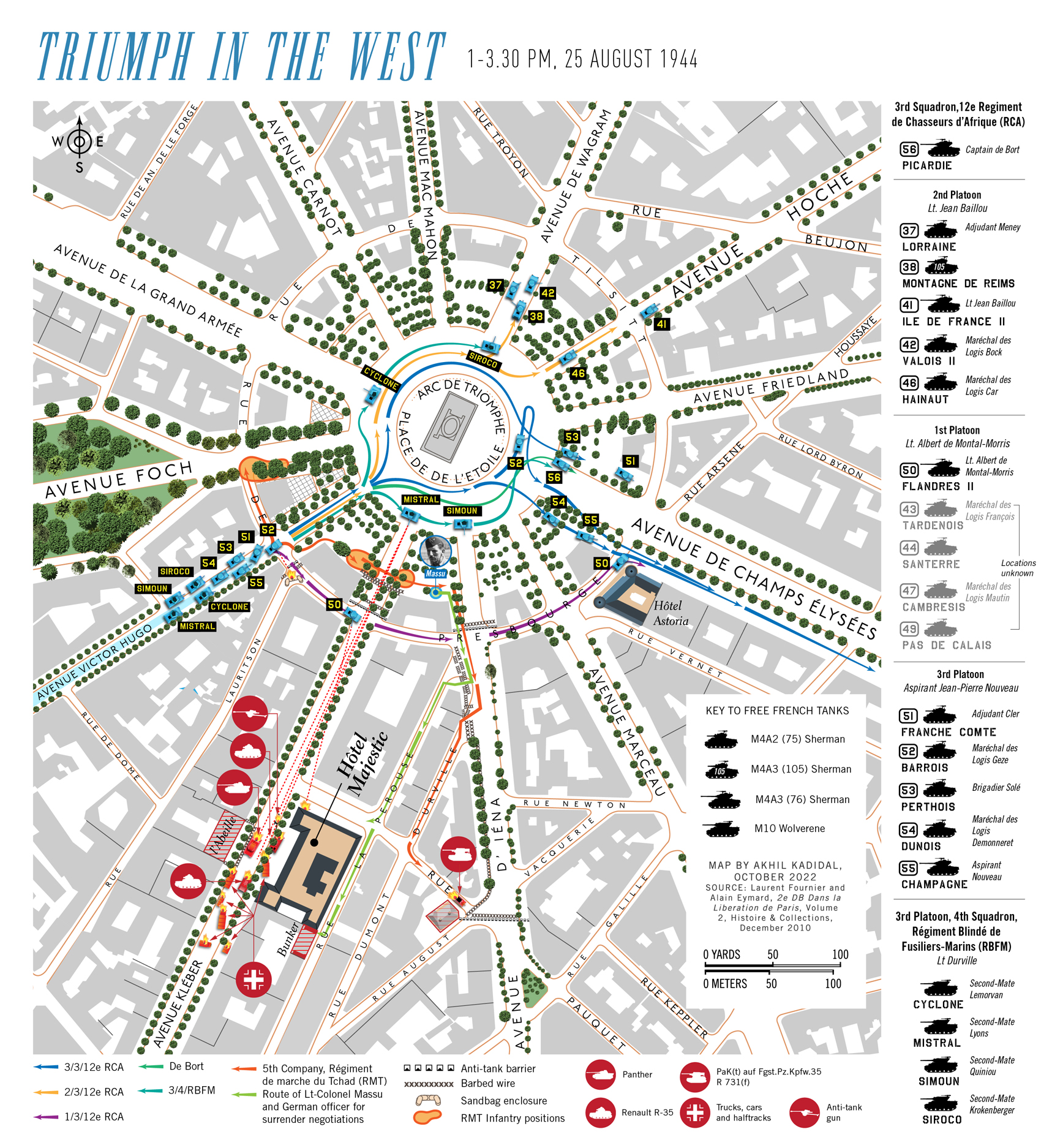
De Langlade had arrived at the Arc de Triomphe to find Massu had deployed his tanks facing down each of the major roads and avenues which radiated outwards from the monument like spokes on a wheel. 

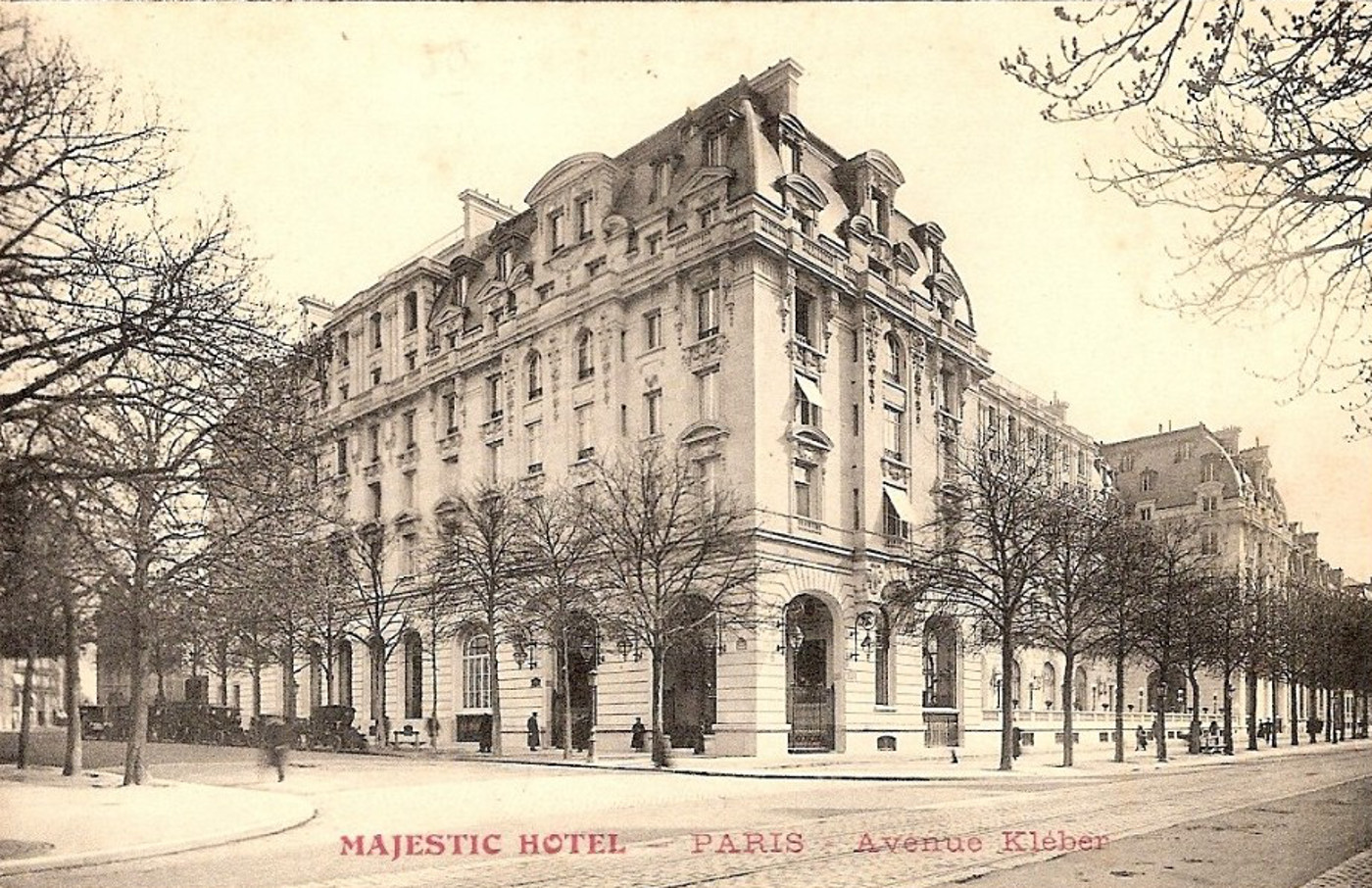
As de Langlade set his forward headquarters next to the monument, his attention focused on the Avenue Kléber where stood the Hôtel Majestic – the headquarters of the Militärbefehlshaber-i-Frankreich (German military high command in France).

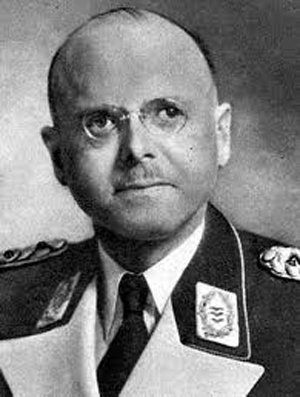
Luftwaffe General Karl Kitzinger (Bundesarchiv)

Officially in command was Luftwaffe General Karl Kitzinger who had replaced Stülpnagel from 17 August. Arrested and tried for treason for his role in the bomb plot against Hitler, Stülpnagel was to be sentenced to death by the Volksgerichtshof on 30 August 1944. He was to be hanged the same day at the Berlin-Plötzensee prison.

The many services of the German administration had been installed at the Hôtel Majestic during the occupation. The building had a large assembly of German staff officers, administrative members and even civilians. (http://museedelaresistanceenligne.org/ media4505-Officiers-allemands-du-Majestic) However, Kitzinger was not present. Like so many other senior commanders, such as General Karl Oberg, head of the SS in the city and Pierre Laval (the Vichy prime minister), he had fled the city.

Battlegroup Langlade occupied the Arc de Triomphe area in force – and found itself in battle with Germans in the Hôtel Majestic. This map is based on another published in the seminal book, “2e DB dans la Libération de Paris,” Vol. 2 by Laurent Fournier and Alain Eymard. (Akhil Kadidal)
The Majestic was a stately structure that opened in 1908. A possession of the French government from 1936, it was sold in 2007 to the Qatar government.

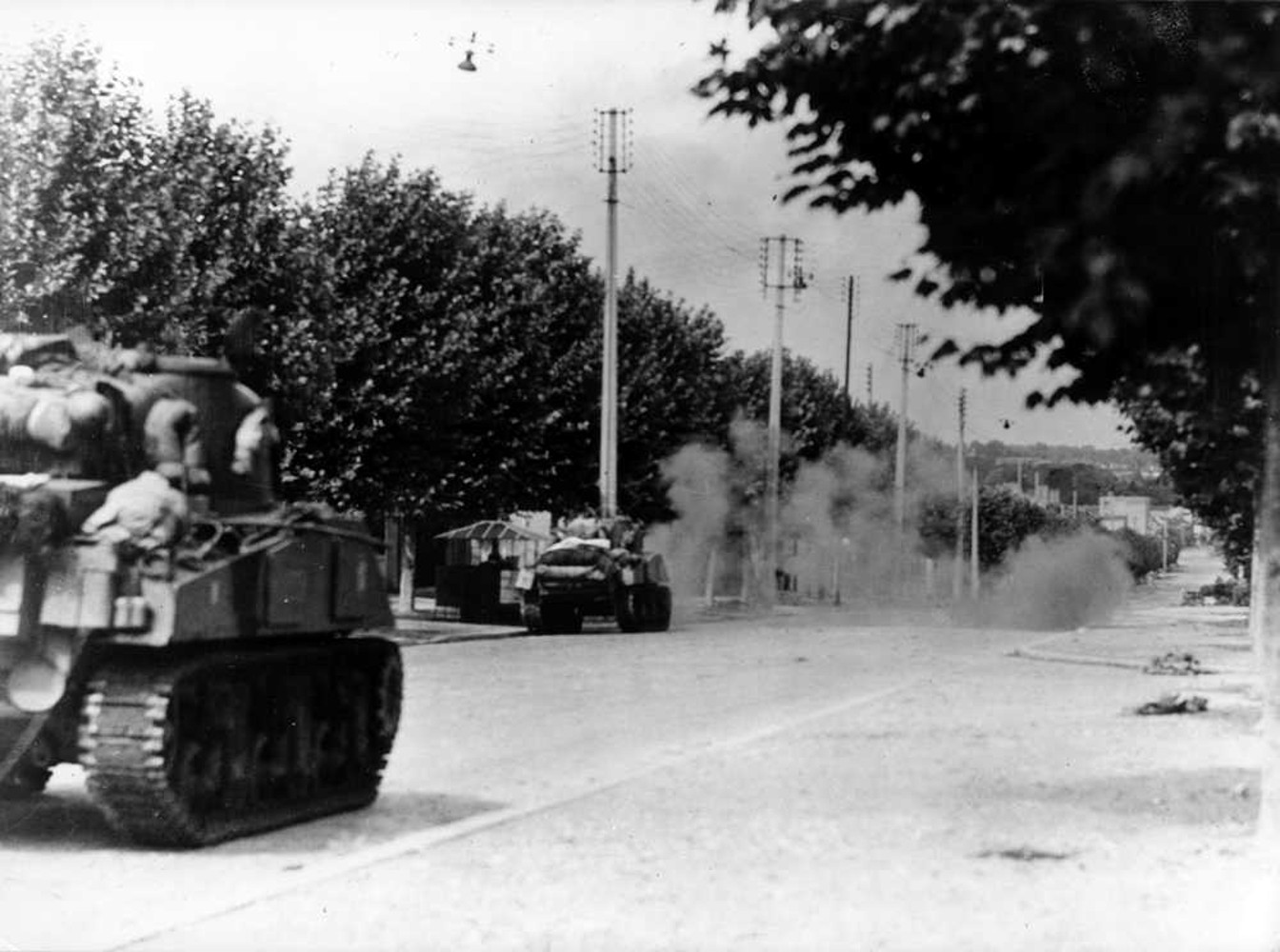
Massu sent the 5th Company (RMT) under Lt. Lucien Berne to seize the hotel. Two of Massu’s tanks (Sherman No 50, Flandres II) and an M10, the Mistral, fired volley after volley down the avenue, exploding three German tanks and several vehicles positioned outside the hotel. A Free French infantry bazooka unit ambushed and wiped out a Panzerjäger tank by the Avenue d’Iéna.

FFI forces tipped-off the Free French about German dispositions around the hotel. The Germans had built a massive bunker on the Rue de la Perouse. (https://liberation-de-paris.gilles-primout.fr/la-reddition-de-lhotel-majestic) As the men of the 5th RMT approached the eastern side of the hotel, the troops in the German bunker opened fire.

A thick smoke filled the sky. A bareheaded, balding German officer appeared, waving a white flag. The German officer told de Langlade that the units around the Majestic would surrender under certain conditions.

Free French infantry from the 5th Company (2nd Battalion, RMT) and several resistance fighters, shoot at the Hôtel Majestic. The troops are armed with a mix of US-supplied M1 Garand rifles, M1 carbines and two Browning .30-cal machine guns. (Paris Musées)

Langlade replied that the Germans either surrender within 30 minutes or face annihilation. The officer returned to the Majestic, accompanied by Colonel Massu, a number of soldiers and even a film crew. As the group crossed the rue de la Perouse, a shot rang out. A German sniper had killed Sergeant-Chief Rene Dannic, 38.

Despite this, the Massu and the Free French contingent proceed into the Hôtel Majestic, only to come face-to face with several armed Germans in the east foyer.

“Heraus!” (Get out of here!), Massu yelled.

Continue reading “Paris 1944, 3. Liberation”

No Retreat: The Battle of Lanzerath 1944

How this research began…

I do not consider myself an expert on the “Battle of the Bulge.” The battle is dense and eventful. But I thought I knew enough about the Ardennes offensive to elevate me above the rank of battle hound. Then I read Alex Kershaw’s “The Longest Winter” and discovered the actions of the Intelligence & Reconnaissance Platoon of the 394th Infantry. As with some of my work, this post is centered around a map of the engagement. During the course of the research, I discovered that two of the GIs (PFC Bill James of White Plains (NY) and PFC Risto Milosevich of Los Angeles (CA) were students of my alma mater, Tarleton State (Texas A&M).


Lanzerath, 16 December 1944. The initial situation

A shortage of manpower in the US military at the twilight of World War II forced the army to transfer some of its best and brightest college-educated draftees who were training to become technical experts and officers to frontline units in 1944 as enlisted personnel. 

As members of the US Army Specialized Training Program (ASTP), the draftees were to be employed as high-grade technicians and specialists. However, on 1 April 1944, many were reassigned to infantry, airborne, or armored units. Eighteen such men found themselves in a so-called Intelligence and Reconnaissance (I&R) Platoon of the US 394th Infantry Regiment in the European Theater of Operations, in the winter of 1944. 

Isolated, in a forward position in eastern Belgium, amid snowy, near sub-zero conditions , the platoon found itself snarled in a maelstrom of combat during the opening blows of what would become known as the “Battle of the Bulge.”


Isolated Location

The 394th Infantry Regiment’s I&R Platoon had been posted to an unremarkable hilltop overlooking the Ardennes village of Lanzerath, a few thousand yards from the German frontier on 10 December 1944. Like in the rest of the Ardennes Forest, the platoon’s deployment was regarded as being in a “quiet sector” with scant presence of the hostile German military.

The core role of I&R Platoons in the US Army was to gather detailed information about enemy forces and the terrain in locations that US Arm rifle companies and battalions could not easily access. But in being posted to Lanzerath, the 394th’s I&R Platoon was also expected to fulfill another, more critical role: plugging a gap in the US lines.

The platoon’s parent unit, the US 99th Infantry Division, was a rookie to the wilds of the western European campaign. Known later as the “Battle Babies”, the division arrived on the continent on 6 November 1944, having missed the Normandy campaign and the subsequent Allied breakout across France. Posted to the Ardennes, the division’s inexperience was exacerbated by the fact that it was forced to string its three infantry regiments (393rd, 394th and 395th) out across a 25-mile front, along forest-covered hills.

US army doctrine stipulated that a infantry battalion could cover 800 yards of a frontline. But the 99th’s nine infantry battalions were each covering between 830-1,000 yards. This made it near impossible for US patrols to cover the gaps.

By 14 November, all of the 99th’s battalions and companies were on the frontline barring the 3d Battalion of the 394th Infantry, which was held in a divisional reserve near the boundary with US V and VIII Corps, near the so-called “Losheim gap”, a particularly thinly held part of the frontline.

With only two battalions under his command, Colonel Don Riley of the 394th Infantry Regiment, tried to plug potential holes in his perimeter with small units. One worry was the village of Lanzerath which commanded a road leading westwards, deeper into American lines. The village was the responsibility of the neighboring US Army units such as VIII Corps and the US 14th Cavalry Group. 

However, the 394th Infantry lacked combat troops to occupy the village in force and so Riley employed the I&R platoon to provide advanced warning of a German advance or attack in the area. In command of the 394th’s I&R Platoon was First Lieutenant Lyle Bouck Jr, just 20 years old but not an ASTPer. Instead, he was a pre-war army volunteer who had risen through the ranks to become an officer.

“Our I&R Platoon was ‘temporarily’ moved into the resulting gap with orders to investigate and report any observed enemy activity,” a former platoon member, Private G Vernon Leopold, told US Congress in 1981.

The platoon’s location at Lanzerath occupied a veritable no-man’s land between two US Army Corps. 

Lanzerath itself was unremarkable, having fewer than ten houses with wooden framework construction that could not withstand enemy fire. However, the village was situated about 300 yards south of a key road junction that connected Buchholz Station to the town of Losheimergraben. Northwest of Losheimergraben lay a major road network which would become a primary route of advance for the German Sixth Panzer Armee (Tank Army) during Operation “Wacht am Rhein” (The Watch on the Rhine) which would go down in the annals of history as the “Battle of the Bulge.”

The Sixth Panzer Armee was under an old veteran, SS Oberst-Gruppenfuhrer (General) Josef ” Sepp” Dietrich who intended to use the road network to reach the Belgian city of Liége.

As night fell on western Europe on 15 December, neither Lt. Bouck nor his men suspected that they had an engagement with history in the morning.

One of the 105,000 ASTP trainees to be reassigned to combat divisions was the postwar giant of postmodernism, Kurt Vonnegut, who was assigned to the doomed 106th Infantry Division. Like the men of the I&R Platoon in the 394th Regiment, Vonnegut was also an I&R member, of the 423rd Regiment.